Scientists race to solve Poland's 90-year-old Crooked Forest mystery before it's lost
Source Entity
TOI SCIENCE DESK
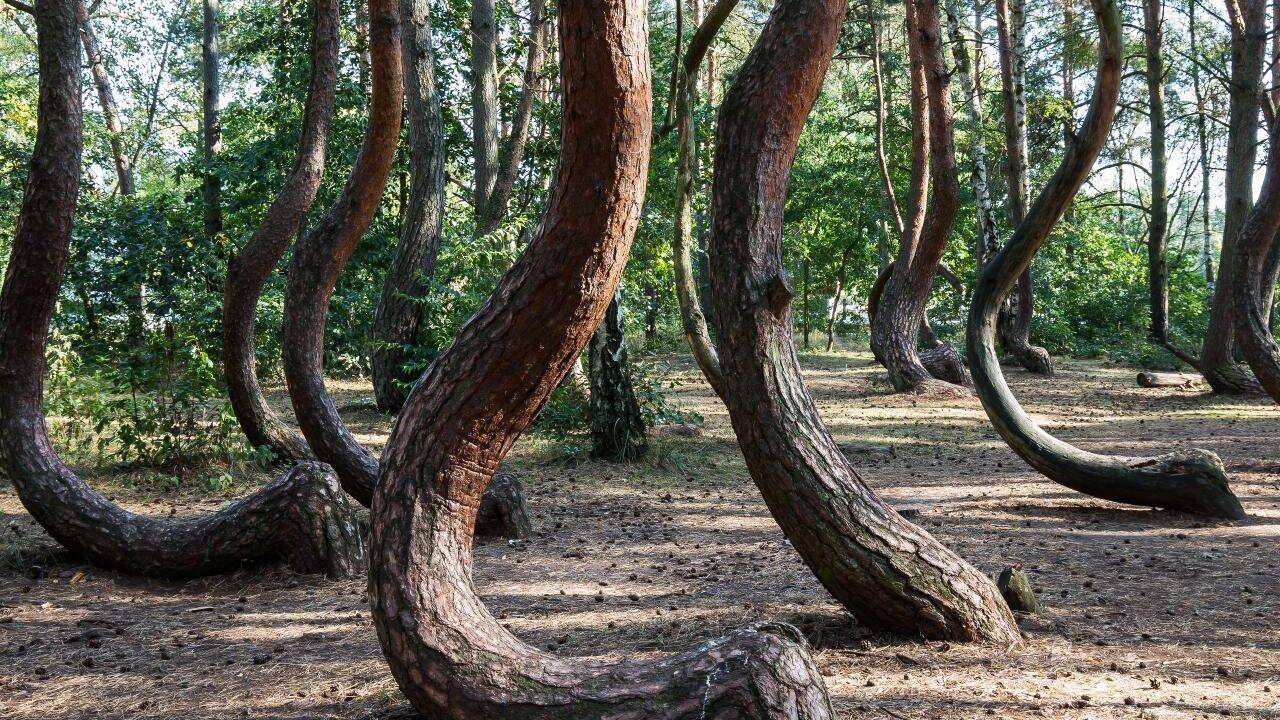
Scientists are racing to uncover the origin of Poland's Crooked Forest, a mysterious grove of pine trees with sharply curved trunks planted in the late 1920s and left undisturbed due to the onset of World War II.
Unlocking the Secrets of Poland's Crooked Forest
Poland's Crooked Forest remains one of the most visually arresting botanical anomalies in Europe. Located in the West Pomeranian region, this grove consists of hundreds of pine trees that all exhibit a nearly identical, sharp curve at their base, bending north before straightening out as they grow upward. For decades, this phenomenon has captivated tourists and researchers alike, serving as a living puzzle that bridges the gap between natural evolution and human intervention. The current urgency among scientists to solve this mystery stems from the aging of the trees and the precarious nature of the site, making it a race against time to secure definitive answers before the evidence decays.
The Theory of Anthropogenic Intervention
One of the most compelling hypotheses is that the curvature was a deliberate act of human engineering. In the late 1920s, it is theorized that local foresters may have intentionally bent the saplings to produce "curved timber." Such specialized wood was historically prized for the construction of furniture, boat ribs, and other artisanal crafts that required naturally contoured pieces of wood without the structural weakness introduced by steaming or mechanical bending. This theory suggests a sophisticated level of forestry management for the era, where the environment was manipulated to create a sustainable source of high-value, pre-shaped raw materials.
Natural Phenomena and Environmental Stress
Conversely, many researchers point toward natural causes, specifically the impact of extreme weather events. The "heavy snow" theory posits that a massive snowfall during the trees' early growth phase could have pinned the young saplings to the ground. If the saplings remained bent under the weight of the snow for a prolonged period, they may have developed a permanent deformation, eventually growing upward once the snow melted. This biological response, known as thigmomorphogenesis, explains how external mechanical stress can permanently alter a plant's growth pattern, though critics of this theory argue that the uniformity of the bend across hundreds of trees is too consistent to be purely accidental.
The Shadow of World War II
Regardless of whether the cause was man-made or natural, the preservation of the Crooked Forest is inextricably linked to the geopolitical turmoil of the mid-20th century. The trees were planted in the late 1920s, but the outbreak of World War II brought an abrupt end to local agricultural and forestry operations. As the region became a theater of war and populations were displaced, the forest was effectively abandoned. This historical vacuum prevented the trees from being harvested for their intended purpose or cleared for other land uses, essentially "freezing" the botanical experiment in time and allowing the grove to survive into the modern era as a curiosity.
Scientific Urgency and Future Implications
Today, the race to solve the mystery is driven by the realization that these trees are not immortal. As the grove ages, the trees become more susceptible to disease, pests, and the effects of climate change. Scientists are now utilizing advanced dendrochronology and soil analysis to determine the exact timing and nature of the bending. Solving this mystery is not merely about satisfying curiosity; it provides critical insights into how pine species respond to extreme stress and how historical land-use patterns influence current biodiversity. The findings could potentially inform modern forestry practices regarding the resilience of timber to environmental shocks.
Conclusion
The Crooked Forest stands as a poignant intersection of natural wonder and human history. Whether the result of an ambitious forestry project interrupted by the horrors of war or a freak occurrence of nature preserved by historical coincidence, the grove remains a testament to the enduring mysteries of the natural world. As researchers work to provide a definitive answer, the forest continues to serve as a reminder of how human conflict can inadvertently preserve scientific anomalies for future generations to study.