Ollaya – Ollama for open-source, Jev-style decision models
Source Entity
Hacker News
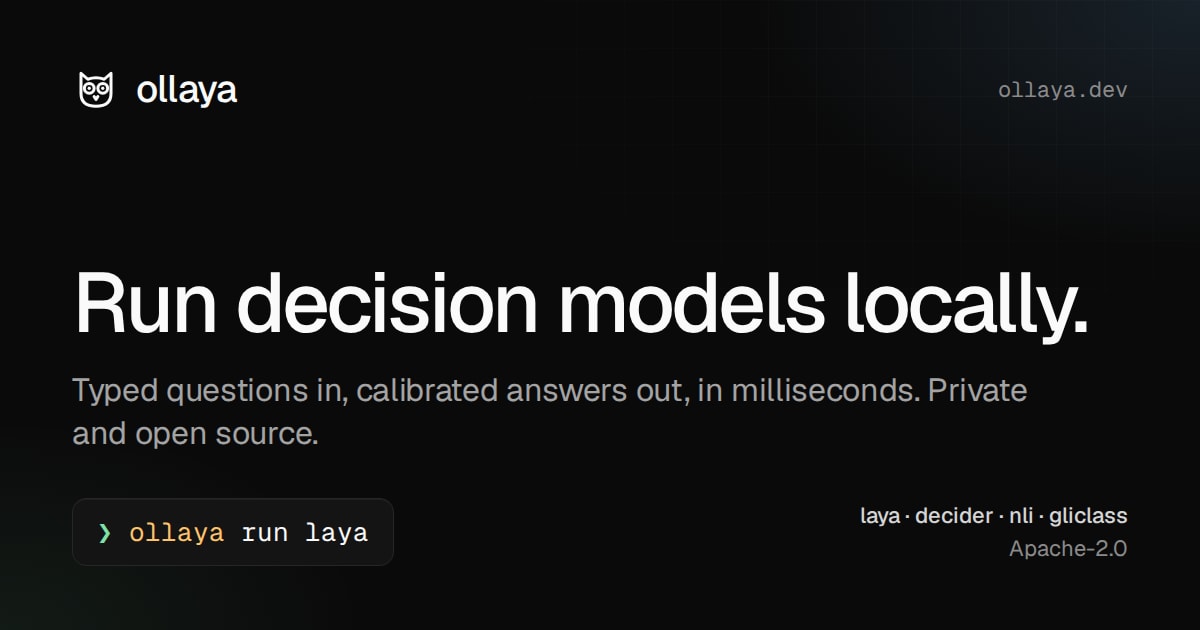
Ollaya is a new framework designed for high-performance, open-source decision models that process requests in milliseconds without token-by-token generation. By bypassing traditional autoregressive methods, it achieves sub-10ms latencies on consumer hardware like the RTX 4090.
The Emergence of High-Speed Decision Models: Analyzing Ollaya
The landscape of artificial intelligence is currently dominated by autoregressive language models that generate text token-by-token, a process that is inherently sequential and often sluggish for simple classification or decision-making tasks. The introduction of Ollaya marks a significant shift in this paradigm, focusing specifically on decision models that function through single forward passes. This approach effectively eliminates the latency overhead typically associated with LLMs, enabling near-instantaneous responses that are critical for real-time applications.
Architectural Advantages: Beyond Token Generation
Unlike traditional chatbots that require multiple computational steps to build a sentence, Ollaya operates on a non-generative architecture. By processing inputs in a single forward pass, the system achieves remarkable speed, with benchmarks showing the laya:multilingual model returning results in as little as 8.1 milliseconds on an NVIDIA RTX 4090. This performance leap is transformative for developers who require high-throughput decision-making capabilities, such as automated routing, data classification, or rapid-fire NLI (Natural Language Inference) tasks.
Comparative Performance and Benchmarking
When compared to existing hosted solutions like the TypeSafe Jev API, which reports median request latencies between 236 and 276 milliseconds, Ollaya demonstrates a massive competitive advantage. Even when accounting for different precision formats—such as Laya running in fp16 versus others in fp32—the delta is undeniable. The ability to achieve sub-10ms responses for multi-question requests on consumer-grade hardware like the RTX 4090 suggests that high-performance AI is becoming increasingly accessible outside of massive data centers.
Practical Applications and Future Trends
This focus on latency-optimized models suggests a growing trend toward 'specialized' AI over 'general-purpose' AI. While Large Language Models remain essential for creative and nuanced tasks, the industry is clearly moving toward lighter, faster models for operational decision-making. As organizations look to integrate AI into latency-sensitive workflows, such as high-frequency automated systems or real-time user interface responses, the demand for frameworks like Ollaya will likely expand.
Conclusion: A New Standard for Decision AI
Ollaya represents a pivotal development for developers working with open-source models. By prioritizing raw speed and efficient inference, it addresses one of the most persistent bottlenecks in current AI deployment: the trade-off between model intelligence and response time. As benchmarks continue to favor these specialized decision models, we can expect a migration of logic-heavy applications away from heavy generative models toward these faster, more efficient alternatives.