Credit pressure increases on BDC debt investments, led by software
Source Entity
Yahoo Finance
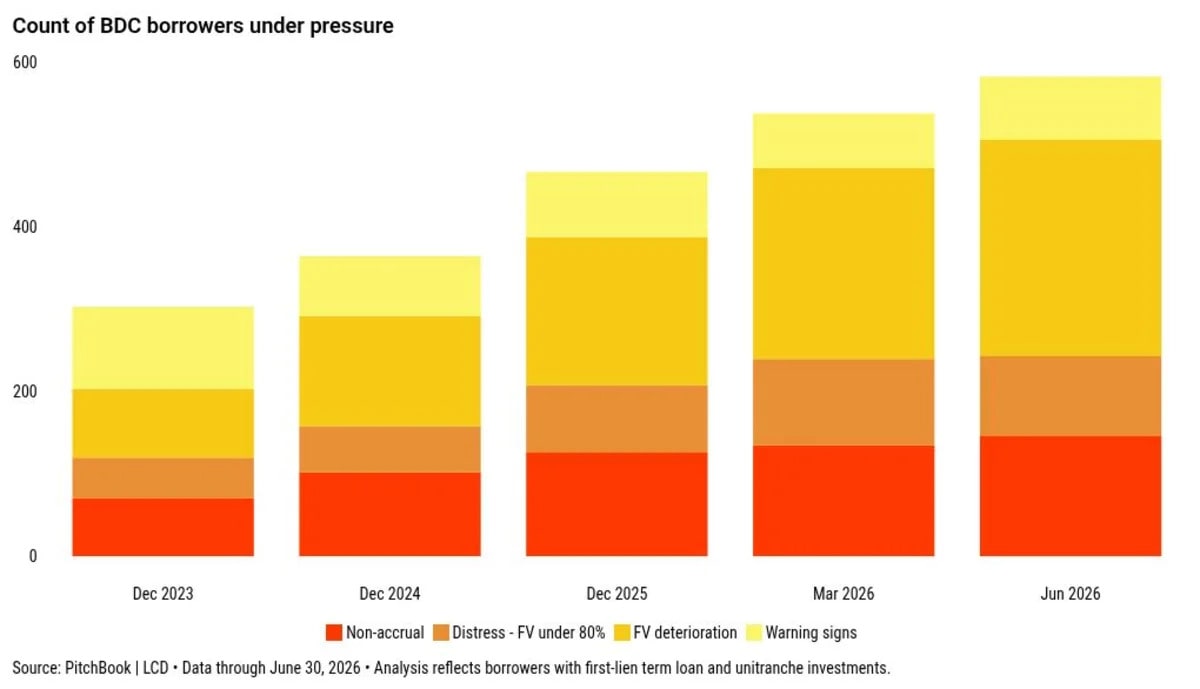
Credit stress in the private credit market is intensifying, with nearly 600 BDC-held companies showing signs of financial pressure. The software sector is disproportionately affected, accounting for 36% of the $47 billion in stressed debt.
The Rising Tide of Credit Stress in Private Markets
Recent data highlights a significant escalation in credit pressure within the private credit market, a sector that has historically served as a vital financing engine for mid-market enterprises. According to LCD’s analysis of over 180 Business Development Companies (BDCs), the number of companies exhibiting signs of financial distress has climbed to 583 as of June 30, 2026. This represents a concerning 8% increase from March and a 25% surge from the end of 2025, signaling that the structural stability of these private portfolios is being tested by current economic conditions.
The Software Sector's Disproportionate Impact
A critical finding in this analysis is the concentration of risk within the software industry. Software firms currently account for 36% of all debt under pressure—the largest share of any single sector. This vulnerability suggests that the high-growth, high-leverage models often employed by software companies are proving difficult to sustain in a period of tightening credit. As these businesses face mounting repayment pressures, the BDCs holding their debt are increasingly exposed to potential defaults or restructuring requirements.
Escalating Dollar Exposure and Market Risks
Perhaps more alarming than the sheer count of distressed borrowers is the rapid growth in dollar exposure. While the number of companies under pressure is rising, the volume of stressed debt is growing at a significantly faster rate. Specifically, the volume of first-lien term loan and unitranche investments under pressure has surged by 92% since the end of 2025, reaching a total of $47 billion. This indicates that larger, more consequential entities—rather than just smaller, isolated startups—are now struggling to meet their financial obligations.
Structural Implications for BDCs
BDCs operate as a primary source of capital for private companies, and the current trend of rising credit pressure forces a re-evaluation of risk assessment models. When nearly 600 companies out of a 5,000-strong portfolio exhibit distress, it suggests a systemic shift in the borrower landscape. Investors and market participants must now account for the reality that the 'private' nature of these loans does not insulate them from broader macroeconomic headwinds, especially when the exposure is concentrated in high-leverage sectors like software.
Future Trends and Outlook
The trajectory of these figures points toward a period of potential volatility for the private credit industry. If the current pace of distress continues, BDCs may face increased pressure to increase loan-loss provisions or engage in complex debt restructurings to mitigate losses. The shift toward larger, more systemic names entering the 'under pressure' category suggests that the impact of this credit tightening will be felt more acutely across the broader financial ecosystem as these debt instruments mature.