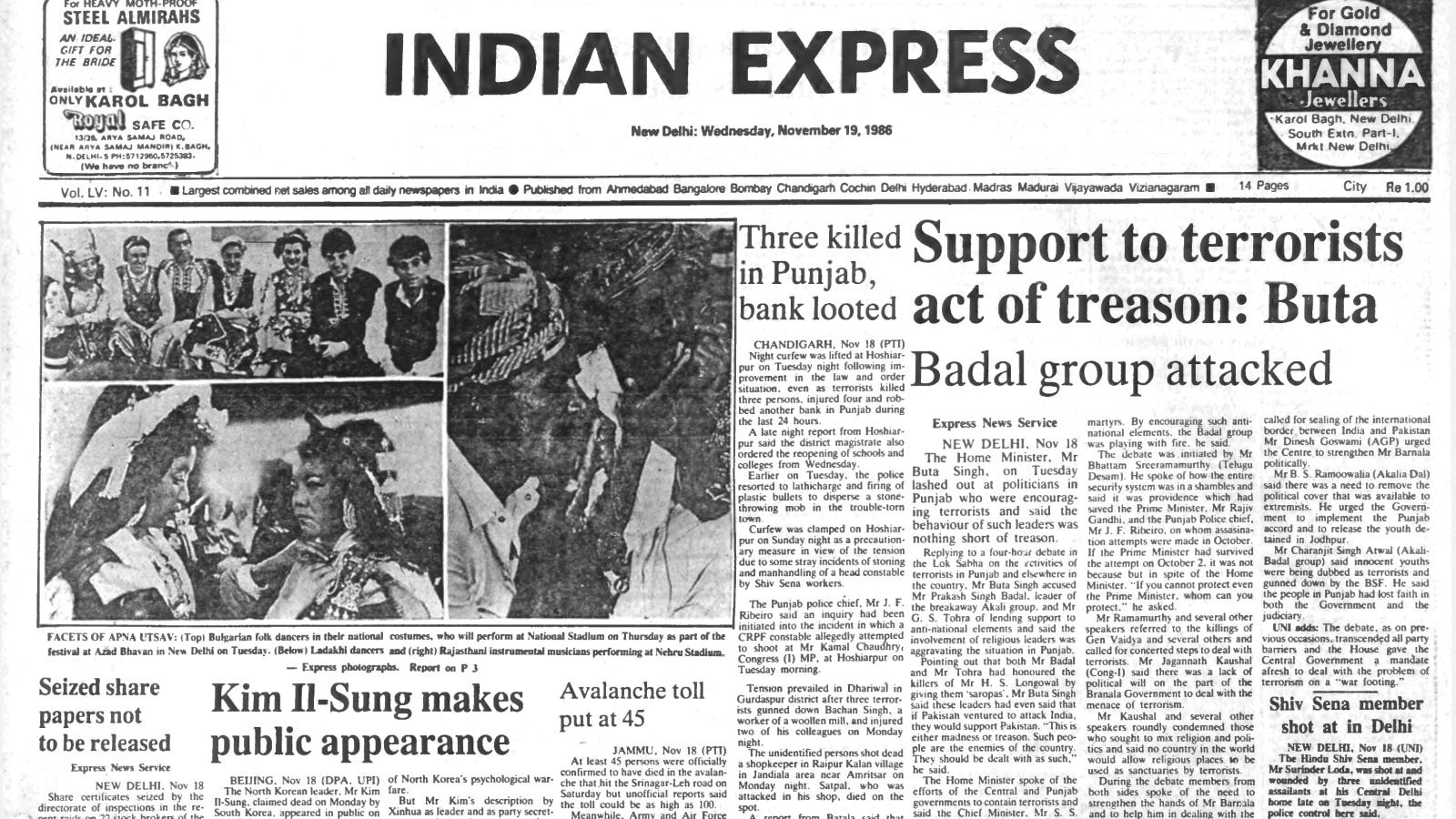
40 years ago: Terror rocks Punjab and a Home Minister accuses Akali leader of ‘encouraging terrorists’
Source Entity
The Indian Express
An official commission report has confirmed that the 1985 fire at Delhi's Siddhartha Continental Hotel, which killed 34 people, was caused by an LPG leak. The report highlighted critical lapses by both hotel management and fire services, labeling the tragedy as entirely avoidable.
The Siddhartha Continental Tragedy: A Historical Analysis
The Anatomy of a Preventable Disaster
On January 22, 1985, the Siddhartha Continental Hotel in South Delhi became the site of a devastating fire that claimed 34 lives. Years later, the findings of the inquiry commission led by Justice D.R. Khanna have provided definitive clarity on the origins of this catastrophe. The report, presented in the Lok Sabha by then-Home Minister Buta Singh, identifies a catastrophic LPG leakage as the primary ignition point for the blaze. This technical failure, while serving as the catalyst, was merely the final link in a chain of systemic negligence.
Accountability and Human Failure
The commission’s report is scathing in its assessment of the institutional failures that allowed the fire to escalate. By explicitly citing "human failure," Justice Khanna’s inquiry shifts the narrative from an unavoidable accident to a clear case of professional negligence. The report notes that both the hotel management and the fire services failed to uphold the necessary safety protocols that could have mitigated the loss of life. This finding underscores a recurring theme in urban infrastructure history: the gap between regulatory requirements and actual on-site compliance.
Lapses in Fire Safety Infrastructure
A critical component of the commission's findings is the assertion that the tragedy was "avoidable." This characterization is significant, as it implies that had the hotel management maintained proper storage and ventilation for LPG, or had the fire services responded with the necessary equipment and coordination, the death toll could have been significantly lower, if not zero. The failure of the fire services to manage the blaze effectively speaks to the limitations of disaster response protocols in Delhi during that era, highlighting a lack of preparedness for high-rise or commercial structure fires.
Political and Administrative Context
The presentation of this report in the Lok Sabha by Home Minister Buta Singh placed the tragedy squarely within the national legislative discourse. During a period in Indian history marked by intense political instability and security concerns, the focus on public safety and the accountability of private commercial entities became a matter of parliamentary record. The government’s willingness to table such a critical report demonstrated an attempt to address the public outcry following the loss of 34 lives and to demand higher standards of safety in the hospitality industry.
Legacy and Future Implications
The Siddhartha Continental fire serves as a foundational case study in the evolution of fire safety regulations in India. The lessons drawn from Justice Khanna’s report influenced subsequent revisions to building codes and the mandatory installation of safety systems in hotels. By documenting the specific failures of 1985, the inquiry provided a blueprint for how authorities should investigate commercial tragedies, ensuring that the burden of proof rests on those responsible for public safety. Ultimately, the report remains a somber reminder of the cost of institutional complacency.