Step 5 Preview, a 1M-context MoE from StepFun, shows up on OpenRouter
Source Entity
Hacker News
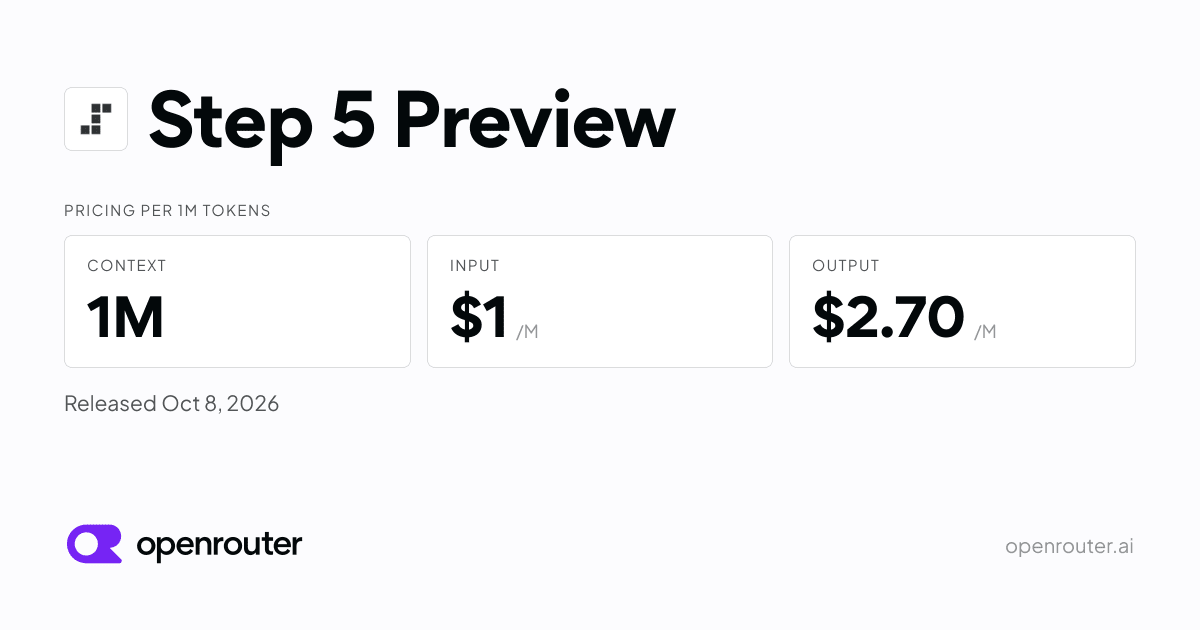
StepFun has released Step 5 Preview, a massive 600B parameter MoE model designed for complex agentic workflows. The model excels in software engineering and finance, utilizing a 1M-token context window to process extensive data.
The Emergence of Step 5 Preview: Pushing Agentic Boundaries
StepFun has officially introduced its flagship model, Step 5 Preview, marking a significant milestone in the evolution of large language models (LLMs). Appearing on the OpenRouter platform, this model distinguishes itself through a massive 600 billion total parameter count, utilizing a sparse Mixture-of-Experts (MoE) architecture. By activating 27 billion parameters per inference, StepFun aims to balance computational efficiency with the deep reasoning capabilities required for high-stakes professional environments.
Architecting for Extended Context
The most defining feature of Step 5 Preview is its 1-million-token context window. In the current landscape of AI, the ability to maintain coherence across vast datasets is the primary differentiator for 'agentic' work. This massive capacity allows the model to ingest entire software repositories, complex financial regulatory documents, or multi-chapter legal filings without losing track of nuanced details. By enabling the model to ingest such high volumes of data, StepFun is positioning its product as a primary engine for automation in sectors that rely on historical data integrity.
Specialization in Professional Domains
While many general-purpose models struggle with the rigid syntax of programming or the volatility of financial data, Step 5 Preview is explicitly optimized for these verticals. The model's architecture is tailored to handle software engineering tasks, suggesting an ability to navigate deep dependency trees within large codebases. Furthermore, its proficiency in financial analysis indicates that the model has been trained to interpret quantitative data alongside qualitative reporting, a combination essential for modern algorithmic finance.
The Shift Toward Multi-Step Agentic Workflows
Beyond mere generation, Step 5 Preview is designed to function as an agent. The core methodology involves using tools and iteratively refining results through multiple steps. This shift from simple input-output interactions to cyclical, self-correcting workflows represents a move toward AI that can independently resolve complex bugs or reconcile financial discrepancies. This iterative approach ensures that the output is not just a static response, but a validated solution.
Broader Implications for the AI Ecosystem
The release of this model on OpenRouter signals a growing trend of high-performance, specialized models becoming accessible to a wider developer base. As companies like StepFun push the boundaries of parameter counts and context lengths, the barrier to entry for building complex, autonomous agents lowers significantly. This competition likely forces a shift in the industry, where performance is no longer measured solely by conversational fluency, but by the reliability and depth of autonomous task execution.
Future Trends and Conclusion
Looking ahead, the success of Step 5 Preview will likely hinge on its integration capabilities within enterprise software suites. As agents become more capable of navigating codebases and financial databases, the demand for transparent, audit-ready AI workflows will increase. StepFun’s focus on long-context, multi-step reasoning positions them as a formidable player in the ongoing race to create agents that can reliably handle the heavy lifting of professional knowledge work.