Too AI; Didn't Read
Source Entity
Hacker News
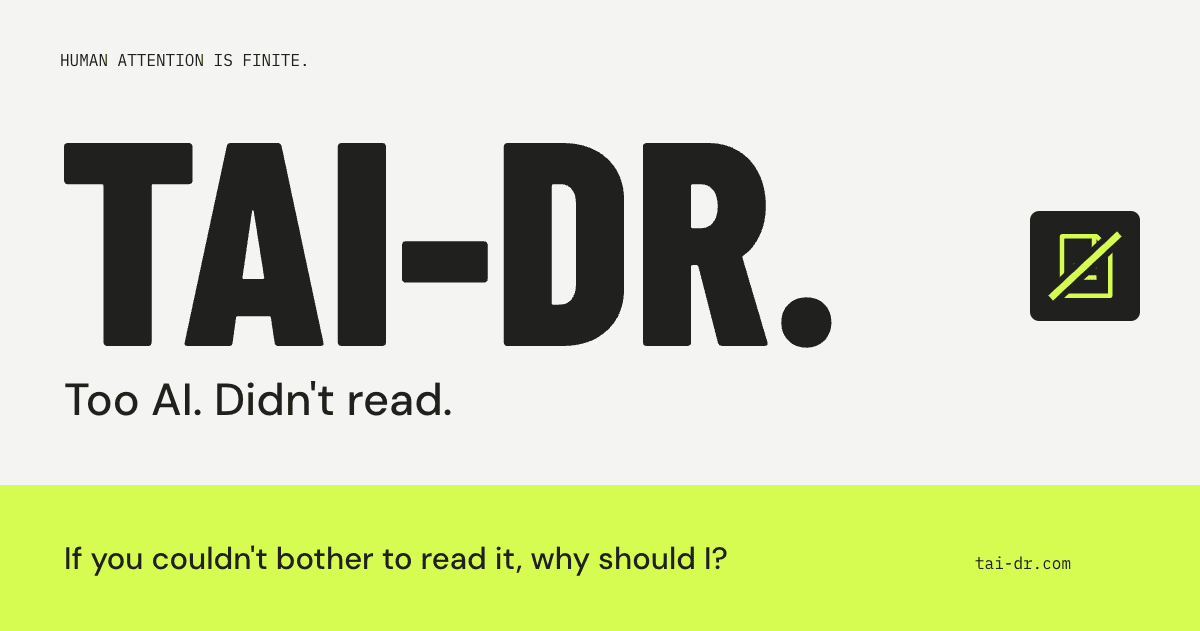
The term 'Too AI; Didn't Read' highlights the growing challenge of information overload as AI-generated summaries become ubiquitous. This phenomenon reflects a shift in how digital content is consumed and processed in an era of automated synthesis.
The Rise of Automated Summarization
In the contemporary digital landscape, the phrase 'Too AI; Didn't Read' has emerged as a clever, albeit cynical, commentary on the deluge of automated content. As large language models become integrated into search engines, browsers, and social platforms, the act of consuming information has fundamentally shifted. Rather than engaging with primary sources, users are increasingly presented with AI-generated digests that prioritize brevity over nuance.
The Erosion of Primary Engagement
The core issue identified by this sentiment is the potential erosion of deep reading habits. When tools automatically condense complex reports, articles, or legal documents into bullet points, the nuanced arguments and contextual layers of the original text are often stripped away. This creates a feedback loop where the consumer is distanced from the source material, relying entirely on the interpretative lens of an algorithm that may hallucinate or misrepresent the author's original intent.
Implications for Digital Literacy
As AI synthesis becomes the default mode of consumption, digital literacy faces a new hurdle: the ability to distinguish between a faithful summary and a biased or inaccurate one. If users stop clicking through to original sources, the incentive for creators to produce high-quality, long-form journalism or research diminishes. This threatens the long-term sustainability of the information ecosystem, as the very data used to train these models relies on the existence of original, high-quality human output.
Efficiency vs. Intellectual Depth
There is an inherent tension between the efficiency offered by AI tools and the value of intellectual depth. While 'Too AI; Didn't Read' suggests a fatigue with the volume of content, it also points to a desire for curation. The challenge for developers and users alike is to find a balance where AI serves as a bridge to understanding complex topics rather than a barrier that replaces the need for critical thinking and firsthand exploration.
Future Trends in Content Consumption
Looking ahead, we can expect a bifurcation in how information is consumed. On one side, there will be a proliferation of 'fast content'—hyper-summarized, AI-driven feeds designed for quick digestion. On the other, there will likely be a resurgence in the value of verifiable, human-verified, long-form content that resists automated summarization. The successful platforms of the future will be those that provide transparency into how their summaries are generated, allowing users to verify the claims made by the AI.
Conclusion
The 'Too AI; Didn't Read' phenomenon is more than just a passing trend; it is a symptom of a significant transition in human communication. By acknowledging the limitations of automated synthesis, both creators and consumers can strive to maintain a healthy relationship with information that values accuracy and context over mere convenience.