
Willpower is a lie. We treat it like an infinite well of strength, but in reality, it is a battery that drains with every single micro-decision you make from the moment you wake up. Every time you resist the urge to check a notification, every time you force yourself to ignore a cluttered desk, and every time you fight the temptation of a browser tab, you are leaking cognitive energy. By the time you reach your most critical task of the day, your battery is at 15%, and you wonder why you cannot concentrate. The solution is not more discipline; it is better architecture.
Decision architecture, a term popularized in behavioral economics, is the practice of organizing the context in which people make decisions. While often used by governments to nudge citizens toward healthier choices, the same principles apply to your personal productivity. If you have to choose to focus, you have already lost. The goal is to engineer your environment so that focus is not a choice, but the default state. Why fight your environment when you can make the environment fight for you?
Prerequisites for the Audit
Before you begin rearranging your furniture or deleting apps, you need a baseline of honesty. You cannot fix a leak if you refuse to admit where the water is coming from. To perform this audit effectively, you will need a physical notebook (to avoid digital distraction during the process), a timer, and a dedicated 90-minute window where you are not expected to be productive. You are not working; you are building the machine that allows you to work.
- A physical logbook or analog notepad.
- A timer (analog preferred to avoid phone interaction).
- A 'friction list' of every interruption you encountered in the last 48 hours.
- A willingness to dismantle habits that feel comfortable but are functionally destructive.

The Step-by-Step Decision Architecture Audit
This is not a one-time cleanup; it is a systemic overhaul. We are applying the principle of 'choice architecture' to eliminate the gap between your intention (focus) and your action (work). The following steps are designed to identify 'friction points'—those tiny obstacles that trigger a decision—and remove them entirely.
- Map Your Friction Points: For one full workday, carry your notebook. Every time you feel the urge to switch tasks or get distracted, write down the trigger. Was it a loud noise? A specific notification? The sight of an unwashed coffee mug? (Source: Thaler & Sunstein, 2008).
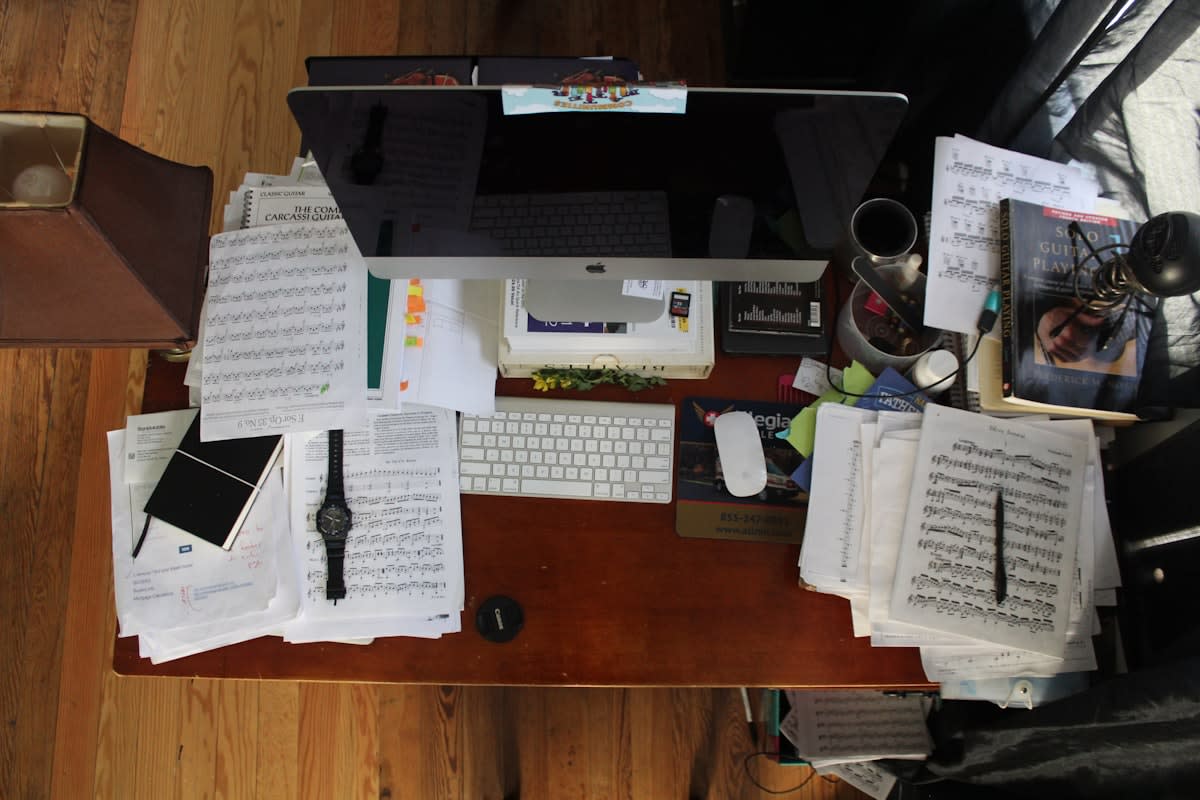
- The Visual Purge: Clear every single object from your line of sight that is not essential to the current task. Visual noise is processed by the brain as a series of 'unresolved tasks,' which creates a subtle but constant drain on your working memory.
- Digital Guardrail Installation: Move all 'high-dopamine' apps (social media, news, email) off your home screen and into hidden folders. Better yet, use grayscale mode to strip the psychological reward from the interface. The goal is to increase the 'interaction cost' of distraction.
- Establish an Environmental Anchor: Create a sensory trigger that only exists during deep work. This could be a specific playlist, a particular scent (like peppermint), or a dedicated lamp. Over time, your brain associates this stimulus with focus, bypassing the need for a conscious decision to start working.
- The Default State Reset: Set your computer to boot directly into your primary work application. Close all unrelated tabs before shutting down at night. When you start your day, the 'path of least resistance' should lead directly to your most important project.
Most people fail here because they try to implement all five steps at once. Do not do that. The audit is iterative. Start with the Friction Map. Spend three days simply observing. Once you see the patterns—perhaps you always check your phone when you hit a difficult paragraph in a report—you can apply a specific architectural fix, such as placing the phone in another room entirely.
"Choice architecture is the design of different ways in which choices can be presented to consumers, and the impact of that presentation on consumer choice."— Richard Thaler, Nobel Laureate in Economics
When we apply this to focus, we are essentially 'nudging' ourselves. If your phone is on your desk, the decision is: 'Should I check this notification?' If your phone is in a drawer in another room, the decision becomes: 'Is this notification worth the physical effort of standing up and walking across the room?' By increasing the friction of the distraction, you make the focus the easier path.
The Practitioner's Perspective: The Optimization Trap
In my years implementing these systems for high-output teams, I have seen a recurring phenomenon I call the Optimization Trap. This happens when a practitioner becomes more obsessed with the architecture than the work. They spend three weeks researching the perfect ergonomic chair, the ideal lighting temperature, and the most sophisticated app-blocking software, but they never actually write the code or the report. In the field, the real debate isn't about which tool is best, but about the balance between 'sterile' environments and 'stimulating' ones. Some people thrive in total silence; others need the ambient hum of a cafe in Mexico City or a bustling hub in Nairobi to hit a flow state. The key is not to copy a 'perfect' setup, but to identify your specific cognitive triggers.
The cost of a single distraction is far higher than most realize. According to research from the University of California, Irvine, it takes an average of 23 minutes and 15 seconds to return to the original task after an interruption (Source: Gloria Mark, 2008). If you are interrupted four times an hour, you are effectively never operating at full cognitive capacity. You are living in a state of permanent 'attention residue,' where fragments of your mind are still processing the previous distraction while you try to tackle the current problem.
Common Pitfalls to Avoid
- Over-Engineering: Building a system so complex that maintaining the system becomes a task in itself. Keep your architecture invisible.
- The 'Fresh Start' Fallacy: Believing that a new desk or a new app will solve a deep-seated behavioral issue. Architecture supports habits; it does not replace them.
- Ignoring Digital Leaks: Focusing only on the physical desk while leaving a browser with 40 open tabs. Your digital environment is just as physical as your office.
- Lack of Iteration: Setting a system and never auditing it again. Your friction points change as your projects evolve.
The ultimate goal of the Decision Architecture Audit is to reach a state of 'effortless focus.' This doesn't mean the work is easy; it means the act of starting and staying with the work is no longer a battle. You have removed the pebbles from your path, leaving only the mountain you actually intended to climb.
Editorial Note
Ensure you are not confusing 'comfort' with 'architecture.' A comfortable chair is a luxury; a chair that is positioned away from a distracting window is architecture. One feels good; the other makes you productive.
Fact-Check & Accuracy Note
The claims regarding 'choice architecture' and 'nudging' are based on the foundational work of Richard Thaler and Cass Sunstein (2008). The statistic regarding the 23-minute recovery time is sourced from the work of Dr. Gloria Mark at the University of California, Irvine (2008). The concept of 'attention residue' is a core tenet of deep work theory as discussed by Cal Newport (2016).