The July Paradox: Rules Stalled, Access Granted
The International Seabed Authority (ISA) just handed the industry a contradictory signal. During its council meeting from July 13 to 24, the 36-member body failed yet again to finalize the commercial rules required to govern seabed mining in international waters. On the surface, this looks like a victory for caution. However, the fine print tells a different story. While the overarching rulebook remains a draft, the ISA simultaneously extended a controversial exploration contract for Nauru Ocean Resources Inc. (NORI), a subsidiary of the Canadian firm The Metals Company (TMC). This move ensures that exclusive exploration rights for blocks of the Pacific seabed remain firmly in private hands.
Why does this distinction matter? It creates a regulatory vacuum where the 'how' of mining is undecided, but the 'who' is already being locked in. By finding that NORI met all criteria for renewal, the ISA has effectively signaled that exploration is greenlit even if exploitation remains in legal limbo. We are seeing a pivot from a cautious, science-first approach to a strategic land-grab—or rather, a seabed-grab. The industry is no longer asking if it can mine; it is simply waiting for the clock to run out on the regulators.
"A sales-pitch pivot brings deep-sea mining closer to reality."— Mongabay Reporting
This tension between regulation and exploration is not just a bureaucratic glitch. It is a reflection of the immense pressure mounting from the global energy sector. The demand for critical minerals is no longer a future projection; it is a present-day bottleneck. As we shift toward energy technologies, the desperation to diversify supply chains is overriding the appetite for a perfect regulatory framework. The industry is moving faster than the UN can write the laws.
The shift in momentum is palpable when comparing the current landscape to a year ago. Twelve months ago, the conversation focused on the 'if'—if the ISA would ever allow mining, and if the environmental cost was too high. Today, the conversation has shifted to 'when' and 'how much.' The extension of TMC's contracts in July 2026 proves that the institutional momentum has shifted toward enablement, regardless of the missing rulebook.
The Geopolitical Engine: Beyond the Reserves
The International Energy Agency (IEA) has been clear: the energy transition is fueling an accelerating demand for critical minerals. But the real driver isn't just the scarcity of the minerals themselves. It is the terrifying concentration of where they are processed. Sait Uysal of the Turkish Critical Minerals Initiative points out a critical truth: the geographical concentration of supply poses a far greater risk than the actual availability of reserves. If the world relies on a handful of nations for refining, the energy transition becomes a geopolitical hostage situation.
This is where deep-sea mining transforms from an environmental gamble into a national security imperative. By tapping into the seabed, nations hope to bypass the terrestrial monopolies of the current mining era. The race is no longer just about profit; it is about resilience. When Uysal notes that shortages are expected even if every project planned through 2035 is completed on schedule, the seabed stops being an option and starts becoming a necessity.
| Risk Factor | Terrestrial Mining | Deep-Sea Mining |
|---|---|---|
| Supply Concentration | High (limited processing hubs) | Potential for diversification |
| Regulatory Status | Established/National | Developing/International (ISA) |
| Availability | Known but depleting/costly | Massive but largely unexplored |
| Primary Driver | Market Demand | Energy Transition & Security |
Does this mean the environment is being sidelined? Not entirely, but the nature of the argument has changed. We are moving away from an absolute ban toward a 'mitigation' mindset. The goal is no longer to prevent impact—which is impossible in any mining operation—but to manage it through technology and data.
Capitalizing the Abyss: The Nasdaq Ambition
The financialization of the seabed is accelerating. Deep Sea Minerals (DSM) is not just looking for rocks; it is looking for a Nasdaq listing. This move signals a desire to bring the volatility and scale of public equity markets into the deep ocean. For DSM, the path to a public offering is paved with regulatory milestones, such as the recent NOAA substantial-compliance determination. This is a critical piece of evidence that the US regulatory environment is beginning to align with commercial ambitions.
The focus for these companies is the Clarion-Clipperton Zone (CCZ), a vast stretch of the Pacific that acts as the epicenter for this industrial rush. To appease critics and investors alike, firms are pivoting toward 'fact-based environmental baselines.' The strategy is to deploy continuous monitoring and harvesting technologies specifically designed to minimize sediment plumes and habitat disruption. It is a high-tech promise: we can take the minerals without killing the ecosystem.
Market Signal
The shift from 'concept' to 'regulatory reality' is most evident in the pursuit of public listings. When a company moves from private venture capital to targeting the Nasdaq, it indicates that the perceived risk of the deep-sea market has dropped enough to attract institutional investors.
However, the technical challenges remain staggering. How do you actually recover polymetallic nodules from thousands of meters below the surface without creating a cloud of sediment that chokes the water column for miles? The industry's answer is iterative technology. By establishing baselines first, they argue they can adjust their machinery in real-time to limit impact. It is an 'adapt-as-you-go' model that contrasts sharply with the 'precautionary principle' advocated by scientists.
Sovereign Ambitions: The Indian Model
While private firms like TMC and DSM chase the CCZ, sovereign states are playing a longer, more strategic game. India's approach is a masterclass in dual-track exploration. The government has separated its interests into two distinct programs: the Samudra Manthan scheme and the Deep Ocean Mission. While Samudra Manthan is laser-focused on hydrocarbon reserve accretion to fuel immediate energy needs, the Deep Ocean Mission is about the future.
The Deep Ocean Mission prioritizes scientific discovery, specifically the study of polymetallic nodules and other strategic seabed minerals. By framing their activity as 'scientific discovery' rather than 'commercial mining,' India is building the intellectual and technical infrastructure necessary to lead when the ISA finally drops its rulebook. It is a hedge. They are gathering the data now so they can execute the extraction later.
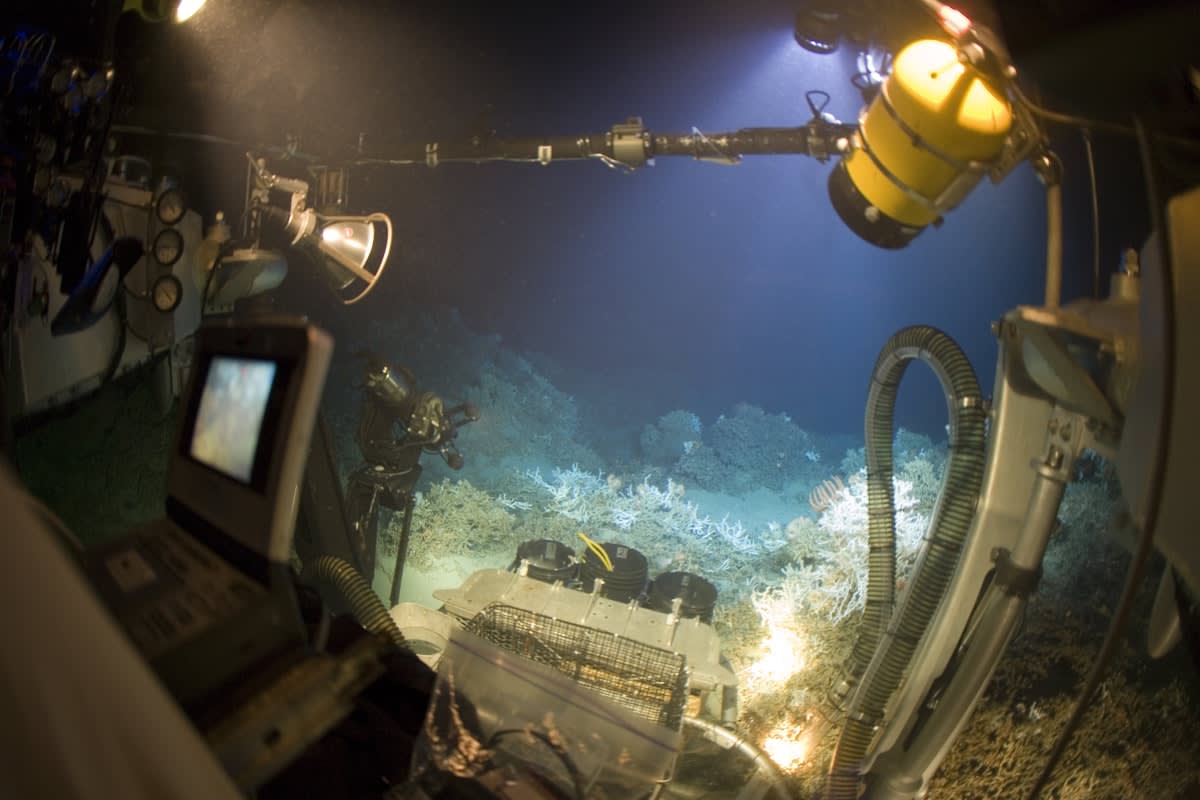
This sovereign strategy mirrors the broader global trend: the decoupling of scientific research from industrial exploitation. By funding 'discovery' missions, states can claim environmental stewardship while simultaneously mapping the most lucrative mineral deposits on the planet. The line between a research vessel and a prospecting ship has become dangerously thin.
The 2035 Horizon: Adaptation or Exhaustion?
Looking toward 2035, the trajectory is clear. Even with an aggressive rollout of all planned terrestrial mines, the world is staring at a critical mineral deficit. This creates an irresistible gravity pulling the industry toward the deep sea. The 'Silent Descent' is no longer a slow drift; it is a calculated dive. The industry has realized that the lack of UN rules is not a barrier—it is a window of opportunity to establish a fait accompli.
The real turning point hit in July 2026. By extending contracts while delaying rules, the ISA has inadvertently accelerated the race. Companies are now incentivized to prove their technology and secure their sites before a restrictive global regime can be implemented. The race for the deep sea is no longer about who has the best science, but who has the best timing and the most resilient capital.
Ultimately, the deep-sea mineral race is a mirror of the energy transition itself: messy, geopolitically charged, and driven by an urgent need for adaptation. Whether the industry can actually deliver on its promise of 'low-impact' mining remains to be seen, but the momentum is now irreversible. The descent has begun, and the ocean floor is the new frontier of global power.