Anti-CEC protests in Chennai: AISF, AIYF cadres arrested on Anna Salai; over 30 CJP supporters detained in Besant Nagar
Source Entity
India Latest News: Top National Headlines Today & Breaking News | The Hindu
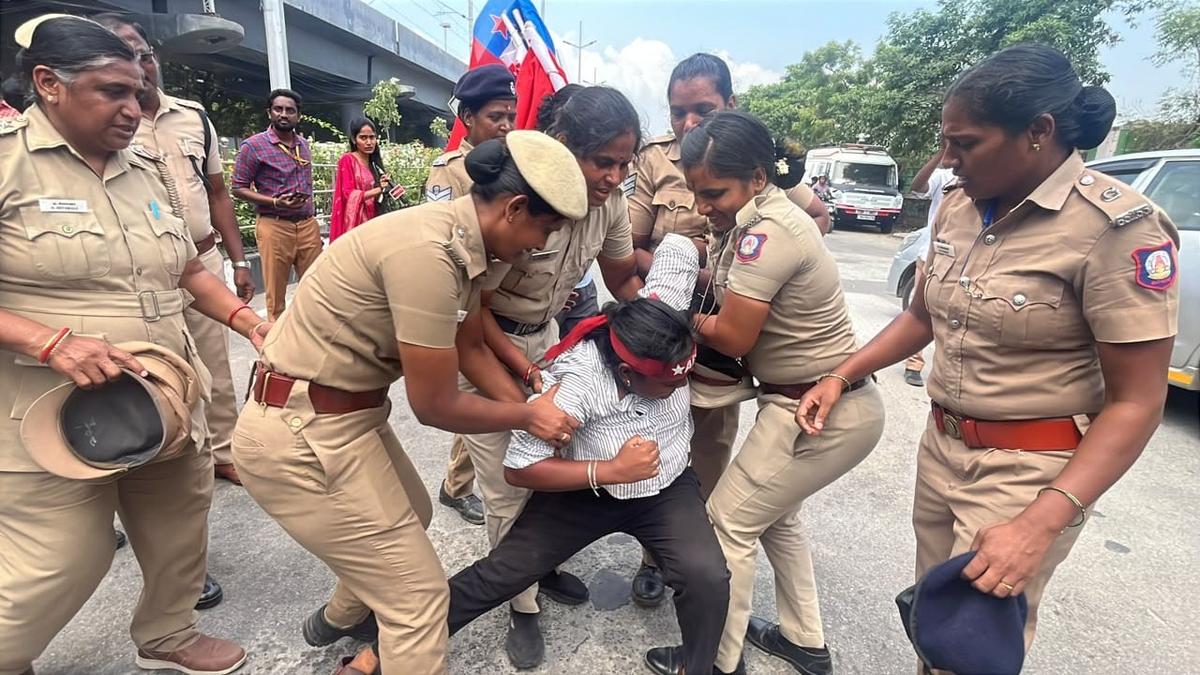
Chennai police arrested over 100 members of the AISF and AIYF during protests demanding the removal of Chief Election Commissioner Gyanesh Kumar. The demonstration, which saw one injury, reflects growing civil society tensions regarding electoral oversight.
Tensions Escalate: Protests Erupt Against Election Commission Leadership
On October 10, 2026, the political landscape in Chennai witnessed a significant disruption as over 100 cadres from the All India Students’ Federation (AISF) and the All India Youth Federation (AIYF) were taken into custody by local police. The demonstrators had organized a march toward the Tamil Nadu Secretariat with the explicit goal of laying siege to the office of the Chief Electoral Officer. This action was driven by a singular, high-stakes demand: the immediate removal of Chief Election Commissioner (CEC) Gyanesh Kumar.
The Anatomy of the Protest
Led by prominent youth leaders K. Bharathi of the AIYF and K. Ibrahim of the AISF, the assembly gathered near the iconic Periyar statue on Anna Salai. The marchers navigated through Sivananda Salai, signaling a coordinated effort to bring their grievances directly to the seat of state power. However, the progression was swiftly halted by police intervention, resulting in the mass arrest of the participants. The intensity of the confrontation was underscored by the fact that at least one protester sustained a head injury, necessitating medical transport and hospital treatment.
Broader Implications for Electoral Oversight
This unrest is not an isolated incident but part of a wider, national wave of discontent. Parallel reports from Delhi, involving the Citizens for Justice and Peace (CJP), indicate that these protests are gaining momentum across multiple urban centers. The detention of over 30 CJP supporters in Besant Nagar highlights a widening circle of civil society involvement. The core of this movement centers on the perceived neutrality and efficacy of the Election Commission of India (ECI), an institution that serves as the bedrock of the world's largest democracy.
Historical Context and Institutional Trust
The demand for the removal of a constitutional authority like the CEC is historically rare and signals a profound crisis of confidence among student and youth political wings. In the context of Indian democracy, the ECI has traditionally been viewed as an impartial arbiter. When student-led organizations mobilize to challenge the legitimacy of the CEC, it suggests that the discourse surrounding electoral integrity has reached a critical threshold, prompting activists to move from legislative advocacy to direct street agitation.
Future Trends in Political Mobilization
Looking ahead, the involvement of youth-led organizations like AISF and AIYF suggests that the campaign against the CEC is likely to remain sustained and decentralized. By urging youth to "take charge" of the movement, these groups are attempting to build a grassroots coalition that transcends state lines. As the police response intensifies and more detentions occur, it is probable that these demonstrations will continue to feature prominently in the political cycle, forcing a national debate on the accountability mechanisms governing the Election Commission of India.
Verification Required?