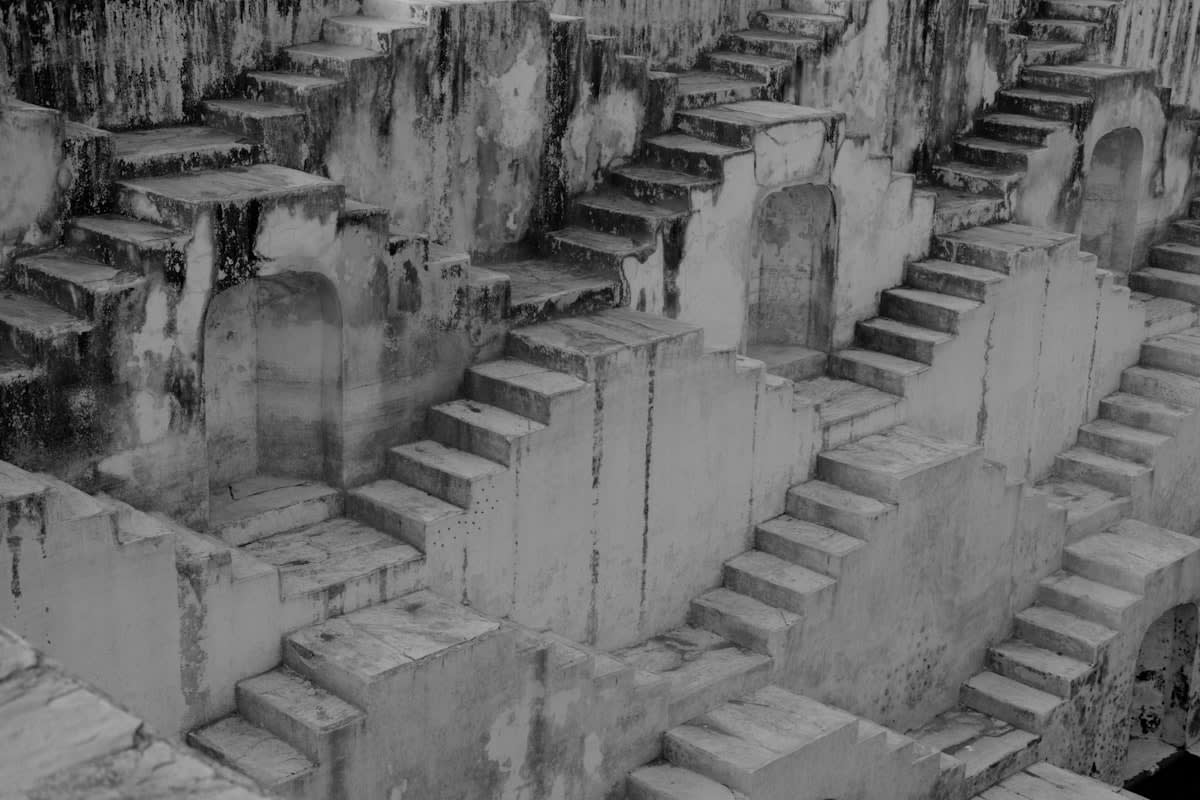
Bangalore and Chennai are not suffering from a lack of rain, but from a lack of memory. For decades, the urban planning logic followed a linear extraction model: find a distant source, build a massive pipe, and pump water into the city. This centralized approach, inherited from British colonial administration, treated water as a commodity to be transported rather than a resource to be harvested. Now, as groundwater tables plummet by as much as 25 percent in critical basins, the machinery of the 20th century is grinding to a halt. The failure is not one of capacity, but of philosophy.
The British Raj viewed the indigenous network of tanks, ponds, and stepwells as inefficient because they were community-managed and difficult to tax. By replacing these decentralized systems with state-controlled canals and pipelines, the colonial government effectively severed the link between the citizen and the aquifer. This created a psychological dependency on the state for a basic biological necessity. When the state fails to provide, the city dies, regardless of how much rain falls on its soil. This dependency is the primary vulnerability of the modern Indian metropolis.
The Engineering of the Invisible
Pre-colonial engineering was not about fighting nature, but about slowing it down. The Baoli, or stepwell, served as more than just a reservoir; it was a sophisticated thermal regulator and a groundwater recharge point. By creating deep, stepped access to the water table, these structures minimized evaporation and encouraged the seepage of monsoon rains back into the earth. They operated on the principle of infiltration rather than extraction. In the arid plains of Gujarat and Rajasthan, these were the anchors of civilization, ensuring that water remained available long after the clouds vanished.

The physics of the Johad, a crescent-shaped earthen check dam, provides a stark contrast to the concrete brutality of modern dams. While a large dam displaces thousands and destroys river ecosystems, a Johad simply obstructs the natural runoff of rainwater, forcing it to pause and sink into the ground. In the Alwar district of Rajasthan, the revival of these structures has transformed dead rivers back into perennial streams. This is not a romantic return to the past, but a calculated application of hydro-geology. By increasing the residence time of water on the land, the community restores the aquifer's pressure.
"The mistake was believing that a pipe is more advanced than a pond. A pipe only moves water; a pond creates it."— Regional Hydrology Analyst
In Tamil Nadu, the ancient Eri system—a network of interconnected tanks—once managed the state's water with surgical precision. These tanks were designed to overflow into one another, ensuring that no single drop of monsoon rain was wasted. The colonial era saw these tanks neglected or filled in for agriculture, leading to the current cycle of flash floods followed by acute drought. The current effort to desilt and reconnect these Eris represents a structural realignment of how the region perceives its landscape. It is an admission that the centralized grid is incapable of handling the volatility of a changing climate.
| Metric | Centralized (Colonial/Modern) | Decentralized (Pre-Colonial) |
|---|---|---|
| Primary Goal | Transport and Distribution | Capture and Recharge |
| Failure Point | Single point of failure (Pipe/Pump) | Localized drought |
| Cost Structure | High CapEx / High OpEx | Low CapEx / Community OpEx |
| Ecological Impact | Aquifer depletion / Habitat loss | Water table elevation / Biodiversity |
| Management | State Bureaucracy | Community Governance |
The data in the table reveals a fundamental truth: centralized systems are optimized for efficiency, but decentralized systems are optimized for resilience. Efficiency works in a stable environment where rainfall is predictable. Resilience is required when the monsoon becomes erratic. When a central pump fails or a pipeline bursts, an entire city goes thirsty. When a single Johad fails, only one village is affected, and the surrounding network continues to function. This redundancy is the hallmark of pre-colonial engineering.
Beyond the Nostalgia
Critics often dismiss these methods as primitive, yet the cost-benefit analysis tells a different story. Constructing a massive desalination plant or a 100-kilometer pipeline requires billions in investment and constant energy input. In contrast, the restoration of traditional harvesting structures often costs less than one-tenth of those amounts. More importantly, the maintenance is handled by the people who use the water. This removes the bureaucratic lag that typically characterizes state-led water management, where a leaking pipe might remain unfixed for weeks due to jurisdictional disputes.
The Modern Parallel
The concept of the Sponge City is essentially a modern rebranding of ancient Indian hydrology. Both prioritize permeability over runoff, treating the city as a living filter rather than a concrete slab.
The socio-political dimension of this transition is perhaps the most disruptive element. Water management in the pre-colonial era was a communal responsibility, tied to local customs and shared labor. By returning to these methods, communities are reclaiming agency over their most vital resource. This shift challenges the state's monopoly on utility management. When a village builds its own check-dam, it is no longer a passive consumer of a government service, but an active producer of its own water security.

The integration of these ancient methods with modern satellite mapping is where the real potential lies. Using GIS data to identify old, silted-up water bodies allows engineers to target restoration efforts with precision. We are seeing a hybrid model emerge: the use of space-age technology to locate and revive 1,000-year-old hydrology. This creates a feedback loop where the precision of the present validates the wisdom of the past. The result is a landscape that can absorb 80 percent of its rainfall rather than letting it wash away into the sea.
The transition is not without friction. Urban developers still prioritize concrete over permeability, and the political incentive remains skewed toward large-scale, high-visibility projects like mega-dams. However, the physical reality of dry taps is a powerful motivator. As the cost of hauling water by tanker becomes an unbearable economic burden for the middle class, the demand for decentralized solutions is moving from the fringes to the mainstream. The pipe dream is finally evaporating, leaving behind a hard, dry truth: the only sustainable water is the water you catch where it falls.