
The Shift from Launch to Logistics
For the last decade, the space industry obsessed over the cost per kilogram to orbit. We watched as reusable rockets turned the dream of cheap access into a mundane reality, shifting the focus toward how many thousands of satellites we could possibly launch. But a quiet, systemic pivot occurred in the last twelve months. The conversation has moved from the launch pad to the orbital slot. We are no longer asking if we can get there, but whether there is actually any usable room left once we arrive. This is the invisible wall: a saturation point where the sheer volume of hardware threatens the very connectivity it aims to provide.
The delta between 2023 and 2024 is stark. A year ago, the industry narrative centered on the rapid expansion of mega-constellations to bridge the digital divide. Today, the urgency has shifted toward Space Traffic Management (STM). According to the European Space Agency (ESA), there are now over 35,000 tracked objects larger than 10cm in orbit, with millions of smaller fragments creating a lethal grit (Source: ESA Space Debris Office, 2023). This isn't just a scientific curiosity; it is a looming operational ceiling. If we continue at the current trajectory, the risk of cascading collisions—the Kessler Syndrome—moves from a theoretical academic paper to a boardroom risk assessment.

"The era of 'launch and forget' is officially over. We are entering a period where the ability to remove a satellite is just as valuable as the ability to launch one."— Representative of the Inter-Agency Space Debris Coordination Committee (IADC)
Why does this matter for the average user in Nairobi or a remote village in the Andes? Because the reliability of satellite internet depends on the stability of these orbital shells. When a collision occurs, it doesn't just destroy two satellites; it creates a cloud of shrapnel that can render an entire altitude unusable for decades. We are seeing a shift in investment toward 'orbital resilience'—the capacity to maneuver, avoid, and eventually clean up. The bottleneck is no longer the rocket; it is the availability of safe, debris-free corridors in space.
This transition is forcing a rethink of how we define space assets. For years, a satellite was a static piece of infrastructure. Now, it must be an agile agent capable of constant course correction. The friction is palpable in the industry's daily operations, where the margin for error has shrunk to mere meters.
The Regulatory Pivot: From Guidelines to Mandates
Historically, the '25-year rule' was the gold standard: satellites were expected to naturally decay and burn up in the atmosphere within 25 years of mission completion. In a world of mega-constellations, 25 years is an eternity. The Federal Communications Commission (FCC) recognized this absurdity and recently slashed that window to five years (Source: FCC, 2022). This move sent shockwaves through the industry, forcing operators to prioritize propulsion systems and de-orbiting mechanisms over raw payload capacity.
| Metric | Legacy Standard (Pre-2022) | Modern Standard (Post-2022) |
|---|---|---|
| De-orbit Deadline | 25 Years | 5 Years |
| Maneuverability | Optional/Limited | Mandatory for LEO |
| Collision Avoidance | Reactive | Predictive/Automated |
| End-of-Life Plan | Recommended | Required for Licensing |
This regulatory tightening is not just about bureaucracy; it is about protecting the economic viability of the sector. If a primary orbital shell becomes too cluttered, the insurance premiums for new launches will skyrocket, effectively pricing out smaller nations and startups. We are seeing a move toward a 'circular space economy' where the lifecycle of a satellite is tracked as rigorously as a carbon footprint on Earth. The question is no longer 'can we launch it?' but 'how do we get rid of it?'
From a practitioner's perspective, this is where the real friction happens. If you are an orbital dynamics engineer today, your day isn't spent optimizing signals; it's spent staring at conjunction assessment alerts. The industry is plagued by 'false positives'—warnings that two objects will collide, only for the risk to vanish as the objects pass. Each maneuver to avoid a potential collision consumes precious fuel, shortening the satellite's operational life. Engineers are currently debating whether to trust automated AI-driven avoidance systems or maintain human-in-the-loop control, knowing that a single mistake could trigger a debris chain reaction.
The Rise of Active Debris Removal (ADR)
Because passive decay is too slow, a new market has emerged: Active Debris Removal (ADR). This is the 'garbage collection' of the cosmos. Companies are now developing 'tow trucks' for space—satellites equipped with robotic arms, nets, or magnetic harpoons designed to grab dead satellites and drag them into the atmosphere. The World Economic Forum has highlighted that the transition to a sustainable space economy could unlock billions in new service-based revenue (Source: World Economic Forum, 2023).
- Robotic Capture: Using precision arms to grapple non-cooperative targets.
- Electrodynamic Tethers: Deploying long wires to use Earth's magnetic field to slow down debris.
- Laser Ablation: Using ground-based or space-based lasers to nudge debris into lower orbits.
- Magnetic Docking: Designing future satellites with standardized 'handles' for easier removal.
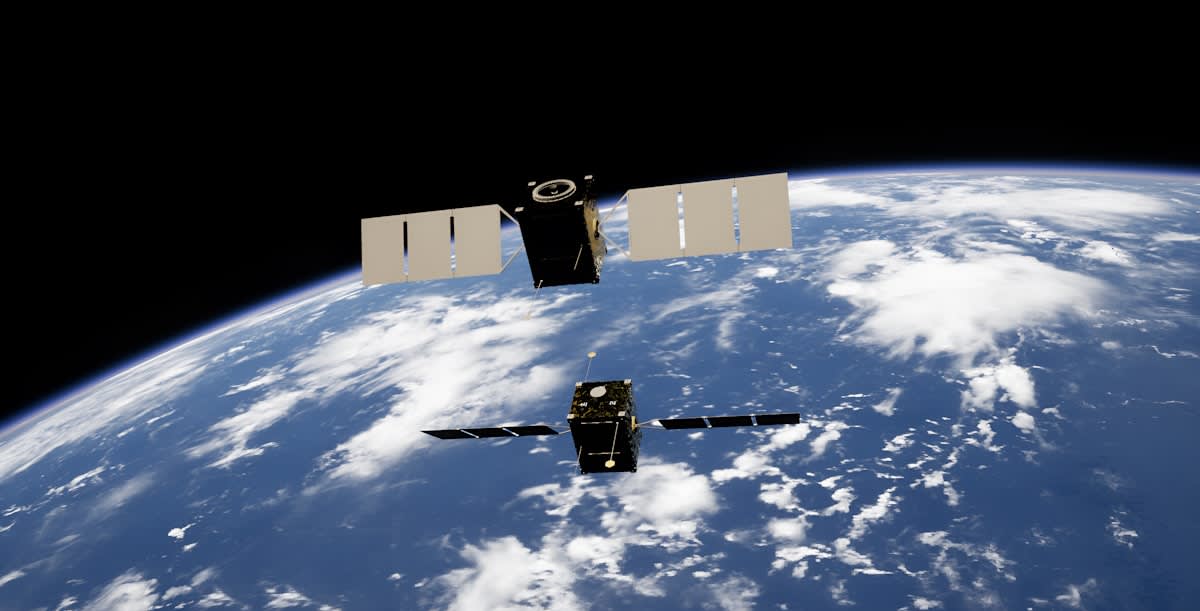
The geopolitical landscape of ADR is complex. If a nation develops the capability to remove a piece of debris, they effectively possess the capability to remove a functioning enemy satellite. This dual-use nature of the technology creates a diplomatic stalemate. Japan's Astroscale and Europe's ClearSpace are leading the charge, but the lack of a global legal framework for 'space salvage' means that removing a piece of debris belonging to another country could be interpreted as an act of aggression.
Despite these tensions, the economic incentive is becoming irresistible. As orbital slots become the most valuable real estate in the solar system, the ability to 'clear a lot' becomes a superpower. We are moving toward a model where orbital sustainability is not a corporate social responsibility goal, but a core competitive advantage.
The New Geopolitical Bottleneck
Orbital slots are finite. Unlike the vastness of deep space, the specific altitudes and inclinations required for global broadband are extremely limited. This has turned the International Telecommunication Union (ITU) into a high-stakes battleground. Nations are now racing to claim 'priority' for specific shells, leading to a form of orbital colonialism. The bottleneck is no longer technical; it is diplomatic.
Projected Satellite Growth vs. Orbital Capacity
Executive Insight
+18.4%
YTD Growth
If we cannot agree on a multilateral system for managing this traffic, we risk a 'tragedy of the commons' on a planetary scale. The resilience of our global connectivity—from financial transactions to emergency response—now hinges on our ability to treat orbit as a shared resource rather than a frontier to be plundered. The invisible wall is closing in, but it also provides an opportunity to build a more disciplined, sustainable, and cooperative framework for the future of humanity's reach into the stars.
Fact-Check & Accuracy Note
Key claims regarding debris counts are sourced from the ESA Space Debris Office (2023). The shift in de-orbiting timelines is based on official FCC regulatory updates (2022). Market projections for the circular space economy reference the World Economic Forum's 2023 analysis. Note: The exact number of 'untracked' small debris remains a subject of ongoing debate among astrophysicists, with estimates varying by several million objects.