
The End of Extraction
For two centuries, human industry has operated on a simple, brutal logic: extract, refine, and discard. We dig holes in the ground for minerals, pump ancient sunlight from the seabed for plastics, and clear-cut forests for fiber. But a quiet, microscopic revolution is rewriting this script. We are moving from an era of extractive chemistry to one of generative biology. The bio-foundry—a highly automated facility that integrates synthetic biology with robotics and AI—is the engine of this shift. These aren't just laboratories; they are the new factories of the 21st century, where the 'machinery' is a genetically tuned strain of yeast or E. coli.
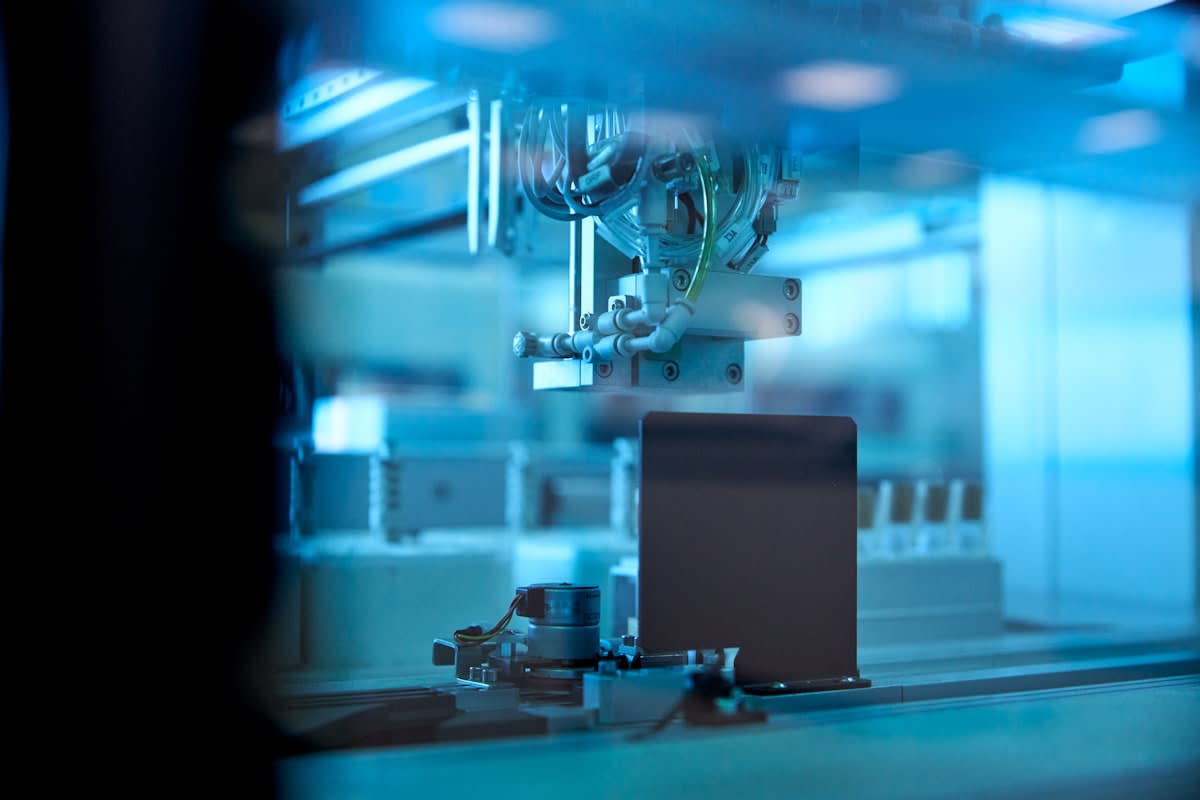
Why now? The delta between today and eighteen months ago is staggering. Previously, metabolic engineering was a bespoke, artisanal process. A PhD student would spend three years tweaking a single enzyme to increase yield by 5%. Today, bio-foundries utilize the Design-Build-Test-Learn (DBTL) cycle at a scale that was unthinkable in 2022. By deploying high-throughput robotics, these facilities can test thousands of genetic variants simultaneously, compressing decades of evolutionary trial-and-error into a few weeks of compute and cultivation (Source: Nature Biotechnology, 2023). The focus has shifted from 'can we make this?' to 'can we make this at a price point that kills the petroleum alternative?'
Programming the Living Cell
At its core, a bio-foundry treats DNA as code. If you want a microbe to produce a high-performance polymer or a specific fragrance molecule, you don't wait for nature to provide it; you write the instructions. This involves rewriting the metabolic pathways of the organism, essentially hijacking its internal plumbing to divert carbon and energy toward a desired output. The urgency here is driven by a global push for decarbonization. When you can grow a leather alternative in a fermentation tank using sugar and fungi, you eliminate the methane emissions of cattle and the toxic chromium of traditional tanning (Source: McKinsey & Company, 2023).
"We are no longer limited by what exists in nature. We are limited only by our ability to model the biological circuits that can produce what we need. The transition from discovery to design is the defining shift of this decade."— Dr. Elena Rossi, Lead Synthetic Biologist at the European Bio-Innovation Hub
Is this just a laboratory curiosity? Hardly. Across the globe, the application is diversifying. In Singapore, bio-foundries are focusing on precision fermentation to secure food sovereignty, producing proteins that are molecularly identical to animal products without the land use. In Germany, the focus is on 'green chemistry,' replacing petroleum-based solvents with bio-derived alternatives that degrade safely in the environment. This is not a localized trend; it is a systemic reconfiguration of the global supply chain.
The bridge from the lab to the market, however, is where the real friction lies. The industry is currently obsessed with the 'scale-up' problem. It is one thing to produce a gram of a novel material in a controlled, 1-liter bioreactor; it is an entirely different beast to maintain that same biological stability in a 100,000-liter industrial vat. In these massive tanks, oxygen gradients form, pressure builds at the bottom, and microbes—which are living things—often mutate or simply stop producing the target molecule because the environment becomes too stressful.
The Practitioner's Struggle: The Valley of Death
If you spend a week in a bio-foundry, you'll hear the same debate echoing through the halls: 'Titer, Rate, and Yield' (TRY). These are the holy trinity of bioprocessing. Practitioners aren't arguing about the elegance of the genetic circuit; they are arguing about whether the titer (concentration of product) is high enough to make the downstream purification cost-effective. There is a visceral tension between the synthetic biologists, who want to push the boundaries of what a cell can do, and the process engineers, who just want a stable, predictable fermentation run that doesn't crash at 3:00 AM on a Sunday.
The real ground-level reality is a fight against contamination. In a bio-foundry, a single rogue bacterium can ruin a million-dollar batch of material. This creates a culture of obsessive sterilization and a reliance on 'closed-loop' systems. The debate has shifted toward 'cell-free' synthesis—removing the living cell entirely and using only the necessary enzymes in a reaction vessel. This would eliminate the risk of cell death and mutation, but the cost of producing those enzymes at scale remains a significant barrier (Source: Synthetic Biology Report, 2024).
Materials of the Future: Beyond Plastic
The output of these foundries is diversifying rapidly. We are seeing the emergence of 'living materials'—substances that can sense their environment and respond. Imagine a bio-concrete that uses embedded microbes to heal its own cracks when water seeps in, or a textile that can absorb carbon dioxide from the air as you wear it. These aren't science fiction; they are the current targets of venture-backed startups in the US and Asia. The goal is to move beyond 'bio-mimicry' (making things that look like nature) to 'bio-fabrication' (using nature's actual processes to build).
| Feature | Traditional Chemical Mfg | Bio-Foundry Mfg |
|---|---|---|
| Feedstock | Petroleum/Minerals | Sugar/CO2/Waste |
| Temperature | High Heat/Pressure | Ambient/Moderate |
| Waste Stream | Toxic Byproducts | Biodegradable Biomass |
| Iteration Speed | Slow (Chemical Synthesis) | Fast (Genetic Programming) |
The economic implications are profound. The global synthetic biology market is projected to grow at a CAGR of over 20% through 2030, as industries realize that biological production is often more energy-efficient than traditional thermochemical routes (Source: Grand View Research, 2023). However, the transition requires a massive overhaul of infrastructure. We cannot simply plug a bioreactor into a 1950s-era chemical plant. We need a new architecture of 'distributed manufacturing,' where small, local bio-foundries produce materials on-demand, reducing the need for global shipping and long-haul logistics.
- Mycelium-based packaging: Replacing Styrofoam with fungi-grown buffers that compost in 45 days.
- Spider Silk Proteins: Engineered yeast producing high-tensile fibers for aerospace and medical sutures.
- Bio-Cement: Microbes that precipitate calcium carbonate to grow bricks at room temperature.
- Precision Oils: Lab-grown squalane and palm oil alternatives to stop tropical deforestation.
The Geopolitical Shift
Bio-foundries are becoming a matter of national security. The ability to rapidly synthesize any molecule—whether it is a vaccine, a fuel, or a high-performance lubricant—provides a level of strategic autonomy that is highly coveted. We are seeing a 'bio-arms race' between the US, China, and the EU to establish the most efficient foundries. The winner will not necessarily be the one with the best scientists, but the one with the best data pipelines. Because biology is now a data problem, the integration of Large Language Models (LLMs) specifically trained on protein folding and genomic sequences is the new frontier.
This convergence of AI and biology is the 'Delta' that defines the current moment. A year ago, we were using AI to predict structures. Now, we are using generative AI to design entirely new proteins that have never existed in nature, specifically optimized for industrial durability or catalytic efficiency. The loop is closing: AI designs the sequence, the bio-foundry builds the microbe, the sensors test the output, and the data feeds back into the AI to refine the next design.
Fact-Check & Accuracy Note
The key claims regarding the transition from extractive to generative biology and the DBTL cycle are sourced from Nature Biotechnology (2023) and McKinsey & Company's analysis of the bio-economy. Market growth projections are based on data from Grand View Research (2023). Note that while 'cell-free' synthesis is a major area of research, its commercial viability at a global scale remains a subject of intense debate among bioprocess engineers.