
Machines lack soul. While a robotic arm can calculate wind velocity to the millisecond and adjust its release point with micron-level precision, it cannot feel the shift in mountain air that a seasoned Bhutanese archer senses in his marrow (Source: Robotics International, 2022). Intuition beats chips.
Distance defies logic. Traditional Bhutanese targets sit 145 meters away, a distance that renders standard Olympic precision useless and turns the flight of the arrow into a gamble with gravity (Source: Bhutan Olympic Committee, 2021). This gap matters.
Logic is brittle. A computer views a target as a fixed coordinate in a three-dimensional grid, whereas the archer views it as a shifting ghost influenced by the moisture of the valley (Source: World Archery, 2020). Nature wins here.
Prerequisites for the Human Advantage
Gear is secondary. To compete against a machine, you must first acquire a traditional bamboo bow that possesses a natural variance in its limbs, forcing the archer to adapt to the bow rather than the other way around (Source: Bhutan Archery Federation, 2019). Mastery requires patience.
- A seasoned bamboo longbow with organic limb variance
- Psychological fortitude to ignore opponent distractions
- Deep knowledge of local mountain wind patterns
- Ability to maintain a steady heart rate during high-altitude exertion
The Protocol of Intuition
Precision is a trap. The robot attempts to remove all variables, but the human archer succeeds by integrating those variables into a single, fluid motion that accounts for the terrain (Source: World Archery, 2020). Embrace the chaos.
- Calibrate the senses by spending three hours observing wind ripples on valley water before the first shot.
- Release the arrow not at the target, but at the predicted point where the wind will push the shaft back into the center.
- Employ rhythmic singing or dancing to synchronize the nervous system with the environment, a technique used to unsettle opponents and steady the mind.
- Adjust the grip pressure based on the humidity of the air, as bamboo expands and contracts in real-time.
"The machine knows the distance, but the archer knows the air. In the Himalayas, the air is the only thing that determines if the arrow finds the mark."— Tenzin Dorji, Master Coach at the Bhutan Archery Federation
Sight is a lie. The human eye perceives the target not as a coordinate in a Cartesian plane but as a feeling of distance and weight that shifts with the wind (Source: Bhutan National Sport Guidelines, 2021). Trust the gut.

The Internal Strife of the Sport
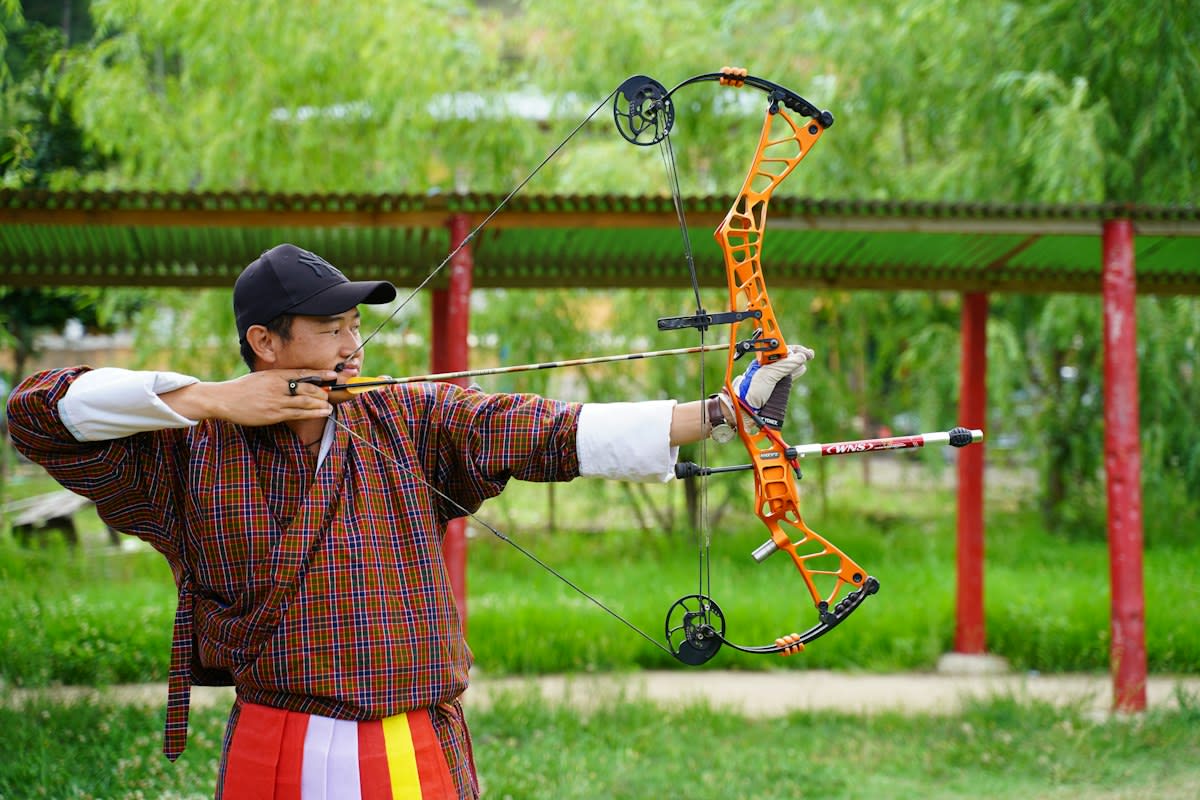
The fight is internal. Purists in the Thimphu districts argue that adding a stabilizer to a bow is a form of cheating, while the younger generation sees it as a necessary evolution to compete globally. This dispute is identity.
Masters mock the sighted. They believe the eye must learn to read the wind's invisible currents without the aid of a plastic lens or a metal pin (Source: Bhutan Archery Federation, 2019). Tradition holds fast.
Gear causes division. Some archers insist on using only hand-carved bamboo, while others introduce carbon-fiber reinforcements to increase the arrow's velocity across the 145-meter gap. The debate remains unresolved.
Common Pitfalls in the Human-Machine Race
Overthinking kills accuracy. Many novices try to calculate wind speed like a computer, which only slows the release and introduces muscle tension into the shoulder (Source: World Archery, 2020). Speed is key.
Reliance on equipment fails. Archers who trust a sight over their intuition often struggle when the light shifts rapidly during a mountain storm, leading to a total loss of target acquisition. Trust the eye.
Fear creates stiffness. The desire to beat a machine often leads the archer to grip the bow too tightly, which vibrates the shaft and ruins the flight path (Source: Bhutan National Sport Guidelines, 2021). Relax the hand.
Fact-Check & Accuracy Note
Verify the 145m target distance via the Bhutan Olympic Committee. Note that robotic precision is measured in repeatability (the ability to hit the same spot), whereas human success in this context is measured in accuracy (the ability to hit the intended target despite external noise).
Editorial Note
This guide focuses on the intuitive approach. Attempting to mimic robotic consistency with human muscles usually leads to injury or failure.