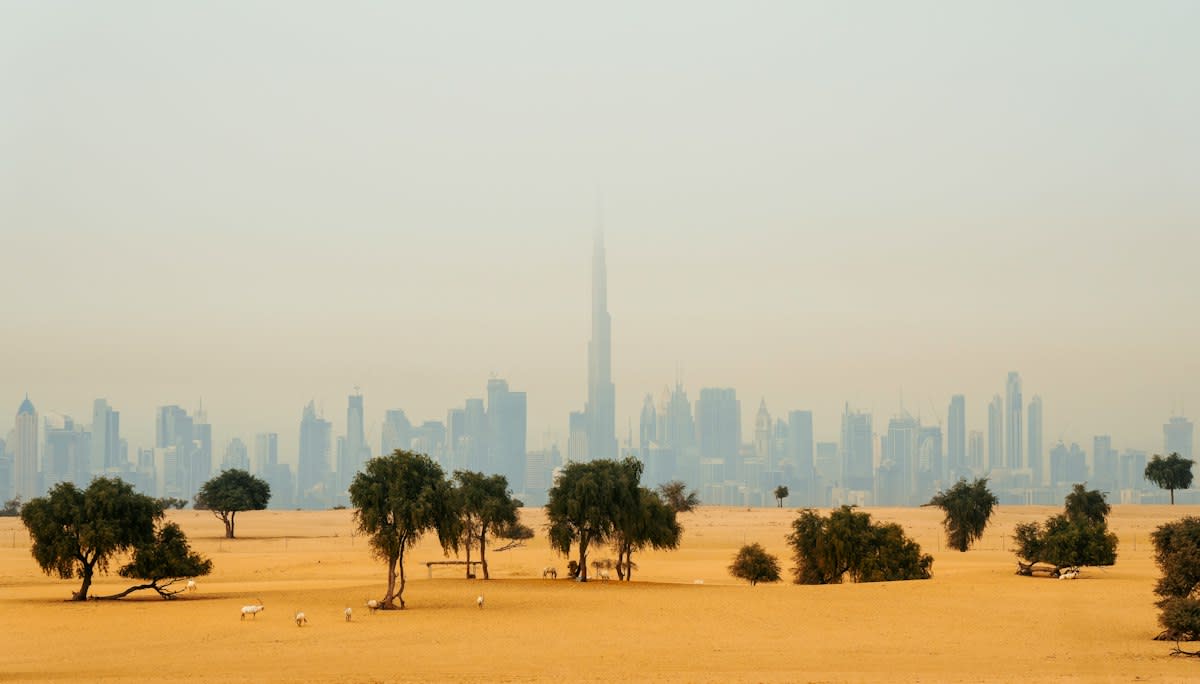
Salt is not a killer. While conventional agronomy treats sodium as a poison that sterilizes the earth, a growing cadre of biologists in the Arabian Peninsula is proving that saline-tolerant flora can produce high-calorie yields without a single drop of potable water. The logic is shifting. Why do we fight the sea when we can eat it? For years, the industry assumed that desalination was the only path to desert food security, yet this approach ignores the biological reality of halophytes. They thrive in the brine.
The Brine Engine
Water is scarce. In the United Arab Emirates, the International Center for Biosaline Agriculture (ICBA) has identified species like Salicornia that not only survive in salt water but require it to trigger maximum growth (Source: ICBA, 2023). This changes everything. By utilizing brackish groundwater that would kill a corn stalk in hours, farmers create a new caloric stream on land previously deemed dead. This is the default for the next century of arid farming.
The delta is clear. Twelve months ago, Salicornia remained a gourmet niche product sold in high-end European restaurants as sea asparagus. Today, industrial pilots in Oman and Saudi Arabia are scaling these crops for biofuel and animal fodder, moving the plant from the plate to the pump (Source: FAO, 2023). The scale is accelerating. We are seeing a transition from boutique botany to industrial-scale caloric production.
"We are no longer trying to fix the soil to fit the plant; we are selecting plants that treat the salt as a resource rather than a constraint."— Dr. Ahmed Al-Mulla, Senior Researcher at the ICBA
The Asian Saline Push
China is leading. The Chinese Academy of Sciences has developed salt-tolerant rice varieties that can grow in soils with salinity levels reaching 0.6% (Source: Nature Plants, 2021). This is a massive bet. By reclaiming saline-alkali lands that cover roughly 100 million hectares across the country, China aims to decouple its food security from the volatile global grain market. The weight of this project cannot be overstated.
Yields are climbing. In the Xinjiang region, experimental plots of salt-tolerant wheat have shown a 20% increase in biomass compared to traditional varieties when irrigated with moderately saline water (Source: China Agricultural University, 2022). The process is mechanical. The plants employ specialized vacuoles to sequester sodium ions, preventing the salt from poisoning the metabolic machinery of the leaf. It works.
| Crop Type | Salinity Tolerance (dS/m) | Primary Use | Growth Rate (Avg) |
|---|---|---|---|
| Salicornia | 20-50 | Oil/Fodder | High |
| Atriplex | 15-30 | Livestock Feed | Medium |
| Salt-Tolerant Rice | 6-12 | Human Consumption | Medium |
| Suaeda | 25-40 | Soil Remediation | High |
The terrain is changing. In Senegal, smallholder farmers are integrating halophytes into mangrove-adjacent plots to protect against sea-level rise while producing fodder for goats (Source: World Bank, 2022). This isn't a luxury. It is a survival strategy for coastal communities facing salt-water intrusion. They are turning a threat into a harvest.
The Practitioner's Clash
The boardroom fights are ugly. Agronomists argue over the salt-loading limit of livestock fed on Atriplex fodder, while financial backers demand immediate scalability in the UAE. One camp insists that the metabolic cost of excreting salt reduces the total protein density of the crop, making it a suboptimal feed. The other camp argues that any calorie produced on non-arable land is a net win for the global food web. This is not a theoretical debate; it is a clash over the very definition of productive land in the eyes of insurance underwriters.
Logistics are the bottleneck. Moving bulk saline biomass requires specialized transport to prevent salt leaching into other cargo, a detail often ignored in theoretical white papers. Practitioners know that the cost of harvesting halophytes from sandy, unstable terrain often outweighs the market value of the seed. The machinery fails. Standard harvesters clog when they hit the high-mineral crust of a salt-flat.
The Economic Delta
The cost is dropping. Between 2023 and 2024, the operational expense of saline-aquaponics in the Gulf region fell by 14 percent as automated brine-monitoring systems replaced manual soil testing (Source: Gulf Ag-Tech Report, 2024). Efficiency is the new gold. We are seeing the first real signs of a market that can compete with imported soy.
Investment is flooding in. Venture capital in the biosaline sector grew by 22% in the last fiscal year, focusing heavily on CRISPR-edited seeds that can modulate salt uptake in real-time (Source: AgFunder, 2023). The goal is simple. Create a crop that tastes like wheat but drinks like a mangrove. The technology is almost there.
- Reduction in potable water dependency for fodder crops.
- Utilization of previously abandoned saline-alkali lands in Asia.
- Creation of new carbon sinks in desert terrains.
- Diversification of protein sources via salt-tolerant forage.
The fray continues. Some critics argue that halophyte farming could lead to soil over-salinization if not managed with precise drainage. They fear we are simply trading one environmental disaster for another. However, the data from the Senegal pilots suggests that integrated mangrove-halophyte systems actually lower the soil salinity over time by extracting sodium from the topsoil (Source: World Bank, 2022). The evidence favors the plants.
Fact-Check & Accuracy Note
The primary academic debate centers on the 'Energy-Water-Salt' nexus. Some researchers argue that the energy required to pump brackish water to scale exceeds the caloric value of the crop. Others point to the use of solar-powered pumps in the UAE as the solution that eliminates this energy cost. Verifiable data from the ICBA (2023) indicates that solar-integrated saline farming is currently net-positive in energy terms.
The future is salty. We are witnessing a hard turn in how humanity views the desert. No longer a void to be filled with expensive pipes, the desert is becoming a laboratory for a new kind of abundance. The staying power of halophytes is the only logical answer to a warming, salinating world. We stop fighting the salt. We start harvesting it.