Market demand, experience in building facility to decide Amara Raja gigafactory expansion: Jayadev Galla
Source Entity
India Latest News: Top National Headlines Today & Breaking News | The Hindu
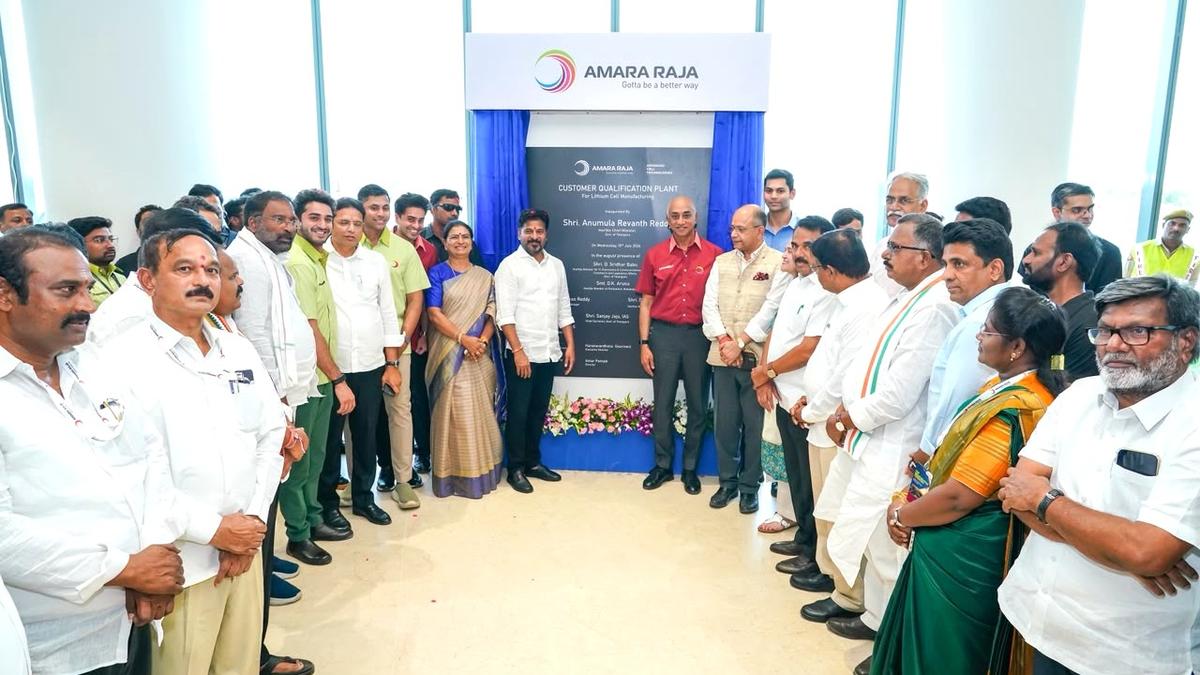
Amara Raja Group is proceeding with its ₹9,500 crore, 16 GWh Gigafactory project in Divitipally, near Hyderabad. Jayadev Galla stated that any further expansion will be strategically decided based on actual market demand and the company's operational experience in building the initial facility.
Strategic Scaling: Analyzing Amara Raja's Gigafactory Ambitions
Amara Raja Group has reaffirmed its commitment to a massive ₹9,500 crore investment for a 16 GWh Gigafactory located in Divitipally, near Hyderabad. This project represents a pivotal shift for the company, transitioning from its traditional stronghold in lead-acid batteries toward the high-growth sector of advanced energy storage systems. The scale of this investment underscores the group's intent to become a cornerstone of India's energy transition, positioning itself as a primary supplier for the burgeoning electric vehicle (EV) and renewable energy storage markets.
The Significance of the 16 GWh Capacity
The decision to establish a 16 GWh capacity is not merely a capital expenditure but a strategic play for scale. In the battery industry, 'gigawatt-hours' (GWh) serve as the primary metric for production capability, determining how many battery packs can be produced to power everything from two-wheelers to heavy commercial vehicles. By targeting this capacity, Amara Raja is aiming to achieve economies of scale that can drive down the cost per kilowatt-hour (kWh), making EVs more affordable for the Indian consumer. The choice of Divitipally, near the industrial hub of Hyderabad, provides the company with critical access to logistics, a skilled workforce, and a supportive regional ecosystem for technology and manufacturing.
Prudent Expansion: Market Demand and Execution Risk
Jayadev Galla's emphasis on making expansion decisions based on 'market demand' and 'experience in building the facility' reveals a calculated approach to risk management. The global battery market is characterized by extreme volatility in raw material prices (such as lithium, cobalt, and nickel) and rapid shifts in chemistry (from NCM to LFP and beyond). By tying expansion to demand, Amara Raja avoids the trap of overcapacity, which has plagued many first-generation battery plants globally. Furthermore, the mention of 'experience' suggests a focus on operational excellence; building a gigafactory is an engineering feat involving complex chemical processes and stringent safety standards. Mastering the first phase is essential before attempting to scale further.
Transitioning the Energy Portfolio
This move signals a broader strategic pivot for the Amara Raja Group. Historically known for lead-acid batteries, the company is now diversifying its portfolio to include lithium-ion and other advanced chemistries. This transition is critical because the global automotive industry is moving decisively away from internal combustion engines. By investing in a Gigafactory, Amara Raja is not just adding a product line but is fundamentally redesigning its business model to align with the 'Green Energy' paradigm. This diversification protects the company against the eventual decline of traditional battery markets and opens new revenue streams in grid-scale energy storage.
Broader Implications for India's EV Ecosystem
The Divitipally project aligns closely with the Indian government's vision of 'Atmanirbhar Bharat' (Self-Reliant India) and the Production Linked Incentive (PLI) schemes for Advanced Chemistry Cell (ACC) battery storage. By localizing the production of cells—the most expensive component of an EV battery—Amara Raja helps reduce India's dependence on imports, particularly from China. This localization is expected to create a ripple effect, encouraging domestic EV manufacturers to design vehicles around locally available battery specifications, thereby accelerating the overall adoption of electric mobility across the subcontinent.
Conclusion: A Balanced Path to Leadership
In summary, Amara Raja Group's approach to its Gigafactory is a blend of aggressive investment and operational caution. While the ₹9,500 crore commitment demonstrates a bold bet on the future of energy, the insistence on demand-led expansion proves a sophisticated understanding of market dynamics. If executed successfully, the Divitipally plant will not only transform Amara Raja into a technology leader but will also serve as a critical infrastructure asset for India's journey toward net-zero emissions.
Verification Required?