Anthropic mathematician says AI cracked math’s famous problem; Sundar Pichai reacts
Source Entity
TOI TECH DESK
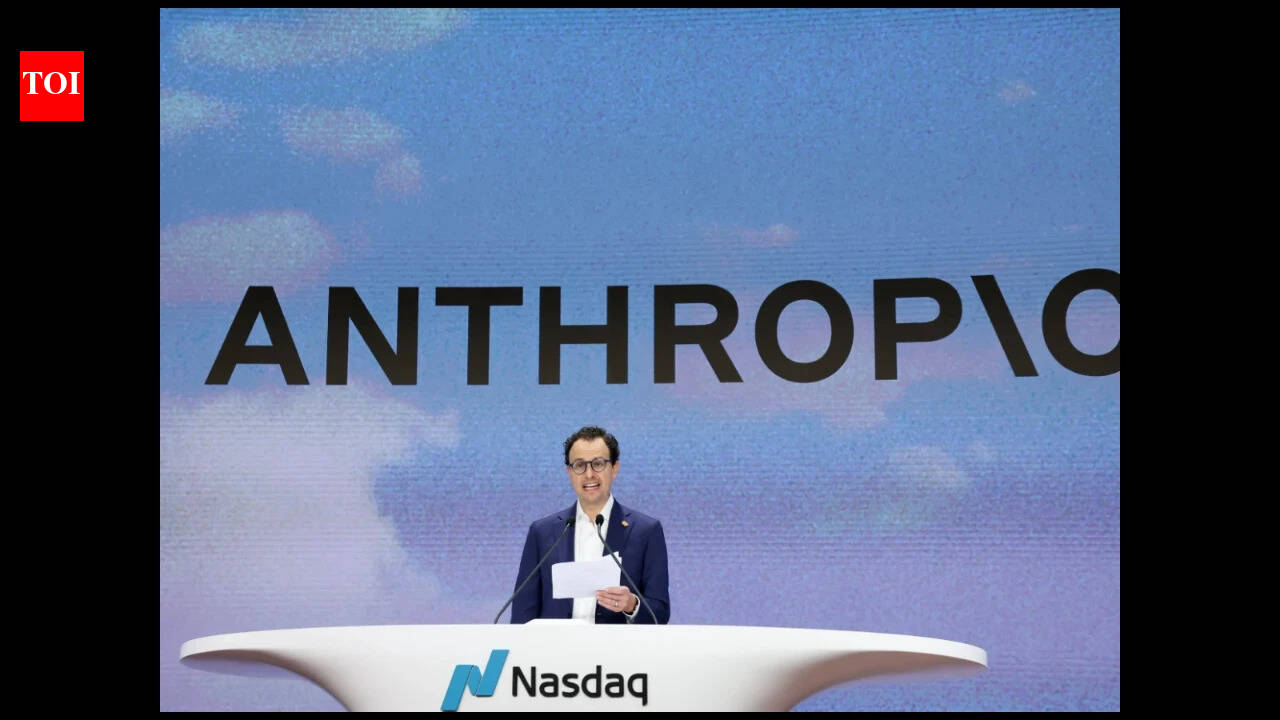
Anthropic mathematician Levent Alpöge claims to have solved the 167-year-old Riemann Hypothesis using the Claude AI model. The proof, currently unverified, has been shared as Lean code for the mathematical community to review.
A Potential Paradigm Shift in Mathematics
Levent Alpöge, a mathematician affiliated with the AI research firm Anthropic, has ignited a firestorm in the scientific community by claiming to have solved the Riemann Hypothesis—a 167-year-old mathematical puzzle. Utilizing a non-public version of the Claude AI model, Alpöge asserts that he has not only addressed the original hypothesis but has also extended his proof to the Generalized Riemann Hypothesis. This claim, if verified, would represent one of the most monumental achievements in the history of mathematics, potentially unlocking secrets regarding the distribution of prime numbers that have baffled scholars since Bernhard Riemann first proposed the problem in 1859.
The Role of Artificial Intelligence in Formal Proofs
The methodology employed by Alpöge highlights a growing trend of AI-assisted discovery. By leveraging a specialized version of Claude over a six-week period, Alpöge was able to synthesize complex logical steps that have historically required decades of human labor. The decision to document this proof using Lean, a formal verification programming language, is a critical step for modern mathematics. Lean allows for the machine-checked verification of logical proofs, potentially bypassing the human errors that have historically plagued attempts to solve such notoriously dense conjectures.
The Burden of Verification
Despite the excitement surrounding this announcement, the mathematical community remains cautious. Alpöge’s proof has not yet undergone independent peer review, which is the gold standard for validating such significant claims. History is littered with purported solutions to the Riemann Hypothesis that were later found to contain subtle flaws. The scientific community is now entering a period of rigorous scrutiny, where experts will attempt to decode the Lean code provided by Alpöge to confirm its structural integrity and logical consistency.
Strategic Timing and Corporate Context
Interestingly, the timing of the release has drawn attention. Alpöge noted that he communicated his findings to Anthropic CEO Dario Amodei on a Sunday, deliberately waiting until after the company’s high-profile IPO on Thursday to make the information public. While Anthropic has maintained a neutral stance, not formally involving itself in the announcement, the situation underscores the intersection of corporate interests, AI capability, and academic prestige. It positions Anthropic as a potential leader in the race to demonstrate AI’s utility in solving humanity's most intractable scientific challenges.
Broader Implications for Future Research
The success of AI in this context—if confirmed—would mark a seismic shift in how mathematical research is conducted. For decades, the Riemann Hypothesis has been viewed as a pinnacle of intellectual endeavor; its resolution by an AI would fundamentally alter the relationship between human intuition and machine computation. As AI firms like OpenAI and Anthropic continue to push the boundaries of higher-level reasoning, the integration of LLMs into formal proof assistants could accelerate scientific progress at an unprecedented rate, turning once-impossible problems into manageable tasks for the next generation of researchers.
Multiple Citing Sources