Bank unions announce strikes on Sept 11 over unresolved issues
Source Entity
India Latest News: Top National Headlines Today & Breaking News | The Hindu
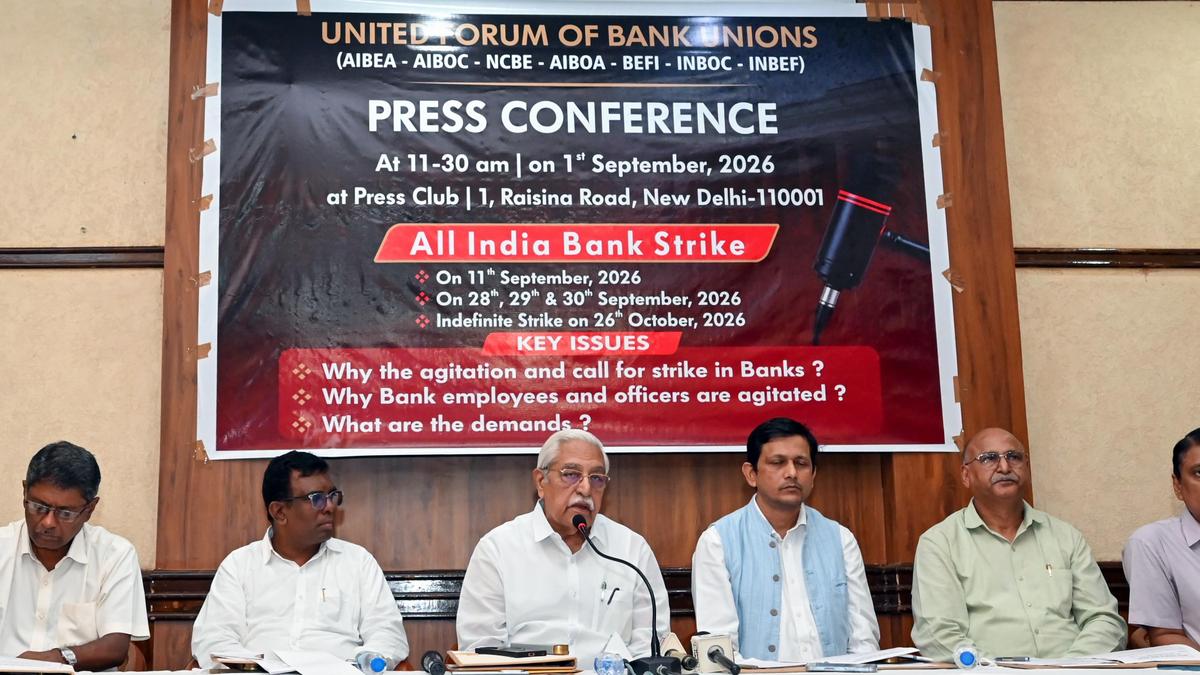
The United Forum of Bank Unions (UFBU) has announced a series of strikes beginning September 11 to demand a five-day work week and revisions to the Performance Linked Incentive (PLI) scheme. The industrial action may escalate to an indefinite strike by late October if negotiations remain unresolved.
Banking Sector Unrest: Understanding the Impending Strikes
The Core Conflict: Wage Settlements and Work-Life Balance
The United Forum of Bank Unions (UFBU), a massive coalition representing over 90% of the banking workforce, has declared a series of strikes in response to stalled negotiations regarding the five-day work week. This demand is not new; it stems from an agreement in principle dating back to 2015, which saw the second and fourth Saturdays declared as holidays. While the issue was revisited in 2020 and subsequently formalized during the wage settlement signed on March 8, 2024, the failure to fully implement the transition has led to significant frustration among bank employees.
Escalation Timeline and Union Demands
The union strategy involves a phased approach to pressure the government and banking authorities. Starting with a one-day strike on September 11, the movement will intensify with a three-day strike from September 28 to 30. Most critically, the UFBU has signaled an indefinite strike starting October 26, 2026, if their four key demands—centered primarily on the five-day week and the revised Performance Linked Incentive (PLI) scheme—remain unaddressed. This escalation reflects a lack of confidence in the current negotiation trajectory.
The Economic Implications of Industrial Action
With the UFBU encompassing seven major unions including AIBEA, AIBOC, and NCBE, the strike threat covers a broad spectrum of the financial sector, including public sector, private, foreign, regional rural, and cooperative banks. An indefinite strike in such a vital sector would create substantial disruptions to retail banking, corporate transactions, and clearing services. The reliance of the modern economy on digital and physical banking infrastructure means that even short-term stoppages can cause significant bottlenecks in liquidity and consumer services.
Historical Context and Institutional Hurdles
The tension between bank employees and management regarding the five-day work week is deeply rooted in the evolution of modern banking. While the 2024 wage settlement was intended to resolve long-standing disputes, the ambiguity surrounding the implementation of the five-day week has clearly persisted. The inclusion of the PLI scheme as a point of contention suggests that employees are not only concerned with hours of work but also with the transparency and fairness of performance-based compensation models in a changing banking landscape.
Looking Ahead: Potential for Resolution
As the September 11 deadline approaches, the pressure on the government to resume dialogue is mounting. The breadth of the UFBU, which speaks for the vast majority of the banking workforce, makes this a formidable collective bargaining force. Future trends in this sector will likely depend on whether the government can provide a concrete timeline for the five-day work week, as this remains the central pillar of the union's grievances. Failure to reach a compromise will not only impact banking operations but could also signal a broader shift in labor-management relations within India's financial services industry.
Verification Required?