Call Center Jobs Are Declining, but 14,000 Calls Show Humans Still Outperform AI
Source Entity
Hacker News
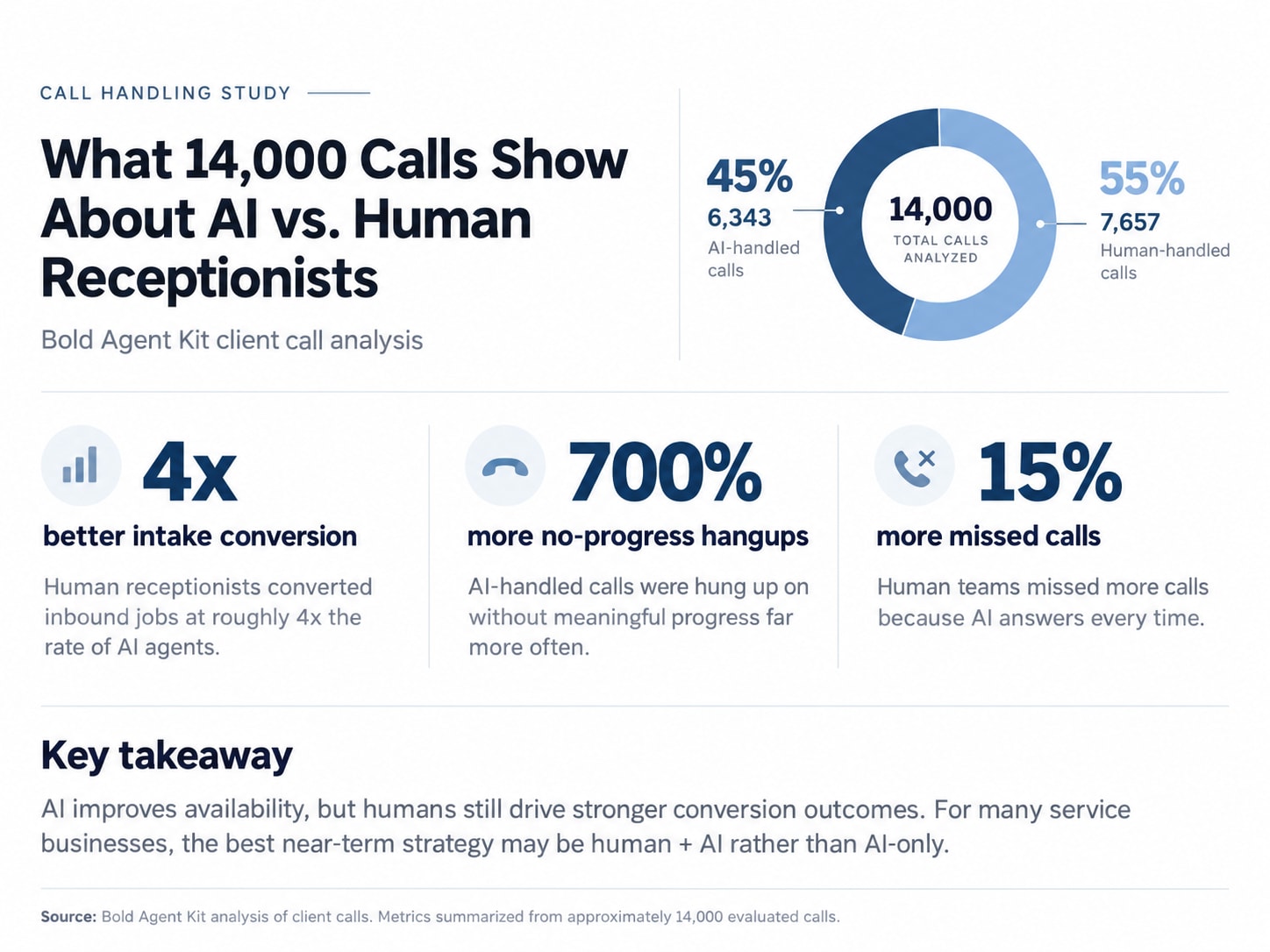
New research indicates a decline in global call-center employment as companies adopt AI, yet human agents continue to outperform automated systems in conversion rates. Data suggests that while AI manages higher call volumes, human receptionists remain four times more effective at inbound intake.
The Shifting Landscape of Customer Service
Recent data from the Bold Agent Kit has brought a critical tension in the modern workforce to the forefront: the struggle between operational efficiency through artificial intelligence and the nuanced effectiveness of human interaction. As corporations scramble to integrate AI receptionists and automated voice agents to reduce labor costs and extend operational hours, the industry is witnessing a fundamental transformation in how customer intake is managed.
The AI Adoption Paradox
The primary driver for this technological shift is economic. By deploying automated systems, companies can scale their call handling capabilities without the linear growth of personnel costs. However, the Bold Agent Kit research reveals a stark performance gap. Despite AI agents managing a higher volume of calls, human receptionists are achieving conversion rates approximately four times higher than their digital counterparts. This suggests that while AI is adept at volume and availability, it currently lacks the persuasive capability and contextual understanding required to turn inquiries into successful intakes.
Analyzing the Employment Decline
The broader implications for the workforce are becoming increasingly visible. An October 9, 2026, report from Andreessen Horowitz (a16z), utilizing data from Revelio, confirms that the decade-long trend of consistent expansion in call-center employment has officially reversed. This negative growth trajectory marks a significant pivot point in the service sector, where automation is no longer just a supplemental tool but a direct replacement for human roles.
Historical Context and Future Trends
For over ten years, the global call-center industry was a reliable engine for job creation, often serving as a gateway for entry-level workers. The current shift toward AI-driven customer service suggests that this era of labor-intensive growth is likely over. As companies prioritize the bottom-line benefits of reduced headcount, the focus will likely shift from mass-hiring to a 'human-in-the-loop' model, where human agents are reserved for complex, high-value interactions that AI cannot yet master.
The Strategic Value of Human Connection
Ultimately, the data suggests that the value of human connection in commerce remains high. While businesses may continue to automate routine tasks to manage costs, the four-fold performance disparity in conversion rates indicates that human receptionists provide a competitive advantage that AI cannot currently replicate. Companies that automate too aggressively risk losing revenue, as the 'human touch' remains a superior engine for intake performance.
Conclusion
The decline in call-center employment is a clear indicator that the labor market is undergoing a structural change due to AI. However, the superior conversion performance of humans suggests that total automation may be counterproductive for businesses focused on revenue generation. Moving forward, the most successful firms will likely be those that balance cost-saving AI with the high-conversion potential of human personnel.