20-day salary cut for ‘misconduct’, Delhi court staffer cites 10,000-case workload
Source Entity
Nirbhay Thakur
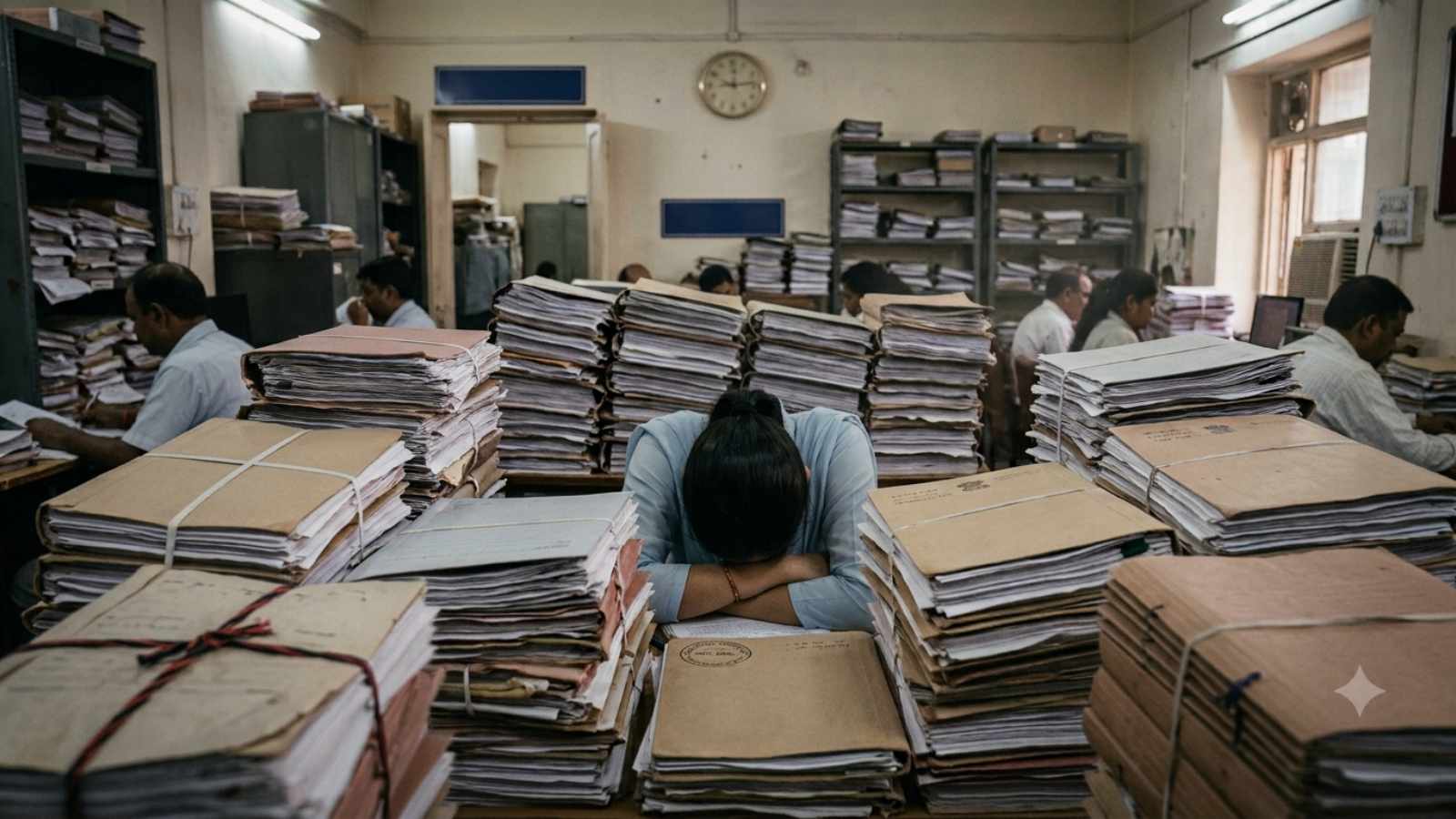
A Delhi court staffer is challenging a 20-day salary deduction penalty imposed by a Judicial Magistrate. The dispute highlights concerns over extreme workload burdens, as the employee was tasked with managing 10,000 cases.
The Burden of Justice: Examining the Rohini Court Staff Penalty
The Administrative Crisis at Rohini Courts
In a recent development at Delhi’s Rohini Courts, a 23-year-old Assistant Ahlmad named Kalpana has contested a disciplinary order that mandated a 20-day salary deduction. The penalty, issued by Judicial Magistrate First Class Reetika Jain on September 25, cited multiple instances of alleged misconduct, including the issuance of incorrect summons, erroneous non-bailable warrants, and the fabrication of court reports. This incident brings to light the grueling conditions faced by lower-level judicial staff within India’s overburdened legal architecture.
The Weight of 10,000 Cases
At the heart of the dispute is the systemic issue of overwork. Reports indicate that Kalpana was assigned to fulfill the duties of the Reader in addition to her own responsibilities. Consequently, the entire administrative workload for 10,000 active cases fell upon the shoulders of just two Assistant Ahlmads. This level of case management is staggering for a single court, suggesting that the errors identified by the Magistrate may be symptomatic of a deeper resource crisis rather than individual negligence.
Legal Recourse and Representation
Recognizing the severity of the penalty and the potential implications for her career, Kalpana has chosen to challenge the judicial order. Notably, she is being represented by Advocate Manmohan Sharma, a former Principal Judge. The involvement of a retired judge in this capacity underscores the gravity of the dispute and suggests that there are significant questions regarding whether the disciplinary action accounted for the impossible operational environment under which the staffer was working.
Systemic Pressures on Judicial Infrastructure
This case serves as a microcosm of the broader challenges plaguing the Indian judiciary. The Rohini Courts, like many district courts across the country, struggle with a massive backlog of litigation. When staff members are forced to manage thousands of files without adequate support or personnel, the likelihood of clerical errors—such as incorrect warrants or faulty reports—increases exponentially. The tension between maintaining judicial discipline and acknowledging the reality of administrative burnout is a critical conversation for legal reform.
The Path Forward
As the challenge to the salary deduction proceeds, the outcome will likely hinge on whether the court considers the workload as a mitigating factor for the alleged lapses. If the defense can prove that the errors were a direct byproduct of systemic overextension, it may force a re-evaluation of how disciplinary actions are applied to administrative staff. Ultimately, ensuring the efficiency of the judicial system requires not just accountability, but also the provision of adequate human resources to manage the staggering caseloads currently burdening the lower courts.