Congress asks the Supreme Court to take suo motu notice against Gyanesh over Form 6 changes
Source Entity
India Latest News: Top National Headlines Today & Breaking News | The Hindu
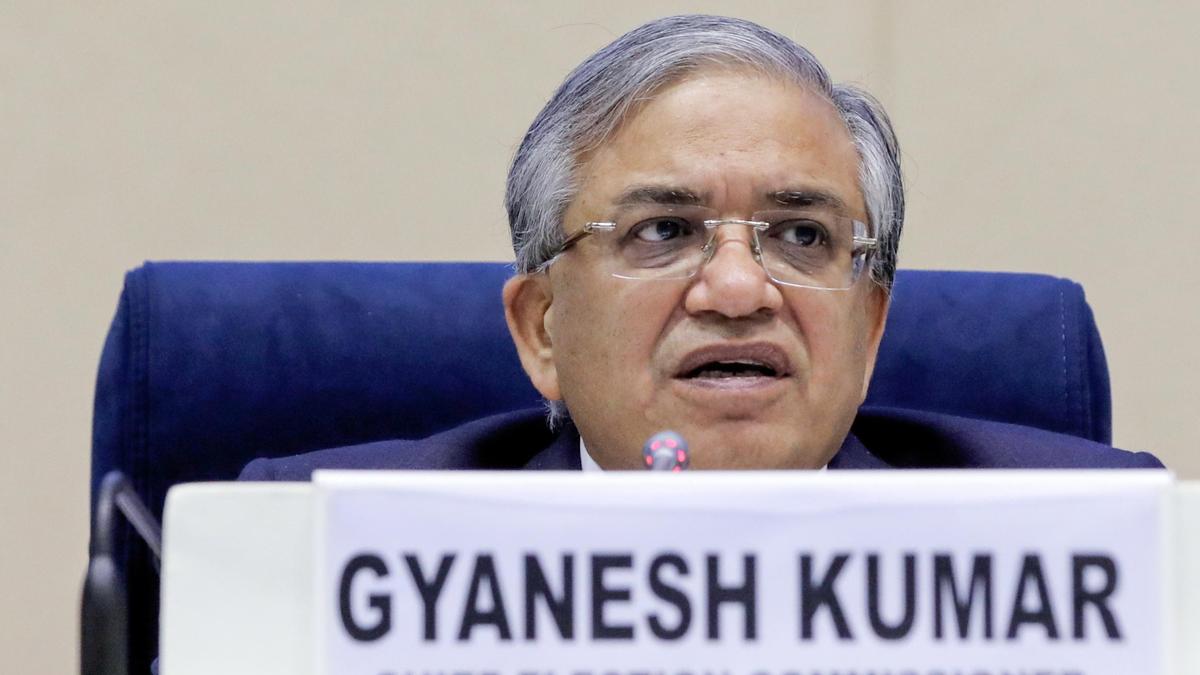
Union Minister Chirag Paswan has urged the Election Commission to address public doubts regarding its neutrality following the postponement of an event involving Commissioner Gyanesh Kumar. The poll body attributed the change to routine logistical adjustments, while Paswan emphasized that the onus of maintaining institutional credibility rests solely with the Commission.
Institutional Credibility Under Scrutiny: The Election Commission's Balancing Act
Recent developments concerning the Election Commission of India (ECI) have thrust the constitutional body into the center of a public discourse regarding transparency and administrative autonomy. The postponement of an event scheduled to feature Election Commissioner Gyanesh Kumar in Uttar Pradesh has sparked a series of reactions, prompting the poll body to characterize such rescheduling as a routine occurrence necessitated by logistical and administrative requirements. This episode, while ostensibly a matter of calendar management, has become a focal point for broader discussions on the necessity of maintaining the integrity of independent institutions in a hyper-polarized political climate.
The Minister's Call for Proactive Transparency
Union Cabinet Minister Chirag Paswan has taken a definitive stance, publicly urging Chief Election Commissioner Gyanesh Kumar to address the growing chorus of doubts surrounding the Commission's recent operations. Paswan’s commentary highlights a nuanced position: while he dismisses the motives of the political Opposition in raising these issues, he simultaneously asserts that the ECI cannot rely on external political actors to defend its reputation. By stating that the Commission must maintain the trust of the people, Paswan underscores the reality that in a democracy, the appearance of impartiality is as critical as the reality of it.
The Burden of Defense in a Constitutional Framework
Central to this analysis is the concept of the Election Commission as an independent constitutional body. Paswan explicitly noted that political parties, including his own, lack the right and the internal access to defend the ECI’s internal decision-making processes. This creates a unique vacuum where, if the Commission remains silent in the face of public or political questioning, the resulting silence is often interpreted as a lack of transparency. The onus, therefore, lies squarely on the Chief Election Commissioner to provide clarity and dispel suspicion regarding the internal workings of the body.
Logistical Realities vs. Public Perception
From an administrative perspective, the ECI manages an immense array of events, data, and logistical hurdles, especially in a state as large as Uttar Pradesh. The poll body’s assertion that event adjustments are a standard part of their operational mandate is technically accurate within the scope of bureaucratic management. However, in the current political environment, administrative shifts are rarely viewed through a neutral lens. The challenge for the ECI lies in bridging the gap between its standard operational procedures and the heightened expectations of a public that is increasingly sensitive to any deviations from established schedules.
Future Trends and the Necessity of Trust
Looking forward, the ECI faces a significant challenge in preserving its institutional stature. As Paswan noted, the goal must be to ensure that not even an iota of suspicion remains regarding the commission's functions. Future trends suggest that the ECI will likely need to adopt more robust communication strategies to explain its logistical decisions proactively, rather than reacting to criticism after the fact. If the Commission fails to address these concerns, the risk is not merely a localized event postponement, but a long-term erosion of the public trust that serves as the bedrock of the entire electoral system.
Conclusion
In summary, the recent friction surrounding the Election Commission is a testament to the high stakes of Indian electoral administration. While the poll body maintains that its scheduling changes are purely logistical, the political response from figures like Chirag Paswan highlights a critical need for the Commission to take ownership of its public narrative. To maintain its constitutional authority and the faith of the electorate, the ECI must navigate the fine line between administrative necessity and the imperative of total transparency.
Multiple Citing Sources
Verification Required?