One in ten people are older than 65. Three in four live under a leader who is
Source Entity
Hacker News
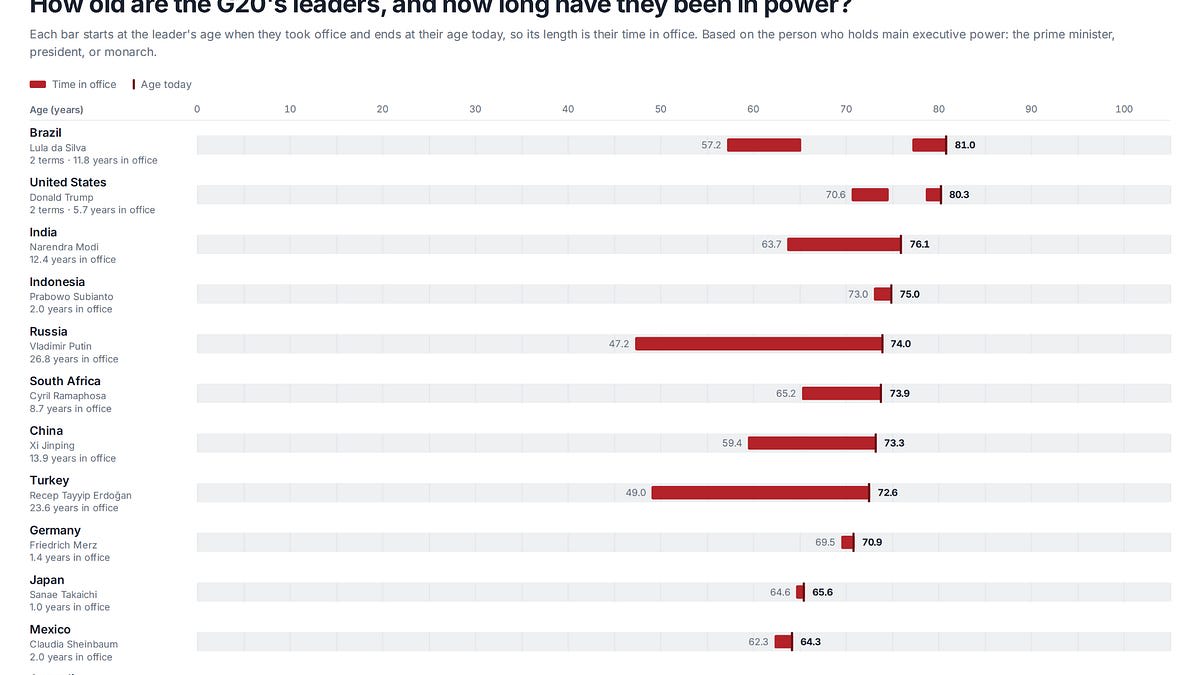
A significant majority of the global population is currently governed by leaders who are over the age of 65. This demographic mismatch highlights a growing gap between aging political establishments and youthful national populations.
The Growing Divide: Global Leadership and the Aging Crisis
Recent data analysis reveals a striking demographic disconnect in modern governance: while only one in ten people globally are over the age of 65, three in four people live under the leadership of someone in that same age bracket. This phenomenon suggests that the world’s executive power—be it held by presidents, prime ministers, or monarchs—is increasingly concentrated in the hands of individuals who have long since passed the traditional retirement age.
The Extreme Case of Cameroon
The most poignant example of this disparity is found in Cameroon, where President Paul Biya, at 93 years old, oversees a nation with a median age of just 18. This 75-year age gap is not merely a statistical anomaly; it serves as a stark illustration of the potential misalignment between those who hold executive authority and the lived realities of the young populations they represent. When a leader’s formative years are separated from their citizens by three-quarters of a century, the capacity for shared cultural and social experience is fundamentally challenged.
Patterns of Global Gerontocracy
Beyond individual cases like Biya, the trend is systemic. Data covering over 140 countries indicates that two in three individuals worldwide are governed by a leader older than 70. This pattern of gerontocracy—the rule of the elderly—suggests that political systems globally are favoring experience and entrenched power structures over the representation of younger demographics. This concentration of power at the top of the age spectrum raises critical questions about political mobility and the inclusion of younger voices in high-level decision-making processes.
Implications for Policy and Innovation
When executive power is consistently held by those who are past the age of standard retirement, the policy priorities of a nation may drift away from the needs of its most productive and future-oriented cohorts. Issues such as long-term climate change mitigation, digital transformation, and modern economic adaptation may be viewed through a lens that prioritizes stability and legacy over rapid, necessary evolution. If the leadership is significantly older than the median age of the citizenry, there is a risk that the political agenda will fail to address the long-term challenges that the youth will eventually inherit.
Future Trends and Political Sustainability
The persistence of this aging leadership trend suggests that political institutions are currently designed to favor incumbency and long-standing political networks. As the global population continues to evolve, the continued reliance on septuagenarian and nonagenarian leadership may lead to increased social friction. If younger generations feel that the political machinery is effectively barred to them by a perpetual gerontocracy, it may lead to decreased political engagement or, conversely, a surge in grassroots movements demanding a shift toward more representative age demographics in executive roles.