Guide to data tools landscape for developers
Source Entity
Hacker News
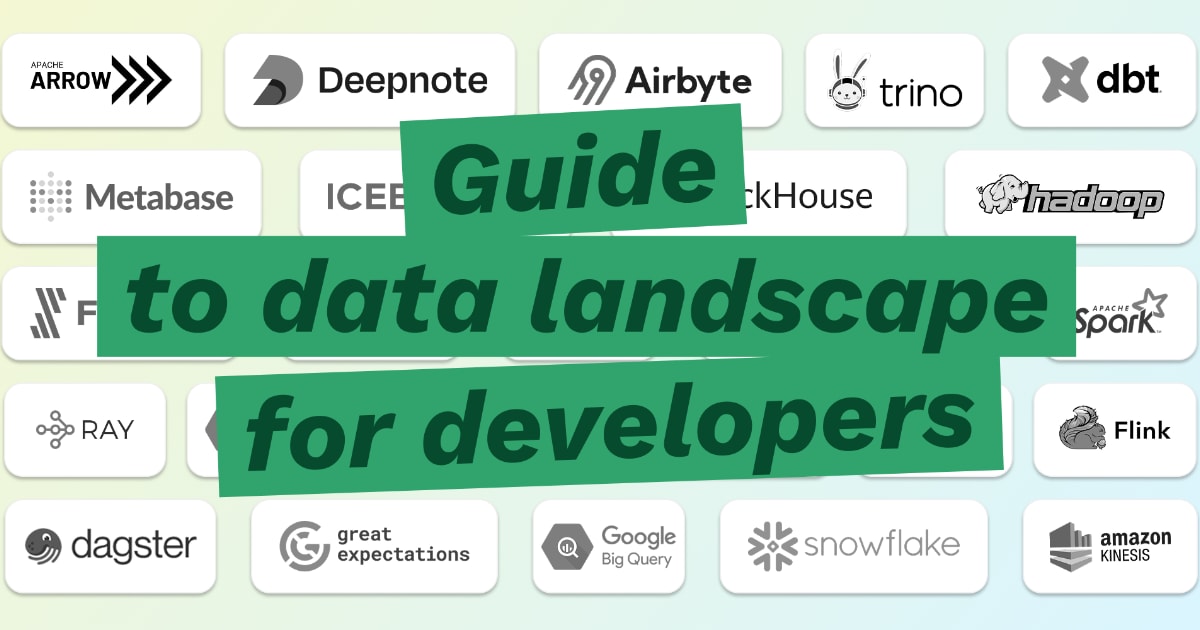
An analysis of the evolving data tools landscape for developers, focusing on the complexity of the modern data stack and the necessity of curated guides to navigate tool sprawl in the era of AI and big data.
Navigating the Complexity of the Modern Data Ecosystem
The emergence of a comprehensive "Guide to data tools landscape for developers" highlights a critical pain point in contemporary software engineering: tool sprawl. As the volume of data generated by applications grows exponentially, the ecosystem of tools designed to store, process, and analyze that data has fragmented into a dizzying array of specialized services. For the modern developer, the challenge is no longer just about writing efficient code, but about architecting a pipeline that integrates disparate tools—from vector databases for AI to stream processing engines for real-time analytics—without creating an unmanageable operational burden.
The Evolution of the Modern Data Stack (MDS)
Historically, developers relied on a few monolithic database systems (primarily relational SQL databases) to handle the bulk of their data needs. However, the shift toward microservices and the rise of "Big Data" necessitated a move toward the Modern Data Stack. This transition introduced the concept of "best-of-breed" tooling, where developers select the most efficient tool for a specific task—such as Snowflake for warehousing, dbt for transformation, and Apache Kafka for event streaming. While this allows for extreme optimization, it increases the cognitive load on developers who must now manage multiple APIs, authentication schemes, and data consistency models across different platforms.
The Impact of AI and Vector Databases
One of the most significant shifts in the current data landscape, and a likely focal point for any modern developer guide, is the integration of Large Language Models (LLMs). The rise of generative AI has catapulted vector databases (like Pinecone, Milvus, or Weaviate) from niche academic tools to essential components of the developer's toolkit. These tools enable "Retrieval-Augmented Generation" (RAG), allowing developers to provide LLMs with specific, private context. The inclusion of these tools in the general data landscape signals a fundamental change in how developers perceive data: it is no longer just about structured rows and columns, but about high-dimensional embeddings and semantic search.
The Role of Community Curation and Peer Review
The fact that this guide is being discussed on platforms like Hacker News underscores the importance of community-driven validation. In an industry where marketing hype often outweighs technical utility, developers rely on peer reviews to separate "vaporware" from production-ready tools. A landscape guide serves as a map, but the community discussion provides the "terrain report," warning developers about scaling issues, pricing traps, or poor documentation. This symbiotic relationship between curated lists and community critique is essential for maintaining stability in the rapidly evolving DevOps and DataOps pipelines.
Future Trends: Convergence and Simplification
Looking forward, the trend is likely to swing back toward convergence. After a decade of extreme fragmentation, we are seeing the rise of "unified platforms" that attempt to merge several stages of the data lifecycle. For example, many traditional databases are adding vector capabilities, and data warehouses are incorporating streaming features. Developers will likely move away from managing twenty different niche tools toward a smaller set of versatile platforms that offer "good enough" performance across multiple categories, reducing the complexity of the overall architecture.
Conclusion
Ultimately, a guide to the data tools landscape is more than just a list of software; it is a strategic necessity for developers operating in a high-velocity environment. By understanding the trade-offs between different storage and processing paradigms, developers can build systems that are scalable, maintainable, and future-proof. As AI continues to reshape the data requirements of modern applications, the ability to navigate this landscape will remain a core competency for any high-level software architect.