High-Bandwidth Flash offers efficient storage for model weights
Source Entity
Hacker News
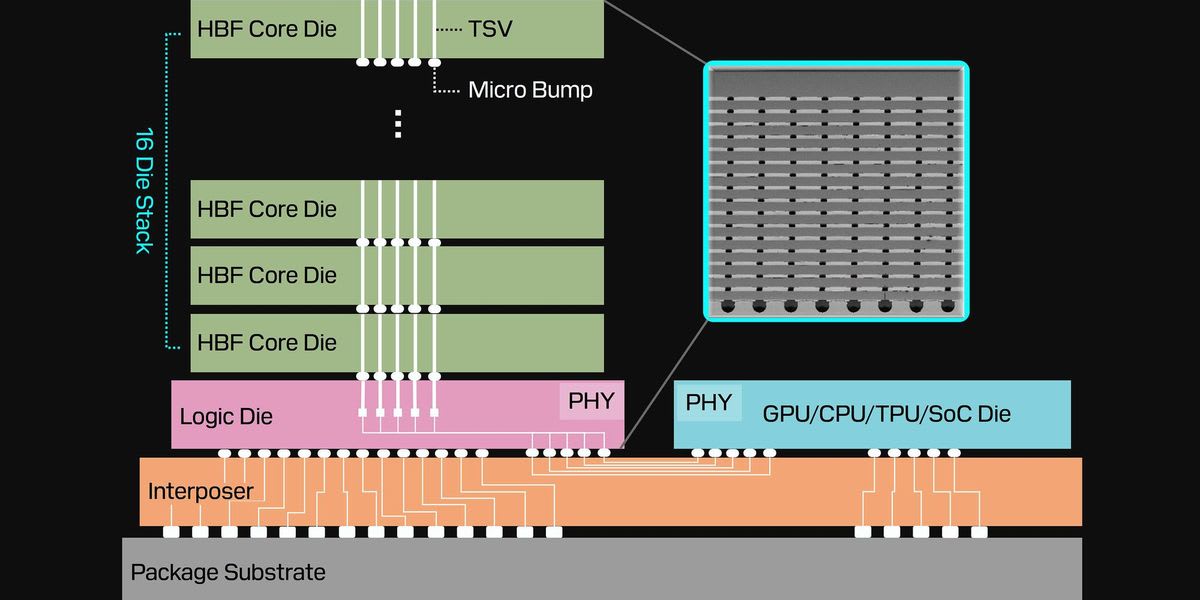
The emergence of high-bandwidth flash storage addresses a critical bottleneck in AI infrastructure by optimizing how massive model weights are stored and retrieved, reducing reliance on expensive HBM and enabling more efficient model scaling.
Overcoming the AI Memory Wall: The Role of High-Bandwidth Flash
The rapid evolution of Large Language Models (LLMs) has led to a critical infrastructure crisis known as the "memory wall." As model architectures scale to hundreds of billions or even trillions of parameters, the sheer volume of model weights exceeds the capacity of available High Bandwidth Memory (HBM) on modern GPUs. This creates a systemic bottleneck where the processor spends more time waiting for data to be fetched from storage than it does performing actual computations. The introduction of High-Bandwidth Flash is a strategic response to this challenge, aiming to optimize the efficiency of weight storage and retrieval.
The Technical Gap: HBM vs. NAND Flash
To understand the significance of high-bandwidth flash, one must analyze the existing storage hierarchy. Currently, AI weights are stored in NAND flash (SSDs) and loaded into HBM for active processing. While HBM offers the extreme speeds necessary for tensor operations, it is prohibitively expensive and physically limited in capacity. Standard NAND flash, while offering vast capacity, operates at speeds orders of magnitude slower than HBM. High-bandwidth flash serves as a critical intermediary, narrowing the latency gap and allowing model weights to be streamed into the compute units with significantly higher throughput, thereby effectively expanding the "working set" of the model without requiring an impossible amount of HBM.
Economic and Operational Implications
Beyond raw performance, the shift toward high-bandwidth flash has profound economic implications for the AI industry. The current reliance on massive GPU clusters with maximum HBM configurations has driven hardware costs to astronomical levels. By enabling more efficient storage of model weights, this technology allows for the deployment of larger models on hardware with lower HBM specifications. This reduction in hardware requirements lowers the barrier to entry for smaller research labs and enterprises, while simultaneously reducing the energy-per-token cost of inference—a key metric for the long-term financial sustainability of AI services.
Historical Context of Memory Hierarchy
This development is part of a historical trend in computer architecture to mitigate the disparity between processing speed and storage latency. From the implementation of L1, L2, and L3 caches in CPUs to the transition from HDD to NVMe SSDs, the goal has always been to keep the processor "fed." High-bandwidth flash is the contemporary manifestation of this struggle, specifically tailored for the unique access patterns of neural networks. Unlike general-purpose computing, AI inference involves reading massive weight matrices in predictable patterns, making it an ideal use case for specialized high-bandwidth storage solutions.
Future Trends: The Path to Edge AI
Looking ahead, the integration of high-bandwidth flash is likely to accelerate the transition toward "Edge AI." If high-capacity, high-speed flash becomes a standard architectural component, we may see a shift where trillion-parameter models can run on local workstations or high-end consumer devices rather than relying exclusively on cloud-based API calls. This would not only enhance data privacy and reduce latency for the end-user but also decentralize the current concentration of AI power held by a few cloud providers with massive HBM clusters.
Summary of Impact
In conclusion, high-bandwidth flash is not merely a marginal hardware upgrade but a necessary evolutionary step for the AI ecosystem. By alleviating the pressure on HBM and streamlining the data pipeline for model weights, this technology enables the scaling of models to new heights of complexity while maintaining operational efficiency. As the industry continues to push the boundaries of model size, the optimization of the storage layer will remain as critical as the optimization of the algorithms themselves.