How machines learned precision
Source Entity
Hacker News
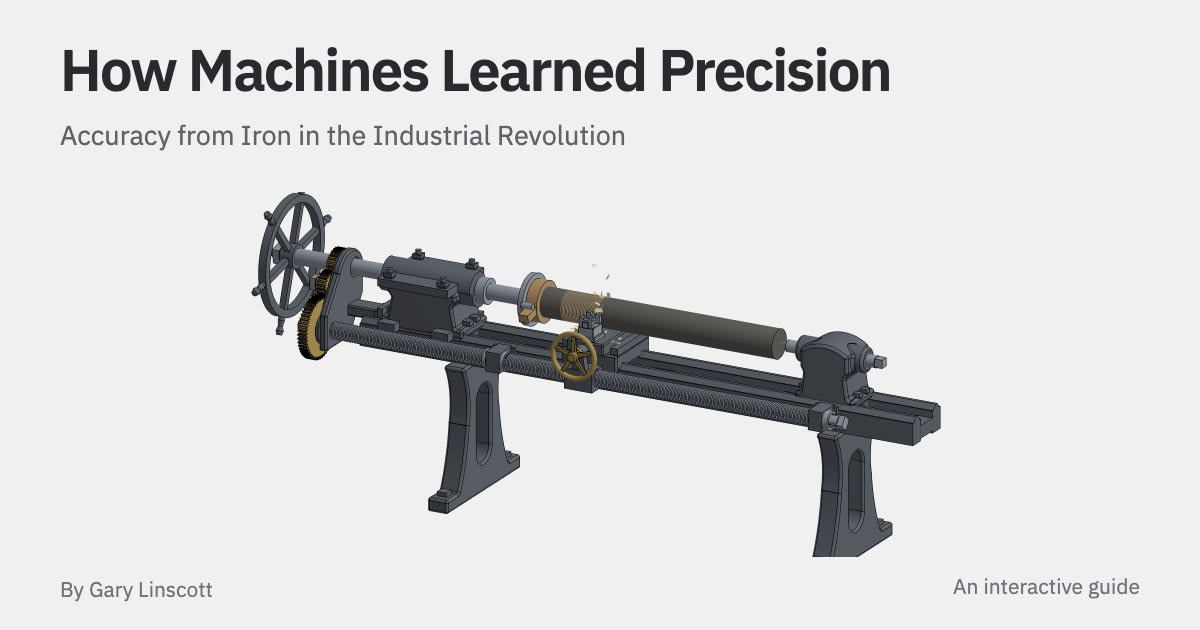
The development of Henry Maudslay’s screw-cutting lathe around 1800 marked a pivotal shift toward industrial precision. By enabling the creation of standardized, accurate machine parts, this innovation became the foundation for the entire Industrial Revolution.
The Foundation of Modern Industrial Precision
At the turn of the 19th century, a transformative shift in manufacturing occurred in London through the work of Henry Maudslay. His development of the screw-cutting lathe around 1800 serves as a critical case study in the evolution of mechanical accuracy. By utilizing a system where a laborer turned a large wheel to rotate a bar while a cutting tool moved along straight iron rails, Maudslay introduced a level of control that had previously been unattainable in manual metalworking.
The Problem of Recursive Accuracy
The fundamental challenge Maudslay faced was a paradox of engineering: to create accurate machines, one must first possess accurate tools. The lathe functioned through a long screw mechanism that moved a carriage at a consistent rate relative to the bar's rotation. However, as noted in the historical context, the integrity of the final product was entirely dependent on the integrity of the lathe's own components. If the iron rails were bent or the lead screw’s threads were unevenly spaced, those imperfections were transferred directly to the workpiece, resulting in catastrophic failure in downstream applications.
Impact on Steam and Mechanical Engineering
The implications of this technological leap were profound. Before the standardization provided by Maudslay’s lathe, mechanical components like pistons and shafts were often hand-fitted, leading to significant inefficiencies. When a screw was uneven, nuts would jam; when a shaft was poorly turned, it would wobble within its bearings. These errors caused steam engines and locomotives to leak or fail, hampering the efficiency of the early Industrial Revolution. Maudslay’s lathe provided the 'mother of machine tools,' ensuring that the engines powering the modern era could operate with reliable, standardized parts.
The Standardization Paradigm
Beyond individual machine performance, Maudslay’s work laid the groundwork for the modern concept of interchangeability. By establishing a reliable method for cutting threads, he allowed for the mass production of screws and bolts that could be replaced without needing to be custom-filed for a specific machine. This transition from 'bespoke' mechanical assembly to standardized industrial production effectively reduced the waste and downtime associated with early steam-powered machinery.
Future Trends in Manufacturing
Looking back from the perspective of modern CNC (Computer Numerical Control) machining, we can see the lineage of Maudslay’s carriage and rails. While today's machines are guided by sophisticated software and sensors rather than a laborer turning a hand-wheel, the core principle remains identical: the machine’s output is limited by the precision of its internal movement. The legacy of the 1800s lathe persists in every high-precision industry, from aerospace to microelectronics, proving that the pursuit of absolute accuracy is the primary driver of technological progress.
Conclusion
The screw-cutting lathe built by Henry Maudslay was more than just a tool; it was the catalyst for an age of consistency. By solving the problem of mechanical error propagation, Maudslay enabled the rapid expansion of steam power and industrial capability. His work remains the bedrock upon which the high-precision manufacturing industry is built today.