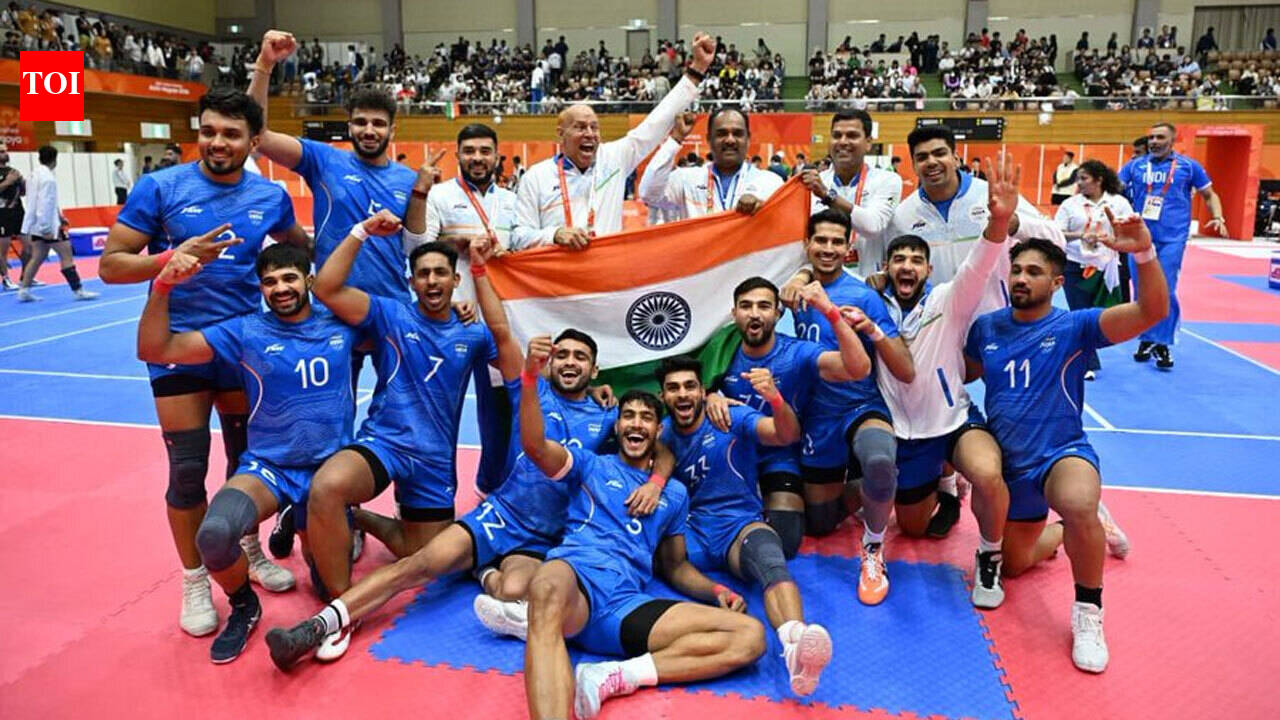
India’s kabaddi double! Men beat Iran to defend gold after women’s triumph at Asian Games
Source Entity
HIJAM RAJU SINGH
Indian athletes are excelling at the Asian Games, highlighted by a record-breaking gold medal in the 10m air pistol mixed team event. Simultaneously, track and field stars like Gulveer Singh and Tejaswin Shankar are demonstrating India's growing prowess in diverse disciplines.
Indian Sporting Excellence at the Asian Games
The recent performances by Indian athletes at the Asian Games underscore a significant shift in the nation's sporting landscape. From the precision of the shooting range to the grueling endurance required on the track and the physical transformation of multi-discipline athletes, India is asserting its dominance across varied athletic spheres.
Resilience and Redemption in Shooting
In the 10m air pistol mixed team event, shooters Suruchi Phogat and Kamaljeet Singh provided a masterclass in mental fortitude. Following the disappointment of their respective individual performances—where exhaustion and anxiety manifested in vastly different ways, from Phogat’s 13-hour recovery sleep to Singh’s sleepless night—the duo showcased remarkable adaptability. Paired at the last minute, they synthesized their focus to secure a gold medal with a record-breaking score of 484.6 points, effectively overshadowing competitors from South Korea and Iran.
The Athletics Surge
Beyond the shooting range, India’s track and field contingent continues to maintain momentum. The silver medal secured by Gulveer Singh in the men’s 10,000m represents more than just a podium finish; it is part of a broader trend of sustained excellence, following closely on the heels of Seema Kumari’s bronze in the women’s 10,000m. This depth in long-distance running suggests that India’s investment in athletics infrastructure and specialized training is yielding consistent international results.
The Evolution of a Decathlete
The narrative surrounding Tejaswin Shankar serves as a compelling case study in elite athletic development. Transitioning from a high jumper—a discipline favoring a lean frame and a specific leg-to-torso ratio—to the multifaceted challenges of the decathlon required a total overhaul of his physiology. By increasing his body mass from 78kg to 90kg and focusing on aerobic strength, Shankar has successfully adapted his anthropometric profile to meet the rigorous demands of ten disparate events.
Broader Implications and Future Trends
These achievements highlight a systemic professionalization of Indian sports. The reliance on strength and conditioning experts, such as Wayne Lombard, indicates that Indian athletes are now competing on a level playing field regarding sports science and nutritional planning. The trend of athletes like Shankar undergoing long-term, calculated physical transformations suggests that future Indian delegations will be characterized by greater versatility and longevity in their respective careers.
Conclusion
The collective success of Phogat, Singh, Gulveer, and Shankar reflects a maturing sports ecosystem. By overcoming personal setbacks and embracing intense physical discipline, these athletes are not only securing medals but are also setting new benchmarks for the next generation of Indian competitors on the global stage.
Multiple Citing Sources