Microduck Obstacle Avoidance: A Sim2Real Workflow with Isaac Lab and Newton
Source Entity
Hugging Face - Blog
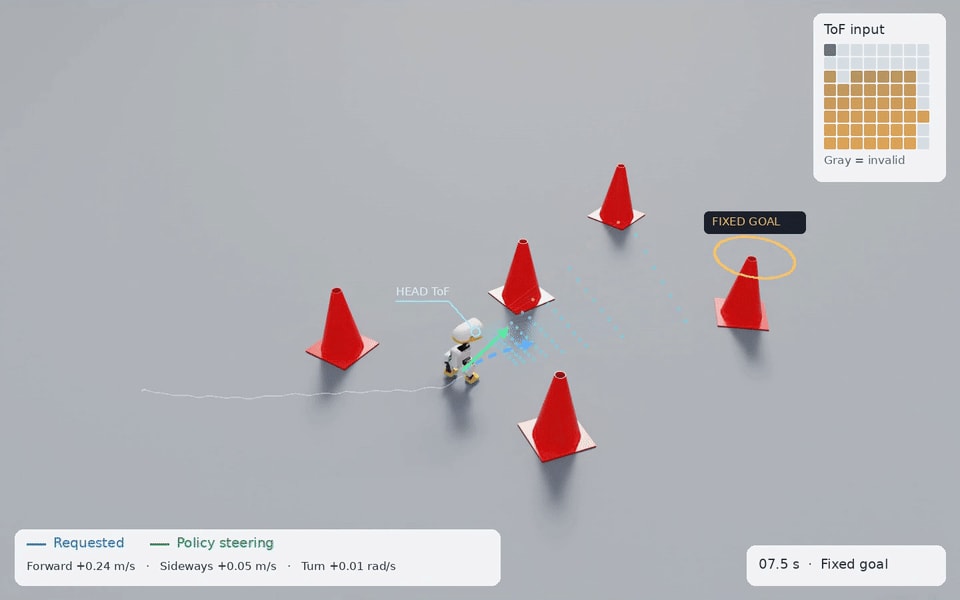
This workflow enables Microduck robots to navigate obstacles by integrating a secondary avoidance controller with existing walking policies. Utilizing Isaac Lab and Newton, developers can train, simulate, and deploy robust navigation systems for real-world robotics.
Enhancing Microduck Mobility: A Sim2Real Workflow
Bridging the Gap Between Walking and Navigation
The Microduck robot, while capable of stable locomotion through its primary walking policy, previously lacked the cognitive layer required for autonomous obstacle avoidance. A walking policy is fundamentally designed for gait stability and balance, but it remains agnostic to the environment’s spatial layout. By implementing a modular approach, developers can now maintain the integrity of the original walking policy while overlaying a sophisticated navigation controller, ensuring that the robot remains upright while simultaneously steering clear of hazards.
Leveraging Isaac Lab and Newton
The core of this development lies in the synergy between NVIDIA’s Isaac Lab and the Newton physics engine. By utilizing SimReady assets, developers can construct diverse, high-fidelity training environments that mirror real-world complexities. The integration of Newton’s raycaster to model Time-of-Flight (ToF) sensors provides the robot with a synthetic perception layer. This simulation-first approach is critical, as it allows for the iteration of navigation logic without the risks of hardware damage during the early training phases.
The Mechanics of the Avoidance Controller
The avoidance controller functions as a mediator between the human operator and the robot’s hardware. When a user provides a gamepad velocity command, the controller intercepts this input, processing the ToF sensor data to determine if the path is clear. If an obstacle is detected, the controller dynamically adjusts the velocity vectors to maintain the user's intended direction while bypassing the obstruction. This ensures that the robot’s movement is both responsive to human intent and reactive to the physical environment.
Simulation Training and Export Pipelines
The workflow emphasizes a structured transition from simulation to real-world deployment. By training the controller within Isaac Lab, developers can run thousands of iterations across varied obstacle courses, effectively hardening the policy against edge cases. Once the controller achieves the desired performance, it is exported for deployment on physical hardware. This streamlined pipeline ensures that the logic developed in a virtual space translates reliably to the mechanical constraints of the Microduck platform.
Future Implications for Robotics
This modular training architecture marks a significant step forward for small-scale robotics. By keeping the walking policy fixed, researchers can isolate variables, making it easier to troubleshoot navigation failures without degrading locomotion stability. As these Sim2Real workflows become more accessible, we can expect to see more agile, autonomous robots capable of navigating cluttered human environments with minimal computational overhead, paving the way for more sophisticated domestic and industrial robotic assistants.