Nasa's asteroid crash test left stadium-sized crater; first images reveal
Source Entity
PRANJAL PANDEY
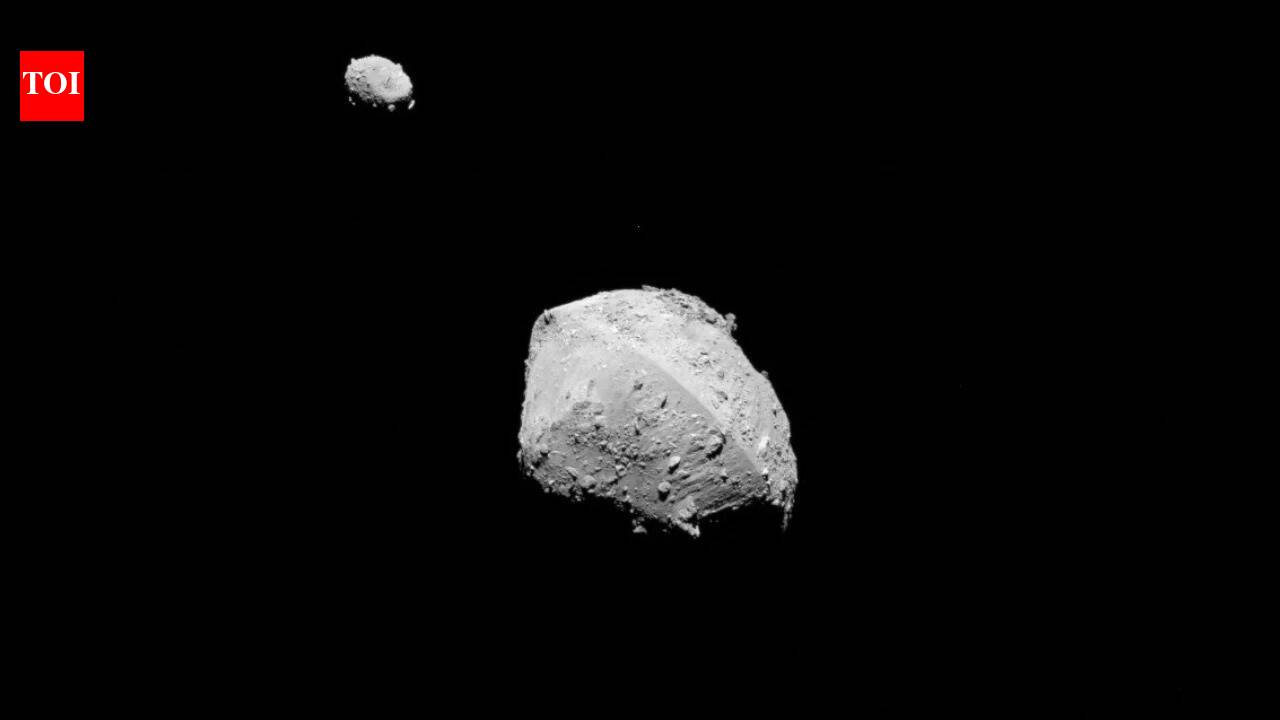
NASA's 2022 DART mission successfully altered the trajectory of the asteroid Dimorphos, leaving a massive, stadium-sized crater. New images from the ESA's Hera spacecraft confirm the profound physical impact of the collision, validating planetary defense strategies.
The Aftermath of DART: A New Era in Planetary Defense
In September 2022, humanity achieved a historic milestone in space exploration and safety: the successful redirection of a celestial body. NASA’s Double Asteroid Redirection Test (DART) mission saw a spacecraft intentionally collide with the asteroid Dimorphos, which orbits the larger asteroid Didymos. Four years later, the European Space Agency’s (ESA) Hera spacecraft has provided the first close-up visual evidence of the event, revealing a massive, stadium-sized crater that confirms the sheer kinetic force of the impact.
Kinetic Energy and Orbital Alteration
The DART mission was not merely a test of navigation; it was a physics experiment on a grand scale. Traveling at speeds exceeding 13,700 mph (6.14 kilometers per second), the spacecraft delivered approximately 10 billion joules of energy upon impact. The result was a profound shift in the asteroid's orbital period around Didymos, which was reduced by roughly 33 minutes. This shift was 25 times greater than the most conservative scientific estimates, demonstrating that kinetic impactors are highly effective tools for planetary defense.
The Hera Mission: Assessing the Damage
While telescopes on Earth provided initial data on the orbital change, the Hera spacecraft offers unprecedented detail from a distance of just 29 kilometers. By observing the 'chaotic scene' left behind, scientists are gaining vital insights into the composition and structural integrity of Dimorphos. The existence of a stadium-sized crater suggests that the asteroid may have been more porous or loosely aggregated than previously thought, providing a 'mess' of data that helps researchers understand how different asteroid types might respond to future deflection efforts.
Implications for Global Safety
Although Dimorphos posed no threat to Earth, this experiment serves as the foundational proof-of-concept for protecting our planet from potential near-Earth object (NEO) impacts. The ability to measure the crater size and the resulting debris field allows space agencies to refine computer models used for planetary defense. These models are critical, as they allow scientists to predict exactly how much force is required to divert a dangerous asteroid based on its mass, speed, and material composition.
Future Trends in Space Security
The success of DART and the subsequent survey by Hera mark the transition of planetary defense from theoretical science to an operational capability. Future missions will likely build on these findings to develop more sophisticated, automated deflection technologies. By combining the kinetic impactor strategy with early detection systems, humanity is moving closer to a state where the threat of catastrophic asteroid impacts can be mitigated with precision and confidence.
Conclusion
The images captured by the Hera spacecraft in November 2026 serve as a testament to human ingenuity. By turning a 'disaster movie' scenario into a controlled experiment, NASA and the ESA have proven that we are no longer helpless against the hazards of the solar system. The legacy of the DART mission will be the foundation of a robust, global planetary defense network that ensures the long-term safety of our planet.
Multiple Citing Sources