Moment Nasa spacecraft hit asteroid - and what happened next
Source Entity
BBC News
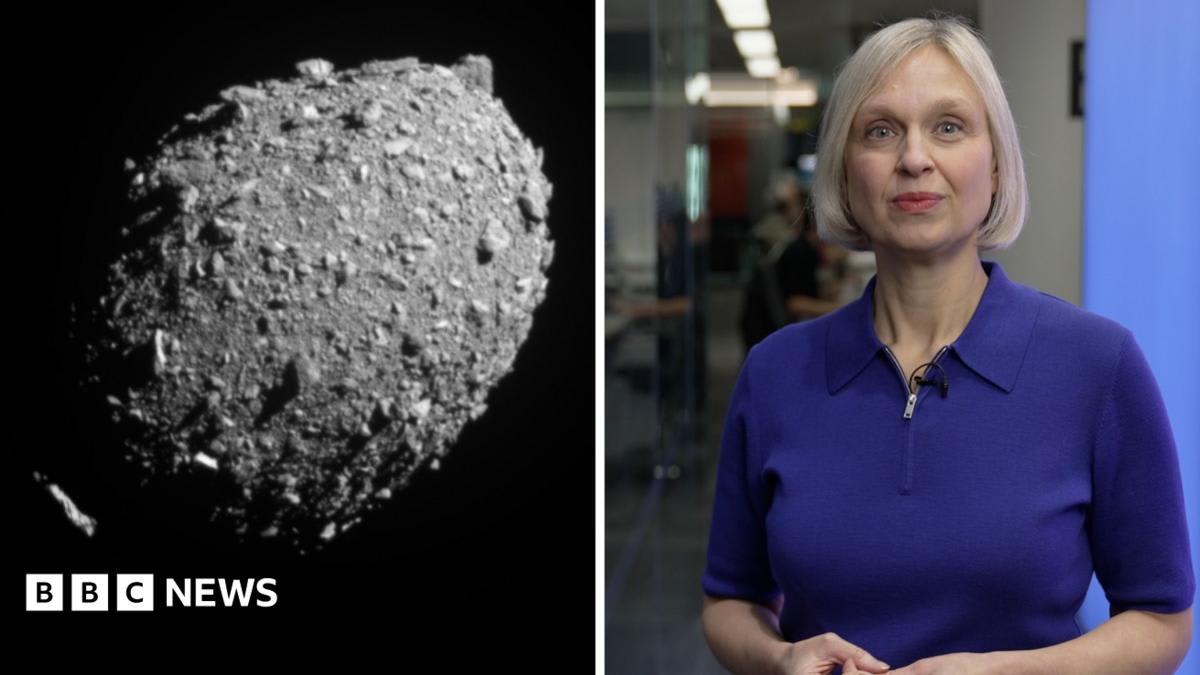
NASA's 2022 DART mission successfully impacted the asteroid Dimorphos, creating a massive crater and significantly altering its orbit. New data from the ESA's Hera spacecraft reveals the physical aftermath of this historic planetary defense test.
The Aftermath of DART: Assessing Humanity's First Planetary Defense Test
In September 2022, NASA executed a historic mission that felt like a scene from a disaster movie: the Double Asteroid Redirection Test (DART). The mission involved deliberately crashing a spacecraft into the asteroid Dimorphos to determine if humanity could successfully alter the trajectory of a space rock. Four years later, the European Space Agency's (ESA) Hera spacecraft has arrived at the scene, providing the first detailed look at the physical consequences of this high-speed kinetic impact.
Unveiling the Crater
New imagery captured by the Hera spacecraft from a distance of 29 kilometers reveals a stadium-sized crater on the surface of Dimorphos. This visual evidence confirms that the DART mission, which struck the asteroid at a staggering speed of 13,700 mph (6.14 kilometers per second), caused significant structural damage. While the impact was essentially a suicide mission for the probe, it released approximately 10 billion joules of energy, fundamentally changing the physical landscape of the asteroid.
Orbital Alterations and Scientific Success
Beyond the visible crater, the mission’s primary objective—to test the feasibility of planetary defense—has been classified as a resounding success. Astronomers observed that the collision shortened Dimorphos’s 12-hour orbit around its companion asteroid, Didymos, by roughly 33 minutes. This result far exceeded expectations, proving to be 25 times more effective than the most conservative scientific projections anticipated prior to the launch.
The Role of ESA's Hera Mission
While the initial impact was observed remotely via telescopes, the arrival of the ESA’s Hera spacecraft marks a new chapter in this experiment. Scientists previously knew the DART mission had created a "large mess" on the surface, but the exact nature and extent of this disruption remained a mystery. Hera is currently conducting a detailed forensic analysis of the site, collecting vital data on how the asteroid's composition influenced the impact and the resulting debris field.
Broader Implications for Planetary Defense
This experiment serves as a critical proof-of-concept for future planetary defense strategies. By demonstrating that humanity possesses the technological capability to deflect an asteroid, the DART mission provides a blueprint for mitigating potential future threats from near-Earth objects. Although Dimorphos posed no threat to Earth, the data gleaned from its collision provides the foundational knowledge necessary to refine kinetic impactor techniques for real-world scenarios.
Future Trends in Space Exploration
The success of the DART-Hera collaboration highlights the importance of international cooperation in deep-space exploration. Moving forward, the insights gained from this chaotic, cratered landscape will inform how space agencies design future interception missions. As we continue to monitor the aftermath, the mission remains a testament to humanity’s transition from passive observers of the cosmos to active participants in planetary protection.
Multiple Citing Sources