Watch: Netanyahu holds up pager at UN, recalls Israel’s attack on Hezbollah
Source Entity
AYUSH PANDEY
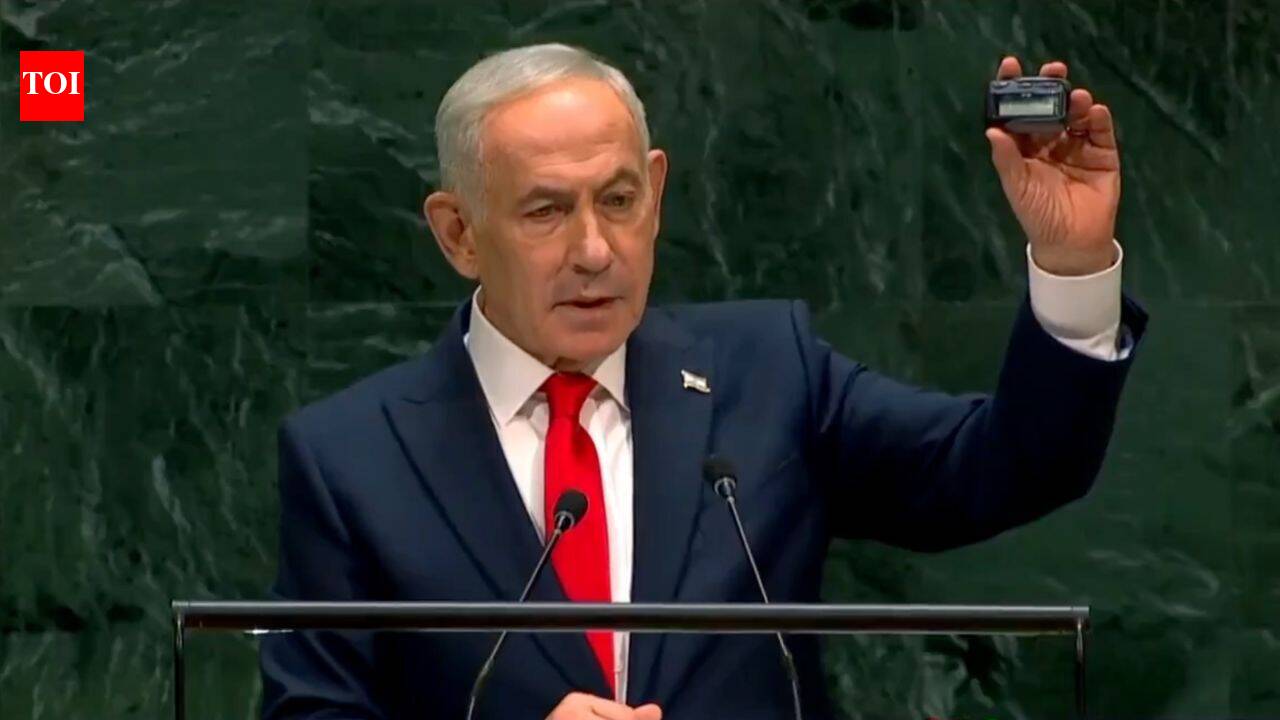
Israeli Prime Minister Benjamin Netanyahu faced a mass walkout at the UN General Assembly while defending military actions in Gaza, Lebanon, and Iran. He labeled protesting delegates as "moral cowards" and vowed to continue the conflict, referencing recent pager attacks on Hezbollah.
Tensions Peak at the UN General Assembly
The 79th session of the United Nations General Assembly became a flashpoint for global geopolitical divides as Israeli Prime Minister Benjamin Netanyahu took the stage. As the Prime Minister approached the podium, dozens of delegates exited the hall in a coordinated act of protest. This diplomatic snub underscored the deepening international isolation Israel faces regarding its ongoing military operations in Gaza and Lebanon, and its broader strategic posture in the Middle East.
Rhetorical Escalation and the 'Moral Coward' Label
Netanyahu responded to the mass walkout with characteristic defiance, labeling those who departed as "moral cowards." He further challenged the remaining assembly members, suggesting that if they shared the sentiments of those who left, they should vacate the hall as well. This rhetoric highlights a widening chasm between the Israeli government's stated security objectives and the prevailing sentiment within the international diplomatic community, which has increasingly scrutinized the humanitarian toll of the conflict.
The Context of Military Operations
Central to Netanyahu’s address was a staunch defense of Israel’s multi-front military campaigns. He explicitly referenced the recent, highly sophisticated pager attacks against Hezbollah, which resulted in over 3,000 injuries. These attacks, which shocked global security analysts, demonstrate the evolving nature of asymmetric warfare. By bringing these actions to the UN floor, Netanyahu signaled that Israel intends to continue its offensive posture despite international pressure, asserting, "We're going to win. We have no other choice."
Denying Genocide Allegations
Throughout his address, Netanyahu forcefully rejected accusations that Israel is committing genocide in Gaza—a charge previously leveled by a UN commission of inquiry. He framed the conflict as an existential struggle, rooted in the Hamas-led attacks of October 7, 2023, which resulted in 1,200 deaths and 251 hostages. By anchoring his defense in the trauma of the October 7 incident, the Prime Minister sought to reframe the narrative from one of international law violations to one of national survival.
Conflicting Visions for the Middle East
The atmosphere at the General Assembly was further complicated by the perspective of Palestinian President Mahmoud Abbas, who, in a recorded message, highlighted the existential threat posed by the expansion of illegal Jewish settlements in the West Bank. This juxtaposition of viewpoints illustrates the fundamental impasse in the peace process. While Israel focuses on its military objectives against groups like Hamas and Hezbollah, Palestinian leadership continues to emphasize the systemic issues of occupation and territorial integrity as the primary drivers of the regional conflict.
Future Implications for International Diplomacy
The events at the UN highlight a dangerous trend of diplomatic erosion. As the Israeli government continues its military campaigns in Gaza, Lebanon, and against regional proxies, the ability of the UN to serve as an effective mediator appears increasingly compromised. The open hostility displayed between the Israeli delegation and other UN member states suggests that the path toward a diplomatic resolution remains fraught with difficulty, with both sides doubling down on their respective positions.
Multiple Citing Sources