Building on Nemotron 3.5 Parse: Open Data, Fine-Tuning, and Faster Inference
Source Entity
Hugging Face - Blog
NVIDIA has expanded its Nemotron 3.5 Parse model ecosystem with new synthetic training data, fine-tuning recipes, and enhanced inference capabilities. This update aims to improve document understanding and structured data extraction for RAG applications.
Advancing Document Intelligence with Nemotron 3.5
NVIDIA has officially announced a significant expansion of its Nemotron 3.5 Parse model ecosystem, marking a pivotal moment in how artificial intelligence handles unstructured document data. By introducing synthetic training datasets, a specific fine-tuning recipe, and the DFlash2 speculator, NVIDIA is addressing the critical bottleneck of efficient, high-fidelity document parsing in enterprise environments.
The Mechanics of Document Parsing
At its core, Nemotron 3.5 Parse is designed to transform static page images into structured, machine-readable data. This capability is essential for modern Retrieval-Augmented Generation (RAG) frameworks and autonomous agents that rely on precise information retrieval. The model goes beyond simple optical character recognition (OCR) by identifying reading order, categorizing content—such as headings, paragraphs, tables, and charts—and providing precise bounding boxes for every detected element.
Training Methodology and Reinforcement Learning
NVIDIA’s approach to training Parse 3.5 reflects a sophisticated multi-stage strategy. The process began with supervised fine-tuning to establish a foundational understanding of document structures. Subsequently, the researchers implemented reinforcement learning techniques to refine the model's output, specifically targeting improvements in accuracy, consistency, and the reliability of task completion. This methodology ensures that the model can handle complex, varied document layouts that often stump traditional parsing tools.
Accelerating Inference with DFlash2
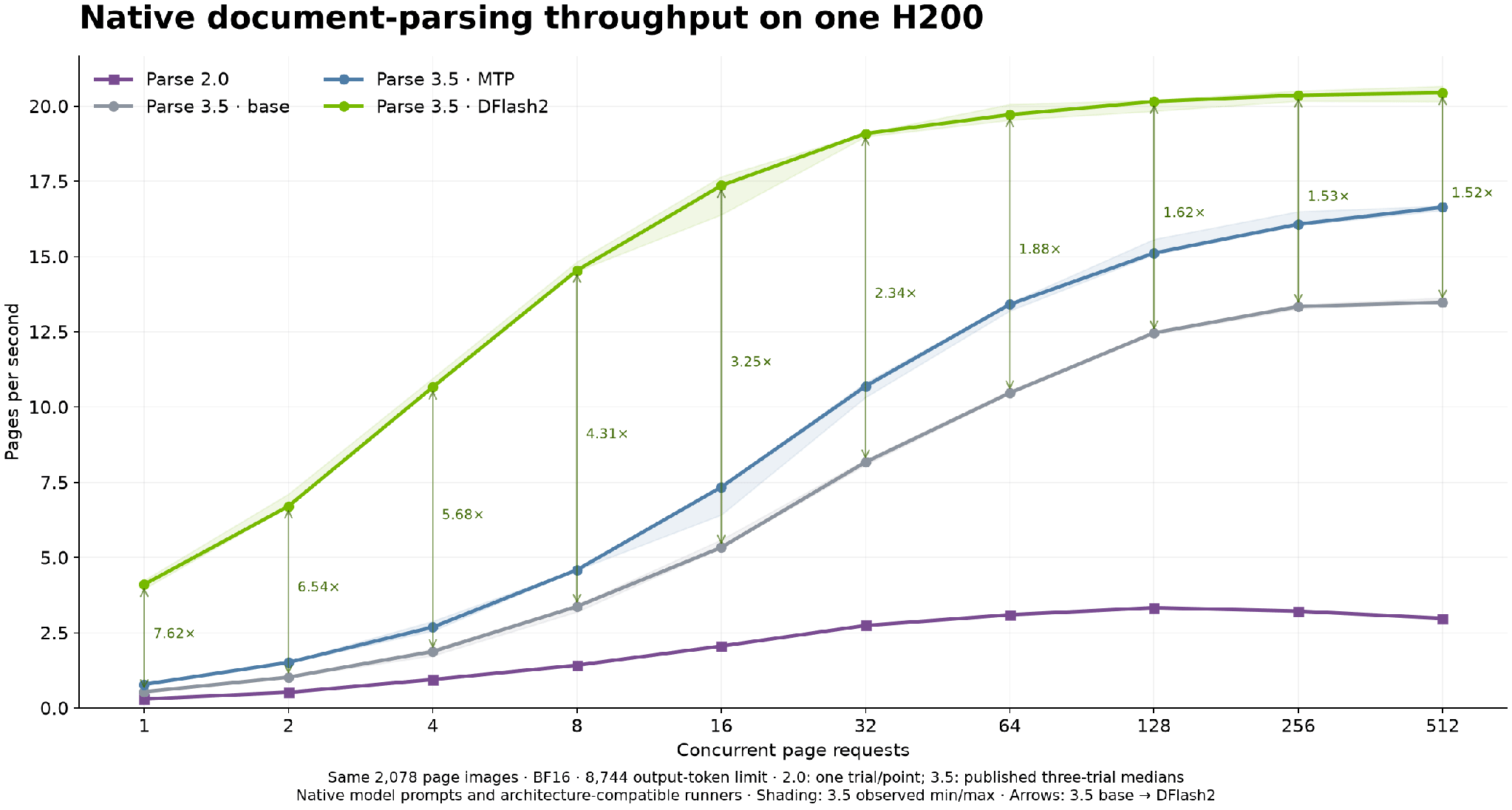
One of the most notable technical additions is the DFlash2 speculator. In the realm of large language models and vision-language models, inference speed is a primary barrier to real-time application. By integrating a speculative decoding mechanism, NVIDIA has optimized the inference pipeline, allowing the model to generate structured outputs faster without sacrificing performance. This is a crucial development for companies attempting to integrate AI into high-volume, automated workflows.
Broader Implications for Enterprise AI
The shift toward structured records—where tables and charts are converted into data formats that can be queried by downstream applications—represents a paradigm shift for data processing. By enabling AI to 'understand' the semantic relationship between document elements, NVIDIA is empowering developers to build more robust RAG systems. As businesses continue to digitize legacy records, tools like Nemotron 3.5 Parse will be foundational to unlocking the value hidden within massive document repositories.
Future Trends and Conclusion
Looking ahead, the combination of synthetic data and specialized model architecture suggests a trend toward more modular, high-efficiency AI components. As NVIDIA continues to refine its fine-tuning recipes, we can expect document parsing to become increasingly accurate, facilitating better decision-making capabilities for autonomous agents. This release underscores the company's commitment to providing the underlying infrastructure necessary for the next generation of intelligent, data-driven enterprise solutions.