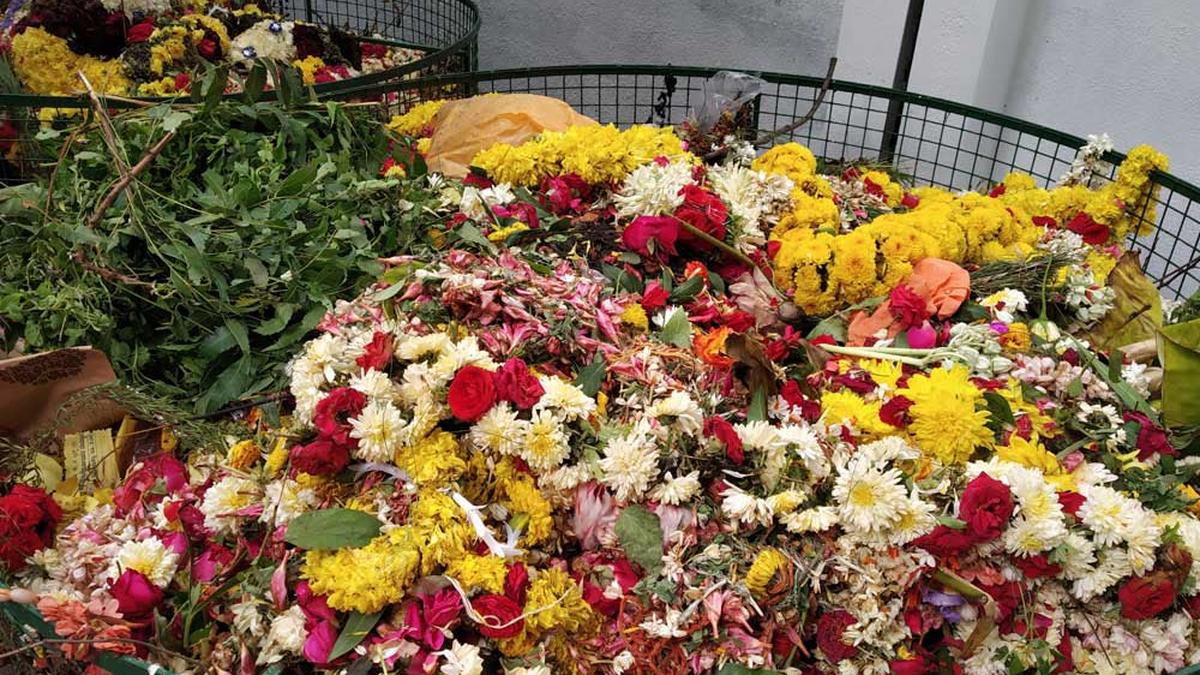
Discarded flowers from Ganesh immersions find second life in Cyberabad
Source Entity
India Latest News: Top National Headlines Today & Breaking News | The Hindu
Telangana's power utility provided ₹17.8 crore in free electricity to Ganesh pandals despite high demand, while civic bodies in Cyberabad and Mumbai launched circular economy initiatives to repurpose festival waste. These efforts reflect a growing trend toward sustainable management of large-scale public festivities in India.
Sustainable Management of Post-Festival Waste and Energy
The recent conclusion of Ganesh Chaturthi celebrations across India has highlighted significant shifts in how civic and utility bodies manage the logistical and environmental aftermath of large-scale public events. From the provision of state-subsidized energy in Telangana to innovative waste-to-wealth programs in Cyberabad and Mumbai, authorities are increasingly integrating social welfare with sustainability.
Energy Subsidies Amidst High Demand
In Telangana, the Southern Power Distribution Company (TGSPDCL) demonstrated a commitment to supporting cultural festivities by supplying free electricity to 51,207 Ganesh pandals. Despite the strain on the power grid caused by the El Nino phenomenon, the government facilitated a connected load of 1,12,586 kW. The total expenditure of ₹17.8 crore, borne by the state, underscores the government's role in subsidizing religious and community gatherings while maintaining grid stability across 21 circles.
Transforming Floral Waste in Cyberabad
The environmental footprint of such large gatherings is traditionally significant, particularly regarding organic waste. In Cyberabad, the Municipal Corporation has successfully implemented a circular economy model by collecting approximately 6,000 kg of floral waste from immersion sites. By processing these discarded offerings into incense sticks, dhoops, and diyas, the civic body is actively reducing landfill contributions and promoting waste segregation at the source.
Upcycling Footwear in Mumbai
Mumbai’s approach to post-festival waste management has focused on the often-overlooked issue of abandoned footwear. Following the dispersal of crowds, BMC teams collected nearly eight tonnes of shoes and sandals. Through a partnership with the GreenSole Foundation, this waste is being diverted from landfills and upcycled for distribution to students in BMC schools and tribal regions. This initiative transforms a logistical nuisance into a social benefit, illustrating a proactive approach to urban sanitation.
Broader Implications for Urban Governance
These initiatives represent a broader trend in Indian urban governance, where municipal corporations are moving beyond simple waste collection toward resource recovery. By treating discarded materials—whether flowers or footwear—as potential assets, cities like Mumbai and Cyberabad are creating models that could be replicated for other major festivals.
Future Trends and Sustainability
Looking ahead, the success of these programs suggests that public-private partnerships, such as the one between the BMC and GreenSole, will become essential for managing the waste generated by India’s massive festival culture. As urban populations grow, the integration of energy-efficient planning, as seen in Telangana, alongside aggressive waste-diversion strategies, will be critical for maintaining city hygiene and environmental health during periods of heightened public activity.
Verification Required?