Proof of Care in the Age of A.I
Source Entity
Hacker News
<a href="https://news.ycombinator.com/item?id=48906125">Comments</a>
The Crisis of Authenticity: Understanding 'Proof of Care'
In an era defined by the rapid proliferation of Large Language Models (LLMs) and generative AI, the digital landscape is facing an unprecedented crisis of authenticity. The concept of "Proof of Care," as discussed in contemporary tech circles and highlighted in the provided context, emerges as a philosophical and practical response to the "Dead Internet Theory"—the idea that the majority of web content and interactions are now synthetic. When a perfectly phrased email or a polished essay can be generated in seconds, the traditional markers of competence and quality are no longer reliable proxies for human effort or genuine interest.
The Devaluation of Polished Output
Historically, a well-written letter or a detailed report was a signal of the sender's investment of time and cognitive energy. This "cost" of production served as a proxy for the value placed on the recipient. However, AI has effectively reduced the marginal cost of producing high-quality text to near zero. As a result, we are witnessing a paradoxical devaluation of polish. When excellence becomes effortless, it ceases to be a signal of care. The "Proof of Care" framework suggests that we must find new ways to signal intentionality—perhaps through the inclusion of specific, idiosyncratic human details, shared memories, or even a degree of "productive imperfection" that AI currently struggles to mimic convincingly.
The Economics of Human Attention
From an economic perspective, attention is the scarcest resource in the digital age. AI allows for the mass-production of "personalized" content, but this scalability leads to a dilution of meaning. If a user receives a thousand AI-generated messages that all feel tailored to them, the perceived value of each individual message plummets. By establishing a "Proof of Care," individuals and brands can differentiate themselves by proving that a human actually spent time thinking about the specific recipient. This shift transforms human attention from a commodity into a premium luxury good, where the primary value is not the information conveyed, but the fact that a human being chose to spend their limited time on the interaction.
Potential Mechanisms for Verifying Intent
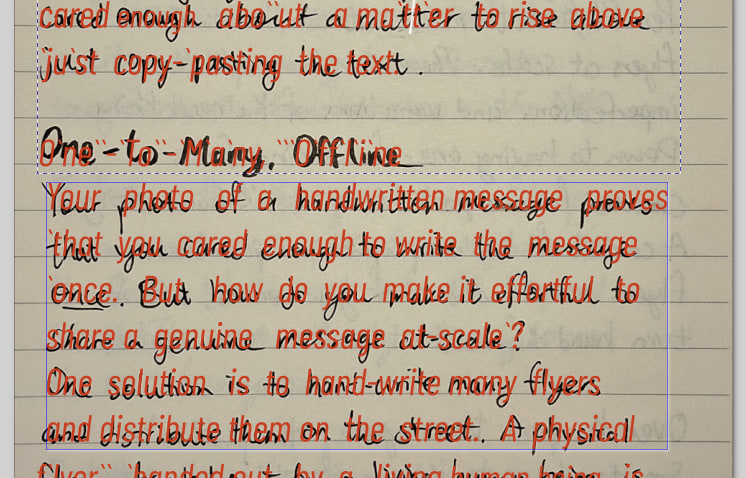
Implementing a systemic "Proof of Care" presents significant technical and social challenges. Some suggest that the solution lies in "Proof of Work" for the mind—requiring actions that AI cannot easily replicate, such as physical presence, handwritten notes, or synchronous, spontaneous voice and video interactions. Others argue for a more cryptographic approach, where human-generated content is signed with a digital identity. However, the most profound form of Proof of Care is likely to remain social and relational: the ability to reference shared, unrecorded experiences that exist outside the training data of any AI model, thereby creating a "closed loop" of trust between two humans.
Future Trends: The Return to Analog and Intimacy
Looking forward, the rise of AI is likely to trigger a cultural renaissance of analog communication. We can predict a surge in the value of physical artifacts—letters, zines, and face-to-face gatherings—as these provide an inherent, immutable Proof of Care. In professional environments, the definition of "productivity" may shift; instead of valuing the volume of output, organizations may begin to value the depth of human synthesis and the strength of interpersonal bonds. The ability to demonstrate that one has truly "cared" for a project or a person will become a critical competitive advantage in a world saturated by synthetic efficiency.
Conclusion
The emergence of the "Proof of Care" discourse marks a pivotal shift in our relationship with technology. It acknowledges that while AI can simulate the result of thinking, it cannot simulate the act of caring. As we navigate this transition, the focus of human communication will likely move away from the transmission of information and toward the verification of intent. Ultimately, the most valuable currency in the age of AI will not be intelligence or efficiency, but the demonstrable investment of human time and empathy.