In Illustrations: What Is Repo Rate? How Does A Hike Affect You?
Source Entity
NDTV News Search Records Found 1000
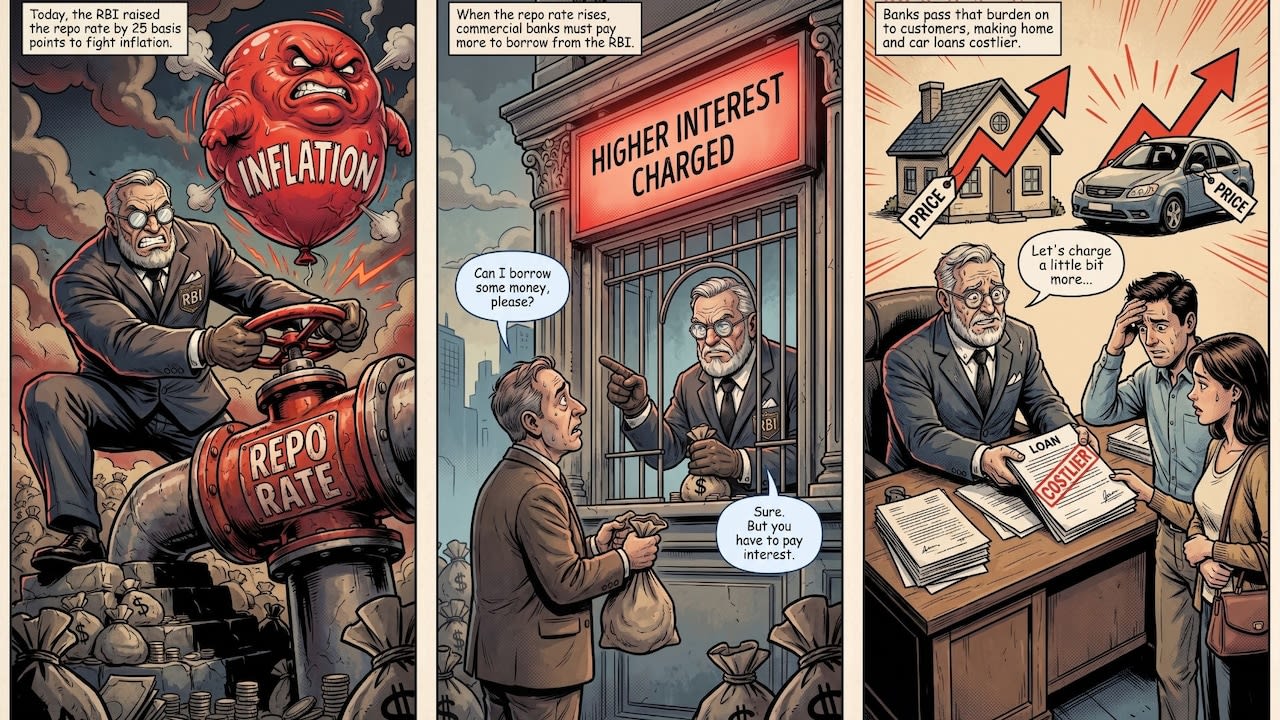
The Reserve Bank of India has raised the repo rate by 25 basis points to 5.5% to combat rising inflation and global economic pressures. This shift to a 'calibrated tightening' stance signals likely future rate hikes, which will lead to increased EMI burdens for borrowers.
RBI Initiates Monetary Tightening Cycle
The Reserve Bank of India (RBI) has officially signaled a shift in its monetary trajectory by increasing the policy repo rate by 25 basis points, bringing the benchmark rate to 5.50 percent. This decision, emerging from the Monetary Policy Committee (MPC), represents the first such hike since February 2023. By moving away from a 'neutral' stance to one of 'calibrated tightening,' the central bank is acknowledging the urgent need to address macroeconomic headwinds that threaten domestic price stability.
Drivers of the Policy Shift
The rationale behind this hike is rooted in a trifecta of economic pressures: persistent inflationary trends, elevated crude oil prices, and the volatility of the Indian rupee. Inflation remains a primary concern for the MPC, which has consequently raised its inflation forecast for FY27 from 5 percent to 5.2 percent. The confluence of rising global commodity costs and a challenging international interest-rate environment has necessitated this preemptive strike to anchor long-term inflation expectations.
Growth Projections Amidst Tightening
Interestingly, the MPC’s decision to tighten liquidity occurs simultaneously with an optimistic adjustment in growth projections. The committee has revised the growth forecast for FY27 upward from 6.7 percent to 7.1 percent. This suggests that while the central bank is tightening policy to curb inflation, it remains confident in the underlying momentum of economic activity within the country, balancing the risks between price stability and growth sustenance.
Impact on the Common Borrower
For the average consumer, the most immediate consequence of this policy shift is the rise in Equated Monthly Installments (EMIs). As the repo rate acts as the foundational benchmark for bank lending rates, a 25 basis point hike translates into a higher cost of capital for commercial banks, which is subsequently passed on to retail and corporate borrowers. Those with floating-rate loans will likely see an upward adjustment in their monthly repayment obligations in the coming cycles.
Future Outlook and Policy Trajectory
The move toward 'calibrated tightening' implies that this 25 basis point hike may not be an isolated event. By adopting this stance, the RBI has provided a clear forward-looking signal that further interest rate increases are a distinct likelihood if inflationary pressures do not subside. Investors and borrowers alike should prepare for a period of transition where the era of low-cost borrowing is replaced by a more disciplined, high-interest environment designed to stabilize the broader economy.
Verification Required?