Mass launched to orbit each year by rocket builder
Source Entity
Hacker News
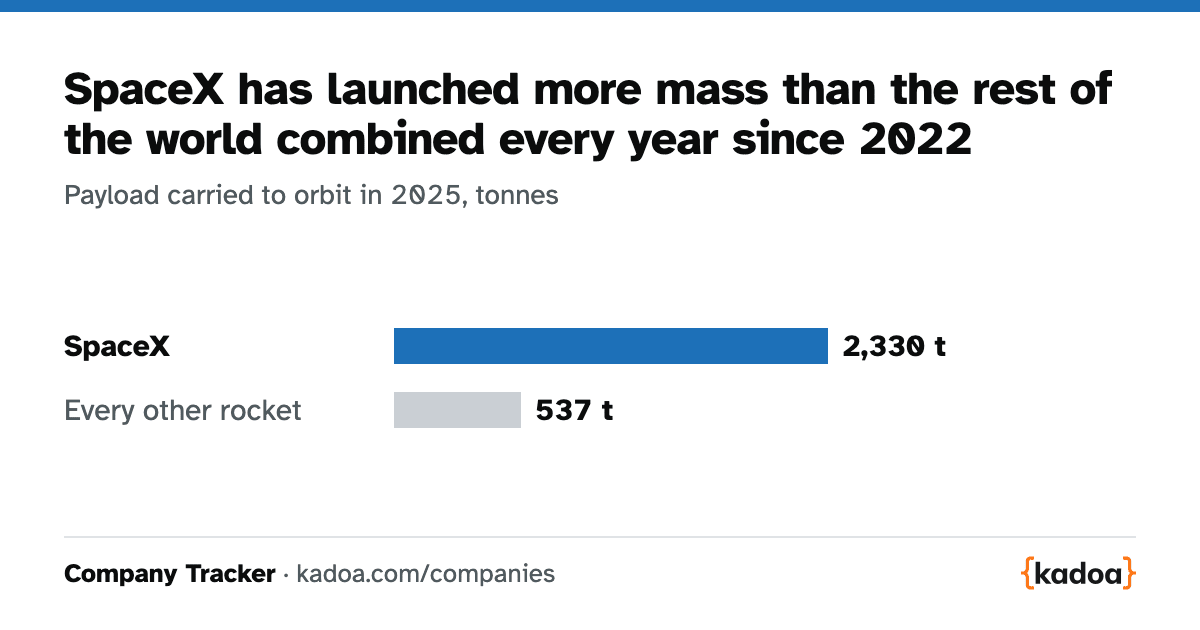
SpaceX now accounts for 19% of all mass ever launched into orbit. At current growth rates, the company is on track to surpass the combined historical launch mass of all other entities within seven to sixteen years.
The Rapid Ascent of SpaceX
SpaceX has fundamentally altered the economics and logistics of space exploration by capturing a staggering 19% of all mass ever delivered to orbit. This milestone represents a paradigm shift in aerospace engineering, moving the industry away from traditional, state-run heavy-lift paradigms toward a high-cadence, reusable model. By consistently lowering the cost per kilogram to reach low Earth orbit (LEO), the company has effectively democratized access to space, allowing for the deployment of massive satellite constellations and increased scientific research capacity.
The Velocity of Orbital Dominance
Data indicates that at the current 2025 launch cadence, SpaceX is projected to surpass the combined historical launch mass of every other organization in history within approximately 16 years. When excluding the historical legacy of the Space Shuttle—a program defined by its high-cost, low-frequency flight profile—this timeline compresses to just seven years. This acceleration highlights the exponential nature of SpaceX’s iterative design process, particularly the success of the Falcon 9 and Falcon Heavy launch vehicles.
Historical Context and Industry Shift
The history of spaceflight was long dominated by the Cold War-era Space Race, where mass-to-orbit was a secondary concern to national prestige and ballistic capability. For decades, the industry was characterized by expendable rockets that were discarded after a single use, creating significant financial barriers to entry. SpaceX’s transition to reusable first-stage boosters has effectively broken this cycle, allowing for a frequency of launches that was previously deemed impossible by aerospace analysts.
Broader Implications for Global Spaceflight
The implications of SpaceX’s current trajectory are profound for global space policy and commercial enterprise. As the company continues to monopolize a significant portion of orbital mass, competitors are being forced to accelerate their own reusable rocket programs or risk obsolescence. This competitive pressure is fostering a new era of innovation, though it also raises questions regarding orbital congestion and the sustainable management of space debris in the coming decades.
Future Trends and Sustainability
Looking forward, the integration of the Starship vehicle—designed for even greater mass capacity and full reusability—suggests that the timeline for SpaceX to dominate total orbital mass could accelerate even further. If the company successfully scales its Starship operations, the traditional metrics of launch capacity will likely need to be redefined. The future of orbital logistics will be defined by this unprecedented volume, necessitating international cooperation to ensure that the rapid increase in launch mass does not compromise the safety and utility of the orbital environment.
Conclusive Summary
In summary, SpaceX’s achievement of launching 19% of all historical orbital mass is a testament to the success of private-sector innovation in spaceflight. While the company's trajectory points toward an eventual total dominance of orbital delivery, the broader impact remains a net positive for the accessibility of space. As the company approaches its goal of surpassing all other historical efforts combined, the focus of the global space community must shift toward managing the consequences of such high-frequency orbital activity.