Spain have the best defence. France have the best attack. But this World Cup semi-final won't be decided by either
Source Entity
Latest News: Today's Latest News Headlines from India & World | Hindustan Times | Hindustan Times
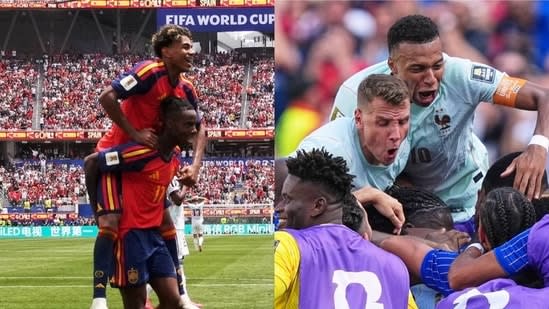
This blockbuster between Europe's two modern-day heavyweights will hinge on one thing: transition. Not possession. Not territory.
The Tactical Chess Match: Spain vs. France
The upcoming World Cup semi-final between Spain and France represents more than just a clash of two footballing giants; it is a collision of contrasting philosophies. On one side, Spain brings a defensive solidity that has become the benchmark for modern stability. On the other, France boasts an attacking arsenal capable of dismantling any opponent in a matter of seconds. However, the core of this contest lies not in the static strengths of either side, but in the volatile moments between phases of play.
The Paradox of Defensive and Offensive Superiority
Spain's current defensive form is characterized by a disciplined structure and an innate ability to absorb pressure. Historically, Spain has been defined by 'Tiki-Taka'—a style rooted in suffocating possession. However, the evolution of their game has seen them integrate a more robust defensive shell, ensuring that their pursuit of control does not leave them vulnerable. Conversely, France has mastered the art of the offensive blitz. Their attack is built on explosive speed and clinical finishing, allowing them to turn a half-chance into a goal with terrifying efficiency.
The Deciding Factor: The Art of Transition
Despite these strengths, the provided analysis suggests that neither the 'best defence' nor the 'best attack' will be the primary determinant of victory. Instead, the match will hinge on transition. In football, transition refers to the critical seconds immediately following a change in possession. For France, the transition from defense to attack is their deadliest weapon, utilizing rapid verticality to catch opponents out of position. For Spain, the transition from attack back to defense—the 'counter-press'—is essential to prevent France from launching those lethal breaks.
Possession vs. Pragmatism
For years, the prevailing wisdom in international football was that possession equals control. Spain has long been the poster child for this ideology. However, the modern game has shifted. Territory and possession are often used as decoys; a team can hold the ball for 70% of the match but lose because they failed to manage the transition. The narrative of this semi-final suggests that France may be comfortable conceding possession if it allows them to exploit the spaces left behind by a pressing Spanish side.
Historical Context and Tactical Evolution
Looking back at the rivalry between these two nations, we see a recurring theme of style versus substance. Spain's dominance in the late 2000s and early 2010s was based on an obsession with the ball. France, meanwhile, has often relied on a more pragmatic approach, blending athletic superiority with tactical discipline. This semi-final is the culmination of these evolving styles, where the winner will be the team that can best navigate the 'chaos' of the transition phase rather than the team that adheres most strictly to their systemic identity.
Future Implications for the Global Game
This match serves as a bellwether for the future of football tactics. If France prevails through transitional play, it will further validate the trend of 'efficient football' over 'aesthetic possession.' If Spain can neutralize the transition and win through their defensive organization, it will prove that a structured, balanced approach can still overcome raw attacking power. The outcome will likely influence how national teams approach the build-up and recovery phases in future World Cup cycles.
Summary of the Clash
In conclusion, while the headlines focus on the brilliance of France's attack and the resilience of Spain's defense, the actual battle will be fought in the margins. The team that manages the switch from offense to defense—and vice versa—with the greatest precision will secure their place in the final. It is a high-stakes game of tactical chess where the most dangerous moment is not when a team has the ball, but the moment they lose it.
Verification Required?