180B Parameters, 32GB of RAM: Pushing MoE Inference to the Limit with Transformers
Source Entity
Hugging Face - Blog
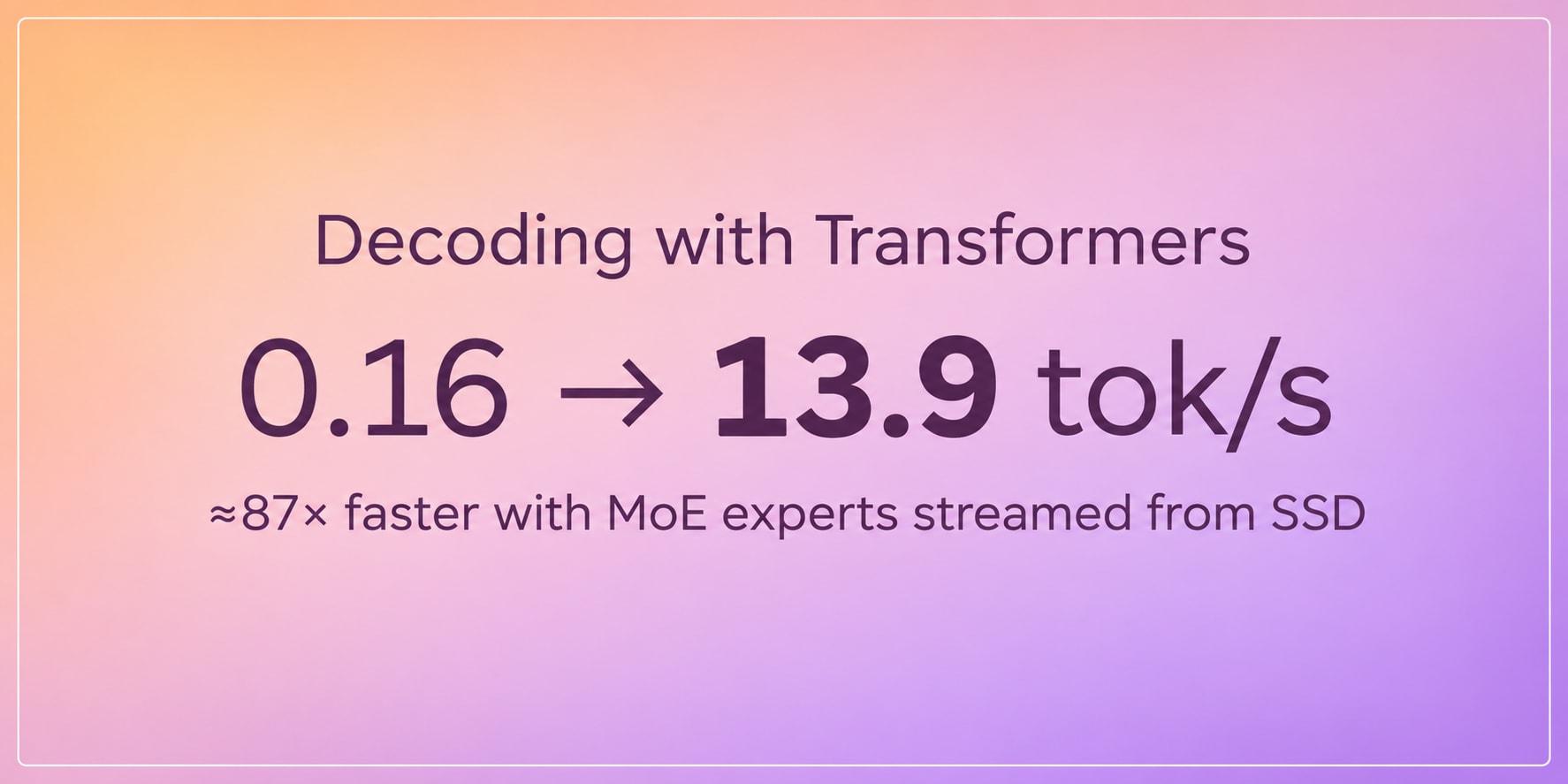
Researchers are optimizing local AI inference by streaming Mixture-of-Experts (MoE) models directly from SSDs. This technique enables large-scale model execution on consumer hardware with limited RAM.
The Frontier of Local AI Inference: Streaming MoE Models
The landscape of Large Language Model (LLM) deployment is undergoing a significant shift as enthusiasts and researchers seek to move away from centralized, cloud-based APIs toward robust local execution. The core challenge in this transition is the massive hardware requirement for models with high parameter counts. By leveraging Mixture-of-Experts (MoE) architectures, developers are finding innovative ways to bypass traditional RAM limitations, specifically by streaming model weights directly from high-speed SSD storage.
The Hardware Constraint and the SSD Solution
Modern consumer hardware, such as the MacBook M5 with 32GB of unified memory or custom dual-RTX 4090 configurations (often dubbed 'Orthrus' setups), presents a paradox. While these systems possess powerful compute capabilities, they are often bottlenecked by memory capacity. The recent breakthrough—achieving inference performance within 6% of Strata benchmarks while streaming MoE experts from an SSD—demonstrates that intelligent memory management can bridge the gap between disk speed and processor throughput.
Why Mixture-of-Experts (MoE) Matters
MoE models are uniquely suited for this optimization. Unlike dense models that require the entire parameter set to be loaded into active memory, MoE architectures activate only a subset of the 'experts' for any given token generation task. This sparsity is the key to the current experimentation: by keeping only the active experts in VRAM/RAM and streaming the remainder from an SSD, users can run models with 180B parameters on hardware that would traditionally be insufficient.
Real-World Implications for AI Enthusiasts
For power users who prioritize mobility or need to balance gaming and development on a single machine, this methodology is transformative. The ability to run massive, highly capable models locally on a laptop—facilitated by tools like llama.app and network-based bridging—means that developers are no longer tied to a static workstation. The move toward 'rooms moving development' (RMD) suggests that the future of AI development is not just about raw power, but about the flexibility of the deployment environment.
Technical Challenges and Future Trajectories
Despite these advancements, moving data from an SSD introduces latency that does not exist when data is pinned in RAM. The 6% performance gap compared to Strata benchmarks is a testament to the efficiency of current I/O caching techniques, but closing that gap further will require even faster storage interfaces and more sophisticated predictive loading algorithms. As consumer SSDs continue to improve in speed (PCIe 5.0 and beyond), the performance penalty of streaming weights is expected to diminish further.
Conclusion
The drive to run 180B parameter models on home systems represents a broader trend toward democratizing high-level AI. By treating local storage as an extension of active memory, the community is effectively lowering the barrier to entry for running frontier-class models. As these techniques mature, we can expect local AI inference to become the standard for privacy-conscious developers and power users alike.