tokenizers v1: encode, decode and scaling, measured
Source Entity
Hugging Face - Blog
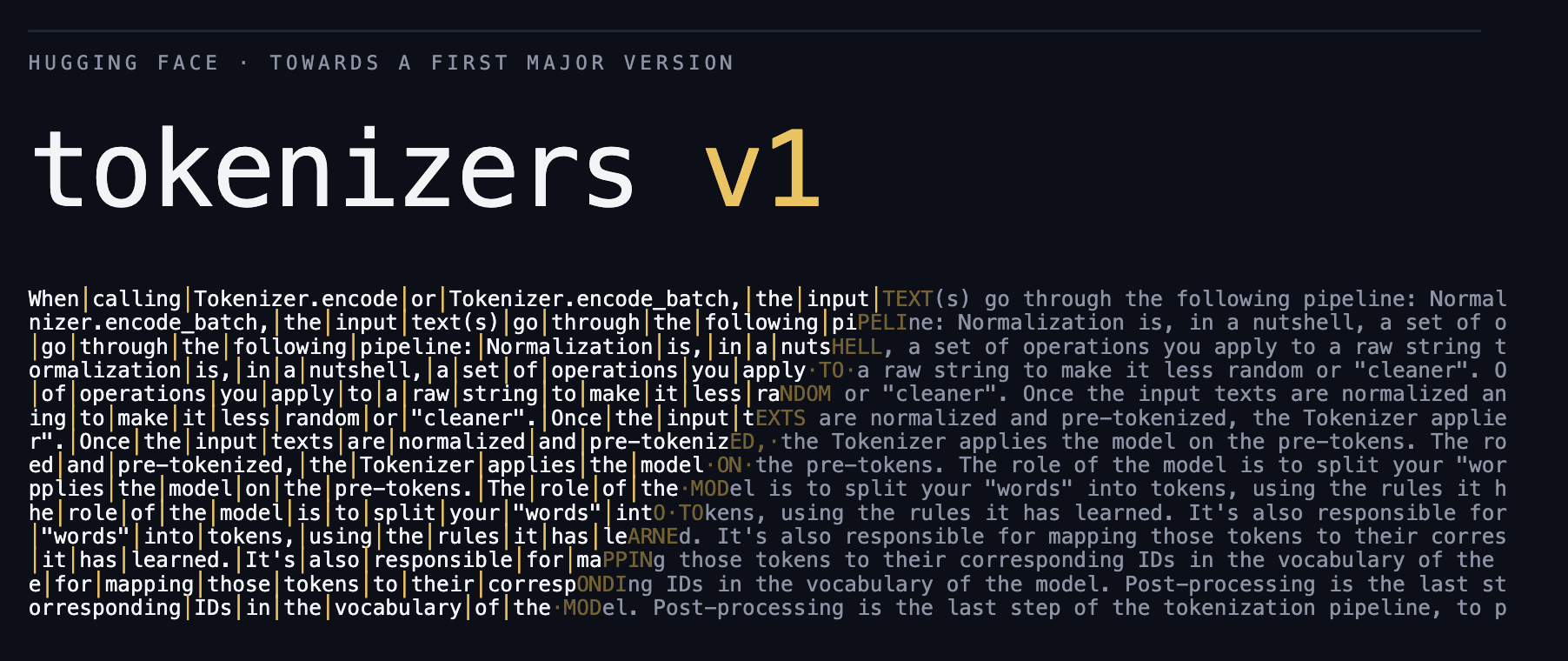
The upcoming version 1 release of tokenizers focuses on performance optimization to prevent data bottlenecks in machine learning pipelines. By ensuring tokenization scales with modern compute demands, the update aims to keep GPUs fully utilized and efficient.
The Evolution of Tokenization in Machine Learning
Historically, the tokenizer has been an overlooked component of the machine learning pipeline, often viewed as a lightweight preprocessing step that rarely interferes with overall system performance. Because the computational intensity of model training and inference typically dwarfs the requirements of tokenization, developers have rarely prioritized its optimization. However, as the industry pushes toward massive datasets and real-time, high-concurrency applications, this traditional understanding is being challenged.
The Shifting Bottleneck
The fundamental issue arises from the disparity between CPU-bound tokenization and GPU-bound model execution. While GPUs are designed for massive parallelization, tokenization tasks are often serial or memory-bound, leading to scenarios where the model is starved of data. As models become faster and more efficient, the overhead of converting raw text into numerical representations becomes a significant drag, causing GPUs to sit idle while waiting for the CPU to catch up.
Scaling for Modern Workloads
The upcoming v1 release of tokenizers addresses this by explicitly focusing on performance as a core feature. By optimizing the architecture to handle larger datasets and more complex, longer inputs, this update ensures that the preprocessing phase scales in lockstep with the model's compute requirements. This is critical for training runs that span days or weeks, where even minor inefficiencies in data ingestion accumulate into significant time and cost losses.
GPU Utilization and Efficiency
A primary goal of this optimization is to eliminate the 'starvation' effect. When tokenization is optimized to be lightweight and high-throughput, it ensures that the data pipeline is always full. By minimizing the latency between the raw input and the model's input layer, the system maintains high GPU utilization, which is the most expensive and critical resource in any modern machine learning infrastructure.
Future Implications for ML Pipelines
Looking forward, as we move toward larger context windows and more complex multimodal models, the efficiency of the tokenizer will remain a central pillar of performance engineering. By prioritizing v1, the developers are setting a new standard for how preprocessing modules should be built: not as an afterthought, but as a high-performance component capable of keeping pace with the rapid evolution of hardware acceleration.
Conclusion
Ultimately, the shift toward performance-focused tokenization is a necessary maturation of the machine learning ecosystem. By addressing the bottleneck at the input layer, these improvements provide a more robust foundation for the next generation of large-scale AI models. This evolution ensures that software capabilities can effectively leverage the raw power of modern hardware, creating a more balanced and efficient training and serving pipeline.