What is Iran's Pickaxe Mountain and why has Trump threatened to strike it? Explained
Source Entity
Latest News: Today's Latest News Headlines from India & World | Hindustan Times | Hindustan Times
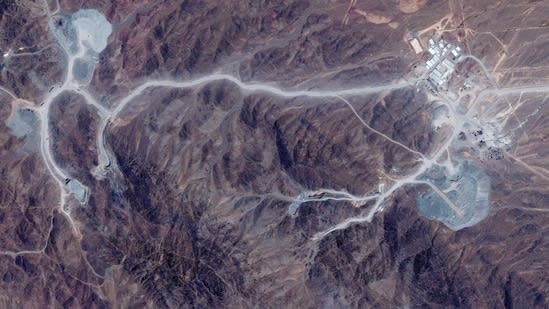
Former President Donald Trump has intensified geopolitical tensions by threatening to target 'Pickaxe Mountain,' a highly fortified site associated with Iran's nuclear program, signaling a potential return to a 'maximum pressure' strategy against Tehran.
Escalation in the Shadow of the Mountain: Analyzing Trump's Threat to Pickaxe Mountain
The recent declaration by Donald Trump regarding a potential strike on 'Pickaxe Mountain' marks a significant escalation in the rhetoric surrounding the long-standing conflict between the United States and the Islamic Republic of Iran. This specific threat targets a facility deeply embedded within Iran's strategic infrastructure, signaling that the U.S. perspective on Iranian nuclear proliferation remains a primary security concern. The mention of a specific site suggests a level of intelligence gathering and targeting precision that is intended to serve as both a deterrent and a warning to the Iranian leadership.
The Strategic Significance of Fortified Facilities
Pickaxe Mountain represents a broader Iranian strategy of 'hardening' its nuclear assets. By constructing facilities deep within mountain ranges, Iran seeks to protect its centrifuges and uranium enrichment capabilities from conventional aerial bombardments. These sites are often reinforced with meters of concrete and rock, making them nearly impervious to standard munitions. From a military analysis perspective, targeting such a site would require the deployment of specialized 'bunker-buster' bombs, such as the Massive Ordnance Penetrator (MOP), highlighting the extreme level of force Trump is contemplating to neutralize these capabilities.
Historical Context and the 'Maximum Pressure' Doctrine
This threat does not exist in a vacuum but is a continuation of the 'Maximum Pressure' campaign initiated during Trump's first term. The historical pivot occurred with the U.S. withdrawal from the Joint Comprehensive Plan of Action (JCPOA), the 2015 nuclear deal. By shifting from diplomatic containment to economic sanctions and targeted military threats, the U.S. aimed to force Iran back to the negotiating table under more stringent terms. The focus on Pickaxe Mountain is a tactical evolution of this strategy, moving from broad economic pressure to the explicit threat of kinetic action against high-value nuclear targets.
Geopolitical Implications and Regional Stability
The implications of such a threat extend far beyond the borders of Iran and the U.S. Regional powers, particularly Israel and Saudi Arabia, view Iranian nuclear ambitions as an existential threat. A U.S. commitment to strike fortified sites like Pickaxe Mountain may embolden these allies or, conversely, push them toward their own independent military actions if they perceive U.S. rhetoric as insufficient. Furthermore, such threats risk triggering a retaliatory cycle, where Iran might respond via its network of proxies in Iraq, Syria, or Yemen, potentially destabilizing the entire Middle East.
Predicting Future Trends in US-Iran Relations
Looking forward, the rhetoric surrounding Pickaxe Mountain likely serves two purposes: signaling resolve to the international community and creating leverage for future diplomatic maneuvers. If Trump returns to power or influences current policy, we can expect a renewed focus on the 'hard targets' of the Iranian program. However, the risk of a full-scale war remains a deterrent. The trend will likely oscillate between high-intensity threats designed to coerce Iran into limiting its enrichment levels and periods of clandestine diplomacy aimed at preventing a catastrophic military engagement.
Summary of the Crisis
In conclusion, the threat to strike Pickaxe Mountain is a calculated move that underscores the volatility of US-Iran relations. By targeting the physical heart of Iran's nuclear resilience, the U.S. is challenging Tehran's belief that its underground facilities provide absolute safety. Whether this leads to a diplomatic breakthrough or a military confrontation depends on Iran's willingness to scale back its nuclear ambitions in the face of an increasingly aggressive U.S. posture.
Verification Required?