Launch HN: Agnost AI (YC S26) – Extract user feedback from agent conversations
Source Entity
Hacker News
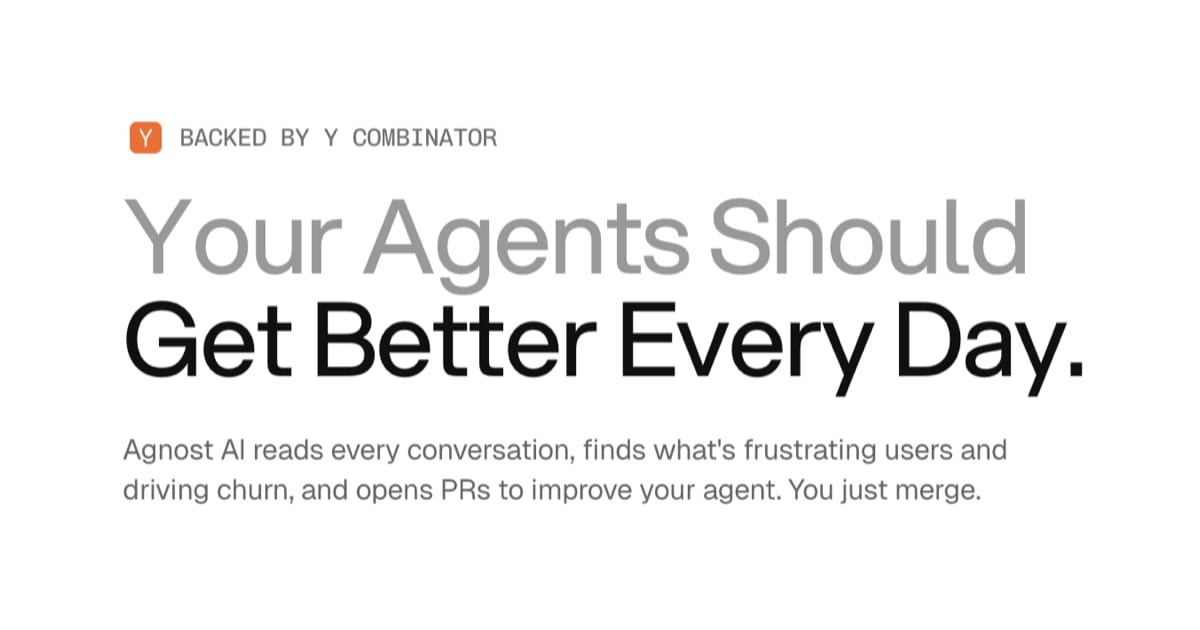
Agnost AI, a Y Combinator S26 startup, has launched a specialized tool on Hacker News designed to automatically extract and synthesize actionable user feedback from conversations between users and AI agents.
Analyzing Agnost AI: Closing the Feedback Loop for AI Agents
Introduction
The emergence of Agnost AI, recently introduced via a "Launch HN" post, marks a critical pivot in the evolution of the AI agent ecosystem. As enterprises shift from simple chatbots to complex autonomous agents, the primary challenge has shifted from deployment to optimization. Agnost AI addresses this by providing a mechanism to extract structured user feedback directly from conversation logs, transforming raw dialogue into actionable product intelligence. This launch signals a growing market demand for "AI observability" tools that focus specifically on the qualitative user experience rather than just technical performance metrics.
The Challenge of Agentic Noise
In the current landscape of Large Language Model (LLM) implementations, companies are often flying blind. While they can track quantitative metrics—such as token usage, latency, and success rates—they struggle to capture the why behind user frustration or the specific desires for new features hidden within thousands of hours of conversation. Manual review of these logs is an impossible task at scale. Agnost AI enters this gap, utilizing AI to analyze AI, effectively filtering through the noise of routine interactions to identify high-signal feedback. This allows product managers to understand precisely where an agent is failing to meet user expectations without manually auditing thousands of transcripts.
Strategic Positioning and Y Combinator Validation
Being part of the Y Combinator (YC S26) cohort provides Agnost AI with significant institutional validation and a strategic network. YC has historically been a bellwether for shifts in the tech industry, and their backing of a tool specifically for agent feedback suggests a belief that the "Agentic Era" is moving into a phase of maturity. The focus is no longer just on the ability of an agent to perform a task, but on the ability of the human operator to iterate on that agent based on real-world usage. This positioning places Agnost AI at the intersection of Product Management (PM) tools and AI infrastructure.
The Virtuous Cycle of Product Iteration
The broader implication of Agnost AI's technology is the creation of a closed-loop system for AI development. Historically, the feedback loop for software was: User finds bug $\rightarrow$ User files ticket $\rightarrow$ Developer fixes bug. With AI agents, the feedback is often implicit; a user might simply stop using the agent or express frustration in a way that doesn't trigger a formal support ticket. By automatically extracting this feedback, Agnost AI enables a proactive iteration cycle where product teams can identify friction points in real-time and update the agent's prompts, knowledge base, or tool-access permissions immediately, thereby increasing user retention and satisfaction.
Future Trends in AI Observability
Looking forward, the trajectory of tools like Agnost AI suggests a move toward "Autonomous Product Management." We can predict a trend where feedback extraction evolves into automated suggestion engines—where the system not only identifies that users want a specific feature but also proposes the exact prompt adjustment or API integration needed to solve the problem. As agents become more autonomous and handle more complex workflows, the need for sophisticated qualitative analysis tools will only grow, moving the industry away from simple A/B testing toward deep, semantic understanding of user intent and dissatisfaction.
Conclusion
Agnost AI is tackling a fundamental bottleneck in the scaling of AI agents. By converting conversational data into structured feedback, they are providing the necessary infrastructure for the next generation of AI-driven products to evolve based on evidence rather than intuition. For any organization deploying agents at scale, the ability to listen to the user at scale is not just a luxury, but a necessity for long-term viability in a competitive AI market.