Boston Dynamics tries using ‘robot dogs’ for deliveries
Source Entity
Andrew Liszewski
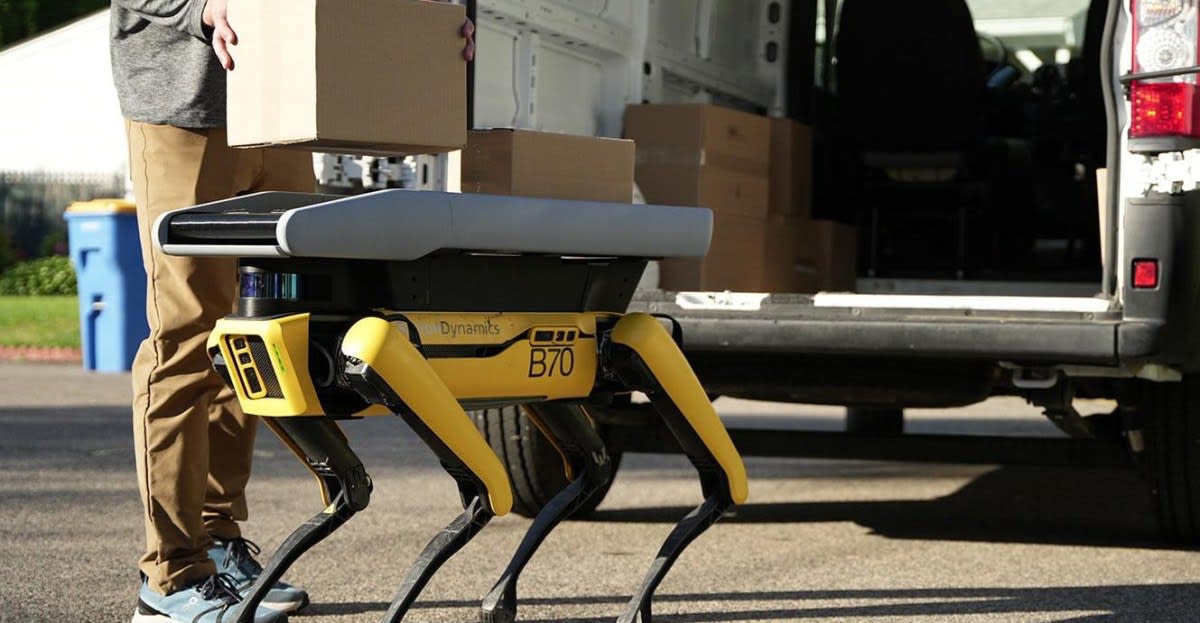
Boston Dynamics is testing a new conveyor belt accessory for its Spot robot, enabling the quadruped to autonomously transport packages from delivery vehicles directly to customers' doorsteps.
The Evolution of Last-Mile Logistics: Boston Dynamics’ Spot Enters Delivery
Boston Dynamics, a global leader in advanced robotics, is expanding the operational scope of its quadruped robot, Spot. While the platform has already proven its worth in high-stakes industrial inspections and cultural preservation—most notably patrolling the ancient ruins of Pompeii—the company is now pivoting toward the "last-mile" delivery challenge. By introducing a specialized conveyor belt accessory, Boston Dynamics aims to bridge the final, most difficult gap between a delivery vehicle and a customer's front door.
Overcoming the "Last-Mile" Hurdle
The "last-mile" is widely regarded as the most expensive and inefficient segment of the entire supply chain. Traditional wheeled delivery robots, while effective on flat pavements, often struggle with curbs, stairs, and uneven terrain, which limits their utility in diverse urban or suburban environments. Spot’s quadruped design provides a distinct mechanical advantage; its ability to navigate complex, non-linear environments allows it to traverse obstacles that would stop a wheeled bot in its tracks. The addition of a conveyor belt system allows for a seamless transition of goods from a transport vehicle to the robot and finally to the doorstep, significantly reducing the need for human intervention in the final stage of transit.
From Industrial Inspection to Consumer Service
This shift marks a significant transition in Spot's deployment strategy. For years, Spot has been marketed as a tool for "dull, dirty, and dangerous" jobs—inspecting oil rigs, monitoring construction sites, or navigating hazardous ruins where human presence is risky. By applying this same agility to logistics, Boston Dynamics is attempting to commoditize the robot's mobility. This move suggests a broader strategic goal: transforming a high-end industrial tool into a scalable solution for the global e-commerce infrastructure, moving from niche B2B applications to a broader service-oriented model.
Technical and Societal Implications
The integration of autonomous delivery robots brings a host of technical and social challenges. While the conveyor belt accessory solves the physical handling of packages, the onboard AI must manage complex navigation in unpredictable residential areas filled with pets, children, and varying weather conditions. Furthermore, the "robot dog" aesthetic has historically sparked public debate regarding the militarization of robotics. Transitioning Spot into a utility-based delivery role may help reshape public perception, rebranding the technology as a helpful domestic assistant rather than a surveillance or security tool.
Future Trends in Autonomous Delivery
Looking ahead, the success of these tests could signal a move toward fully autonomous delivery ecosystems. If Spot can reliably navigate the "doorstep" phase, the industry may shift toward a hybrid model where large autonomous trucks act as mobile hubs, deploying a fleet of quadruped robots to handle the final few hundred meters of a journey. This would drastically lower operational costs for logistics giants and reduce traffic congestion caused by traditional delivery vans idling in residential streets, potentially redefining the architecture of urban commerce.
Conclusion
Boston Dynamics' experimentation with delivery accessories represents a bold step in the evolution of autonomous robotics. By leveraging Spot's existing agility and adding specific hardware for package handling, the company is tackling one of the most persistent problems in logistics. Whether these robots become a common sight in neighborhoods depends on the balance between technical reliability, cost-effectiveness, and public acceptance, but the potential for efficiency gains in the delivery sector is immense.