Volkswagen’s slippery new EV breaks a bunch of efficiency records
Source Entity
Andrew J. Hawkins
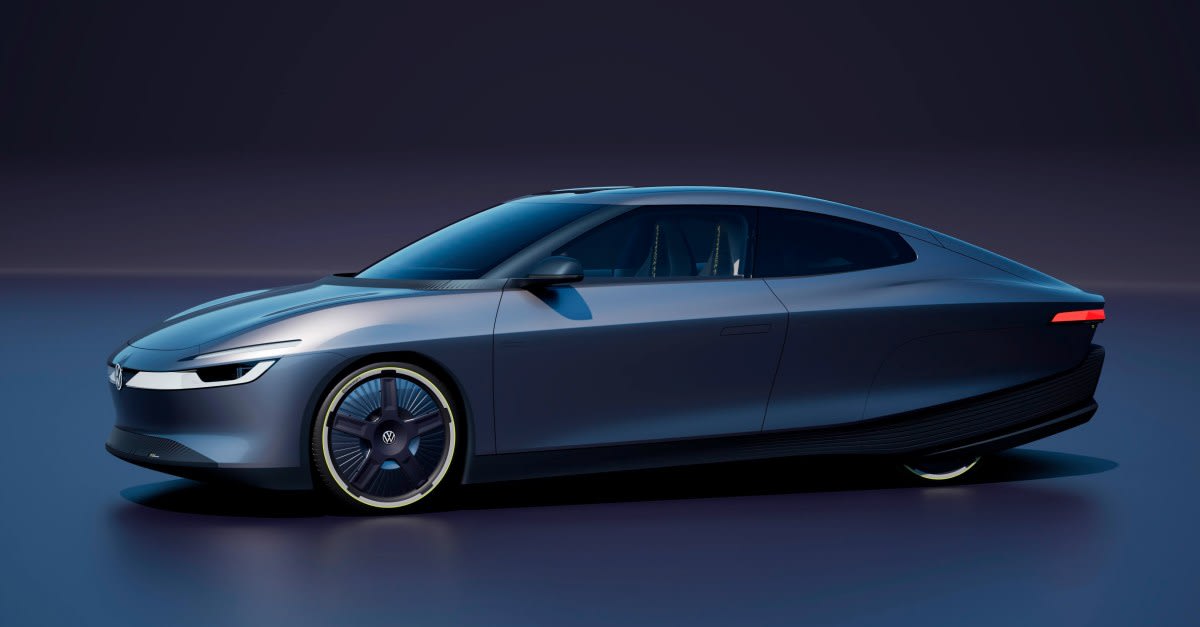
Volkswagen has unveiled its 'Mission Efficiency' prototype, an ultra-aerodynamic electric vehicle built on the MEB+ platform. The car achieved a record-breaking efficiency of 279 MPGe during a 794-mile test drive from Wolfsburg to Vienna.
Redefining Aerodynamic Efficiency: The VW Mission Efficiency
Volkswagen has officially unveiled the 'Mission Efficiency,' a near-production 2+2 seat electric coupe that challenges existing paradigms of automotive design. By achieving a drag coefficient of just 0.158, the vehicle has positioned itself as the world’s most aerodynamic road-approved car. This milestone is not merely a design exercise but a calculated demonstration of the capabilities inherent in Volkswagen’s modular MEB+ platform, which integrates front-wheel drive components destined for future models like the ID. Polo and ID. Cross.
Engineering the Future on the MEB+ Platform
The utilization of the MEB+ platform is a critical indicator of Volkswagen's broader electrification strategy. By incorporating components intended for mass-market vehicles into this high-efficiency prototype, VW is signaling that the aerodynamic principles and energy management systems tested here are intended to trickle down into their consumer-facing fleet. This approach bridges the gap between 'pie-in-the-sky' concept cars and the practical reality of scaling electric vehicle production for a global market.
Real-World Validation: Beyond the Wind Tunnel
Unlike many concept vehicles that rely solely on simulated data, Volkswagen validated the Mission Efficiency through an extensive 794-mile (1,278-kilometer) journey from Wolfsburg, Germany, to Vienna. The results were staggering: the prototype consumed only 7.51 kilowatt-hours per 100 miles, equating to roughly 279 MPGe. By completing this trip with a single charge and 104 miles of remaining range, Volkswagen has provided tangible proof that extreme aerodynamic optimization can drastically reduce energy consumption in real-world driving conditions.
The Competitive Landscape of Efficiency
The significance of this achievement becomes clear when compared to current industry benchmarks. With an efficiency rating nearly double that of the Lucid Air—currently recognized as one of the most efficient production vehicles available—the Mission Efficiency sets a new standard. This leap in performance suggests that future EV development will likely prioritize 'slippery' design profiles to maximize range without relying exclusively on larger, heavier battery packs.
Broader Implications and Future Trends
This development points toward a future where efficiency is prioritized as much as raw acceleration or battery capacity. As charging infrastructure continues to develop, the ability to extract more miles per kilowatt-hour will be the primary lever for reducing both the environmental footprint of EVs and the 'range anxiety' experienced by consumers. The Mission Efficiency serves as a proof-of-concept for how manufacturers can optimize vehicle architecture to improve sustainability.
Conclusion
Volkswagen’s Mission Efficiency is a transformative step forward in automotive engineering. By successfully blending high-tech aerodynamics with the modularity of the MEB+ platform, the company has proven that record-breaking efficiency is attainable for road-legal vehicles. As these technologies transition from the prototype phase to production lines, the industry can expect a shift toward sleeker, more energy-conscious electric vehicles that maximize every watt of power.