‘Bigger than internet’: Trump officially renames AI as ‘super intelligence’
Source Entity
VIJAYA SRIVASTAVA
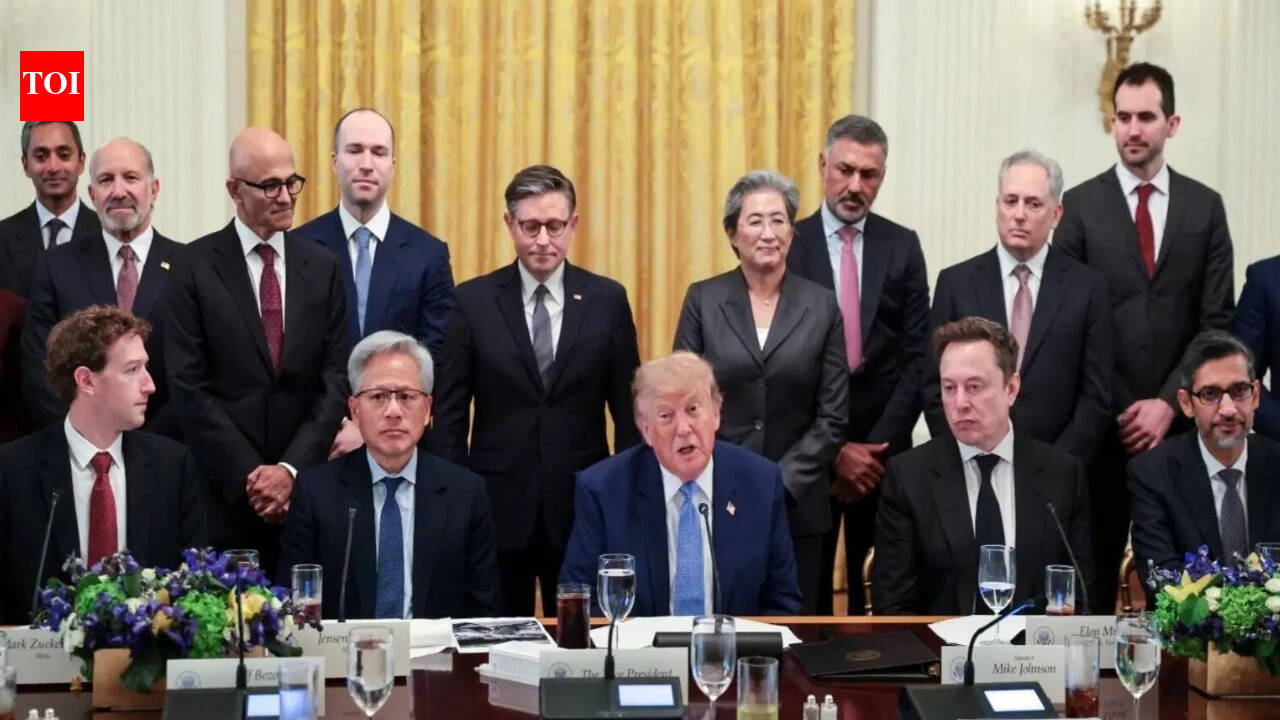
The White House issued an accord on 'super intelligence' featuring a typo that misspelled 'United States' as 'Unites States'. This event highlights President Trump’s controversial push to rebrand artificial intelligence amid public skepticism.
The White House AI Accord: A Typo in the Spotlight
In a recent high-profile gathering at the White House, President Donald Trump hosted leaders from the technology sector, including Nvidia CEO Jensen Huang and SpaceX CEO Elon Musk, to sign a voluntary accord aimed at the safe development of artificial intelligence. However, the event was quickly overshadowed by a significant clerical error: the official document, which bore the signatures of the President and six tech executives, identified the signatory as the 'President of the Unites States.'
The 'Super Intelligence' Rebranding Effort
Beyond the administrative error, the core focus of the meeting was President Trump’s aggressive campaign to rebrand 'artificial intelligence' as 'super intelligence.' This terminology has been utilized by the President during high-stakes diplomatic engagements, such as the visit by Chinese President Xi Jinping, and during his address at the United Nations General Assembly. By attempting to force this linguistic shift, the administration seeks to frame the technology as a monumental, transformative force that is 'far bigger than the internet,' rather than a mere technical advancement.
Navigating Public and Political Skepticism
This push for 'super intelligence' comes at a politically sensitive time. Recent polling suggests that the President’s vocal support for AI expansion and the proliferation of large-scale data centers may be negatively impacting his standing with voters ahead of the midterm elections. While industry leaders have voiced concerns that AI is evolving too rapidly for effective oversight, President Trump has largely dismissed these existential fears, choosing instead to emphasize the economic and strategic potential of the sector.
The Mechanics of the Accord
The document signed on Tuesday serves as a voluntary commitment to safety, attempting to bridge the gap between rapid innovation and regulatory necessity. Despite the gravity of the commitments made by the tech giants involved, the misspelling of the nation's name has raised questions regarding the vetting process for official presidential documents. It remains unclear whether this document will be entered into the Federal Register, which serves as the permanent record for official government actions, or if it will be amended to correct the error.
Future Implications for Tech Governance
This incident underscores the friction between the executive branch's desire to promote American technological dominance and the public’s growing apprehension toward AI. By branding the technology as 'super intelligence,' the administration is attempting to take ownership of the narrative surrounding AI’s future. However, the focus on branding rather than technical regulation may continue to alienate voters concerned about the real-world impacts of automation and data privacy. As the administration moves forward, the success of this initiative will be measured not by the name assigned to the technology, but by the ability of the government to manage the risks inherent in such rapid technological evolution.
Multiple Citing Sources