
Prerequisites for Industrial Scale
Before attempting to scale, an organization must secure three non-negotiable assets. First, an automated quality control system capable of in-process and release testing—exemplified by the Cell Q system—to remove human error from the validation loop. Second, a high-definition biological map of the target output to ensure consistency across batches. Third, a regulatory strategy that aligns with distributed manufacturing models, specifically those that allow a single hub to oversee multiple spoke units. Without these, scaling is merely an exercise in amplifying existing inefficiencies.
The Hard Truth
The bottleneck in synthetic biology is rarely the biology itself; it is the hardware and regulatory lag that prevents the biology from reaching the market.
Execution: The 7 Steps to Industrialization
- Insulate the pipeline through vertical integration of hardware and software.
- Automate in-process and release testing via integrated platforms.
- Phase market entry by targeting high-value, low-volume applications first.
- Implement a hub-and-spoke manufacturing model to decentralize production.
- Utilize AI to predict and model uncontrollable inter-lab variability.
- Anchor operations in mega-hubs with extreme talent density.
- Merge hardcore software engineering with molecular biology expertise.
Vertical integration is the only way to avoid the legacy equipment supplier bottlenecks that plague traditional biotech. Look at Neko Health. By engineering their own proprietary imaging hardware and clinical software in-house, they have insulated their pipeline from external delays. This strategy supported a $700 million Series C funding round to fuel their expansion into Manhattan. When you own the hardware, you control the speed of iteration. Why rely on a third-party vendor who does not share your urgency?
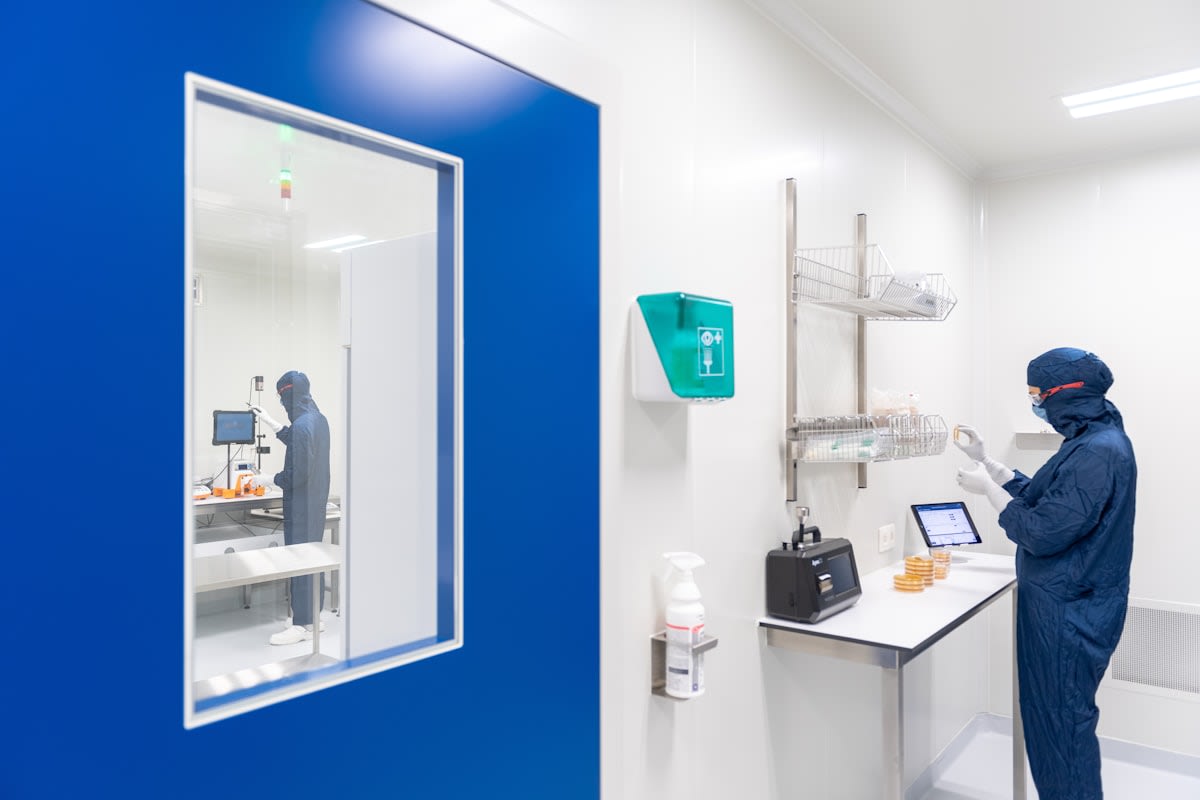
Automation must extend beyond the bioreactor. The collaboration between Cellares and Sonoma Biotherapeutics demonstrates the necessity of translating proprietary processes onto automated platforms like the Cell Shuttle. By automating the manufacturing of SBT-77-7101 engineered Treg cell therapy, they are moving toward commercial readiness. The goal is to achieve economics and throughput that manual processes simply cannot reach. If a human is still pipetting in your scale-up phase, you are not scaling; you are just hiring more technicians.
Market entry requires clinical precision. A KAIST research team recently analyzed the failures of bio-based chemical manufacturing, specifically focusing on PHAs. They found that polymers like P(3HB) are often too brittle and have a narrow window between melting and decomposition, making them poor direct drop-in replacements for conventional plastics. The solution? A phased approach. Start with high-value fields—medical applications and food packaging—where the material properties are an asset or the price premium is acceptable, before attempting to penetrate general-purpose markets.
| Metric | Traditional Biotech | Industrial SynBio |
|---|---|---|
| Production Model | Centralized Mega-Plant | Hub-and-Spoke Distributed |
| Quality Control | Manual Batch Testing | Automated In-Process (Cell Q) |
| Variability Management | Hardware Standardization | AI Predictive Modeling |
| Market Strategy | General Purpose Launch | High-Value Phased Entry |
The regulatory landscape is finally shifting to support distributed production. On July 10, 2026, the FDA proposed streamlined requirements for hub-and-spoke manufacturing models. In this system, a central hub oversees a unified pharmaceutical quality system across multiple spoke units in various locations. This allows companies to collectively evaluate data from multiple sites to develop a validation strategy. However, the FDA was clear: this does not apply to third-party outsourcing. You must maintain direct authority over the quality system at each site to qualify for this streamlined pathway.
Hardware cannot solve every variability problem. In mass spectrometry and proteomics, inter-lab variability remains a persistent ghost in the machine. The current shift, as discussed in recent BioTechniques forums, is to stop trying to eliminate variability solely through hardware. Instead, AI is being used to assess and predict the variability that cannot be controlled, integrating those predictions directly into the modeling process. This turns a biological liability into a computable variable.

Location is a strategic asset. While Boston and South San Francisco remain dominant, the scale of emerging hubs is staggering. Beijing, for instance, has a population of over 21 million—more than double the combined populations of the top US hubs. This creates an unparalleled concentration of talent. With 35 million square feet of lab and R&D space under construction globally as of 2024, the competition for the best software-biology hybrid talent is fierce. You need people who can solve hardcore engineering challenges while understanding the nuances of molecular chemistry.
"Simplicity scales: you get a high-definition map of your biology in less than 60 minutes, explained by an unhurried doctor, all in one location."— Tim Ferriss on Neko Health's model
The final step is the cultural merger of software engineering and biology. The industrialization of synbio is effectively a software problem applied to a biological substrate. The requirement is no longer just for biologists, but for systems architects who can design a global manufacturing footprint. Whether it is Cellares building factories in Europe and Japan or Neko Health managing a 350,000-person international waitlist, the winners are those who treat the biological process as a programmable sequence.
Common Pitfalls in Scaling
- Relying on third-party CMOs for distributed manufacturing, which excludes you from the FDA's streamlined hub-and-spoke registration.
- Attempting to launch bio-based plastics as direct drop-in replacements without addressing intrinsic material brittleness (e.g., P(3HB)).
- Over-investing in hardware to eliminate variability rather than using AI to predict and model it.
- Ignoring the necessity of vertical integration, leaving the pipeline vulnerable to legacy supplier bottlenecks.
- Scaling into general-purpose markets before proving viability in high-value medical or specialty packaging niches.