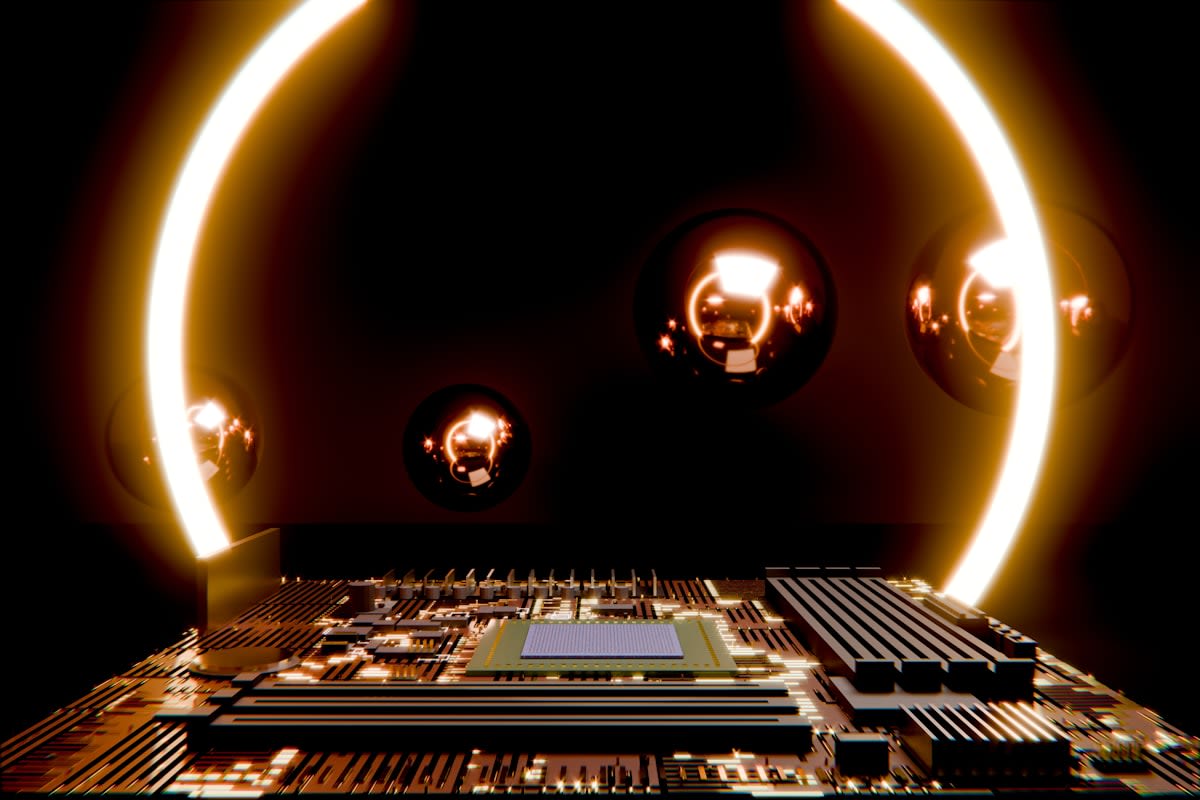
The $750 Billion Thermal Wall
The numbers are staggering, almost hallucinatory in their scale. The market has now attached a $750 billion valuation to the current AI infrastructure wave, a tide that has propelled NVIDIA to a Q1 FY2027 revenue of $81.61 billion, with its Data Center segment alone accounting for $75.25 billion. Alphabet is matching this aggression, guiding its 2026 capex between $180 billion and $190 billion to maintain its cloud dominance. But beneath these balance sheets lies a physical crisis: the thermal and energy limits of silicon-based GPU architectures. We are witnessing a collision between exponential software demands and the linear reality of heat dissipation.
Why does this matter right now? Because the current model of scaling is an arms race of attrition. Oracle’s cloud infrastructure revenue recently surged by 93%, reaching $5.79 billion, while its global GPU utilization sits at a breathless 97.5%. This level of saturation suggests that the industry is running out of headroom. When you are utilizing nearly every available transistor at maximum capacity, the only way forward is not to build a bigger GPU, but to change the medium of computation entirely. The shift from electrons to photons is no longer a theoretical luxury; it is the only exit ramp from the energy trap.
The Iron Triangle of AI
The AI era is defined by an 'Iron Triangle' of performance: Computing Power, Transport Power, and Storage Power, all resting on the physical foundation of Electrical Power. When one vertex of this triangle—computing power—outpaces the others, the entire ecosystem becomes unstable.
The Custom Silicon Pivot
The first sign of the GPU bottleneck breaking is the move toward hyper-specialized silicon. Anthropic is no longer shopping for better GPU deals; instead, it has entered substantive discussions with Samsung to co-develop a custom AI chip. This isn't just a hardware upgrade; it is a strategic declaration. By engineering a purpose-built inference chip designed specifically for the Claude model family, Anthropic is attempting to bypass the general-purpose inefficiencies of the GPU. They are optimizing at the transistor level, recognizing that the moat of the next decade will be built on how efficiently a model can execute, not just how much data it can ingest.
"Anthropic’s move into custom silicon with Samsung isn’t a hardware story — it’s a declaration of where the next competitive moat in AI gets built."— FourWeekMBA Analysis
This shift toward custom inference chips serves as the bridge to optical computing. Once a company controls the architecture of its own silicon, it can begin integrating photonic components that move data at the speed of light. The goal is to eliminate the 'transport power' bottleneck—the energy wasted moving data between memory and processor. If the processing can happen within the light stream itself, the energy cost of AI drops by orders of magnitude. We are moving from a world of 'computing power' to a world of 'transport power,' where the efficiency of the move is as important as the calculation.
Optical Modulators: The New Gatekeepers
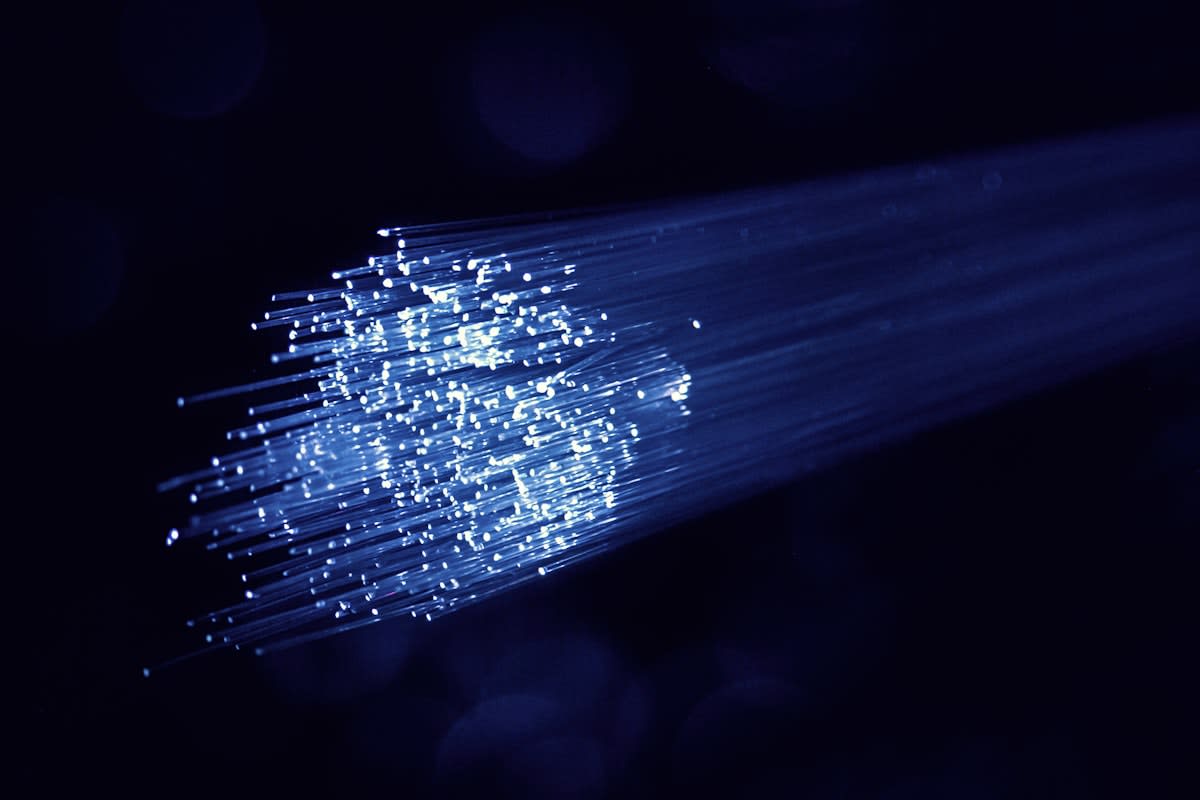
The real breakthrough is happening at the intersection of AI and materials science. Researchers have recently unveiled a deep reinforcement learning framework to design silicon-based photonic crystal fiber (PCF) optical modulators. By utilizing a Deep Q-Network (DQN), these researchers are iteratively optimizing the geometry of D-shaped fibers to achieve ultra-low insertion loss. This is a critical evolution; the modulator is essentially the switch that allows light to carry information. If the loss is too high, the signal dies; if it is too low, the system becomes an efficient, light-speed processor.
The secret weapon in this design is the integration of a VO2 phase-change layer. VO2 is prized for its reversible refractive index contrast, allowing the modulator to switch states with extreme precision. By using AI to design the hardware that will eventually run AI, we have entered a recursive loop of optimization. This photonic crystal fiber approach allows for a density of information transport that electronic circuits simply cannot match, effectively ending the era where the GPU's thermal output dictated the speed of the model's response.
The Quantum Leap in Integrated Photonics
While the West focuses on custom silicon, East Asia is pushing the boundaries of integrated photonics. Researchers at the China Mobile Research Institute and Peking University have demonstrated a new approach to multi-qubit entanglement that could redefine large-scale quantum systems. They successfully generated a 5-qubit Greenberger-Horne-Zeilinger (GHZ) state at a rate of 688 Hz with a fidelity of 0.956. This is a masterclass in precision; high fidelity is the difference between a quantum system that works in a lab and one that works in a data center.
The most disruptive element of this research is the use of 'ququarts.' By leveraging integrated photonics, the team reduced the physical-mode overhead from exponential to linear under specific circumstances. In the world of scaling, moving from exponential to linear is the ultimate victory. It means that adding more qubits to a system no longer requires an impossible increase in physical hardware. This capability enables the verification of quantum teleportation and phase estimation within a single ququart, showcasing a versatility that traditional electronic processors cannot replicate.
| Metric | Traditional GPU Scaling | Integrated Photonics (Ququarts) |
|---|---|---|
| Physical Overhead | Exponential | Linear (under certain conditions) |
| Data Medium | Electrons (Copper/Silicon) | Photons (Light) |
| Primary Constraint | Thermal/Heat Dissipation | Fidelity/Insertion Loss |
| Scaling Logic | Brute Force Hardware Addition | Integrated Mode Optimization |
Can we imagine a world where the 'GPU' is replaced by a photonic crystal lattice? The evidence suggests we are already building it. When you combine the 688 Hz entanglement rates seen in Beijing with the AI-driven modulator designs emerging from the photonic research community, the trajectory becomes clear. We are moving toward an architecture where the 'spiking' nature of neural networks—mimicking the human brain's efficiency—is mirrored by the discrete, high-speed pulses of light.
Investing in the Human Element
The transition to optical computing requires a complete overhaul of the talent pipeline. It is no longer enough to have software engineers; the world needs optics and photonics experts who can manipulate light at the nano-scale. This is why the recognition of emerging talent is so critical. For instance, Morgan Hasenmyer, a doctoral student at Montana State University, was recently awarded the 2026 Women in Optics Scholarship from SPIE. Her work in the Optical Remote Sensor Laboratory highlights the growing importance of the science of light—how it is generated, transmitted, and detected.
These scholarships are not just academic accolades; they are investments in the infrastructure of the future. As the industry pivots from the 'Iron Triangle' of electronic computing to the fluid dynamics of photonics, the people who understand how to manipulate a D-shaped photonic crystal fiber will be the architects of the next AI era. The battle for AI supremacy is shifting from who has the most GPUs to who has the best optical engineers.
The Verdict: The Post-GPU Era
The current $750 billion spending wave is a transition period. We are seeing the peak of the 'electronic era' of AI, where we throw more electricity and more silicon at the problem. But the data from this week shows the cracks are forming. When Anthropic pivots to custom silicon and China Mobile achieves linear overhead in quantum entanglement, the message is clear: the GPU is a stepping stone, not the destination. The future belongs to the speed of light.
The 'so what' is simple: the bottleneck is moving. We are shifting from a crisis of compute to a challenge of modulation. The winners of 2026 and beyond will not be those who bought the most H100s, but those who mastered the photonic crystal, the VO2 phase-change layer, and the integrated ququart. The logic of the future is not binary and electric; it is optical and instantaneous.