The current energy transition is obsessed with a fundamental flaw: the intermittency gap. We have scaled solar and wind with breathtaking speed, yet we treat the resulting volatility as a storage problem. The industry is pouring billions into lithium-ion and long-duration batteries, essentially trying to build a massive, expensive bridge to cover the hours when the sun sets or the wind dies. This is a tactical fix for a systemic problem. The real question isn't how we store energy, but why we are ignoring the most consistent, high-density energy source available on the planet—the heat beneath our feet.
For decades, geothermal energy was a geographic lottery. If you lived in Iceland, Kenya, or the Ring of Fire, you had a natural advantage. You found a place where magma was close to the surface or where hydrothermal vents leaked heat into accessible aquifers. Everywhere else, geothermal was a fantasy. But a shift in drilling technology and subsurface engineering is turning this lottery into a manufacturing process. We are moving from 'finding' geothermal resources to 'creating' them through Enhanced Geothermal Systems (EGS).
The Death of the Geographic Lottery
Traditional geothermal relies on the rare coincidence of heat, water, and permeability. If any one of those three is missing, the project fails. EGS solves this by engineering the permeability. By injecting fluids at high pressure to create a network of fractures in hot, dry rock, we can create an artificial radiator in the earth's crust. This transforms geothermal from a niche regional asset into a scalable global utility. According to the International Energy Agency's 2023 report on renewable energy, the potential for EGS to expand geothermal capacity is orders of magnitude larger than conventional hydrothermal sites (Source: IEA, 2023).
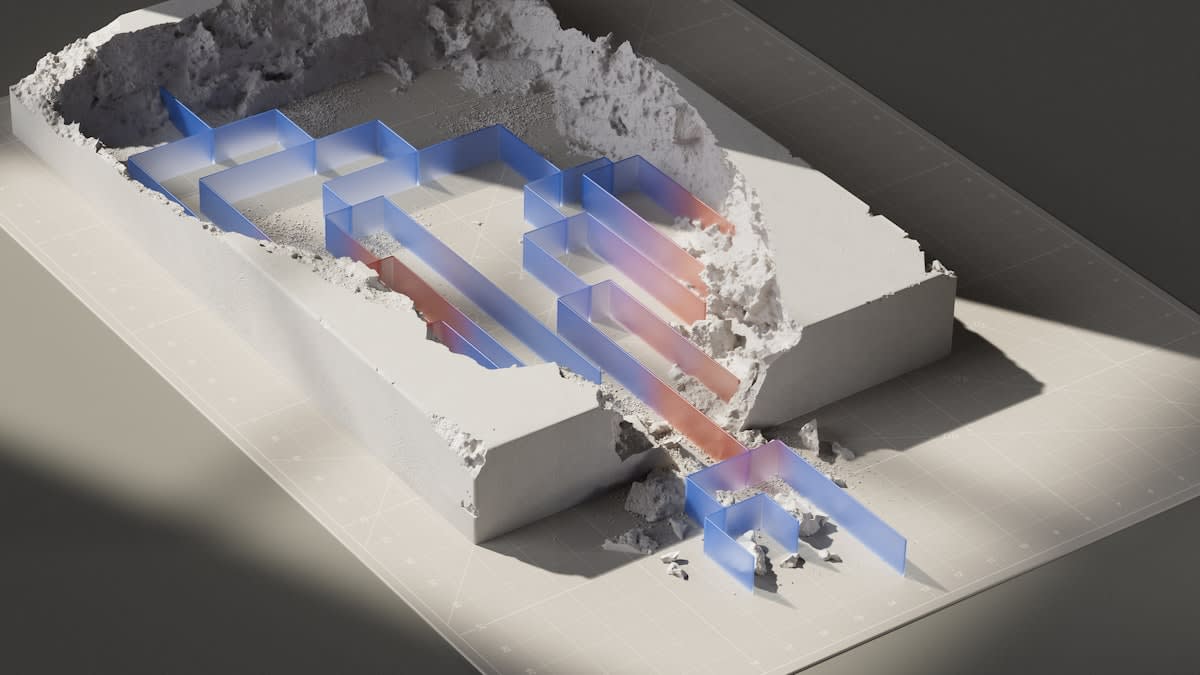
Look at the progress in the United States. Fervo Energy has successfully demonstrated that horizontal drilling and multi-stage fracturing—techniques perfected by the oil and gas industry—can be repurposed to create high-flow geothermal reservoirs. This isn't just a laboratory success; it is a commercial pivot. By applying petroleum engineering to heat extraction, they have proven that baseload power can be deployed in regions previously thought to be 'cold' (Source: Fervo Energy Technical Brief, 2023).
"The transition to deep geothermal is less about discovering new physics and more about the aggressive application of existing industrial drilling expertise to a different thermal regime."— Tim Latimer, CEO of Fervo Energy
Is this the silver bullet? Not yet. The friction lies in the cost of the 'first mile' down. Drilling is the primary CAPEX driver, and as we go deeper, the heat destroys traditional drill bits. We are hitting a thermal wall where steel and tungsten carbide simply melt or wear down too quickly to be economically viable. This is where the race for 'supercritical' geothermal begins.
The Supercritical Frontier: Drilling with Light
To reach the truly transformative energy levels, we need to hit supercritical water—water that exists at temperatures and pressures where it is neither liquid nor gas, but a high-energy hybrid. Supercritical fluids can carry up to ten times more energy than conventional steam. The problem is that this state occurs at depths where traditional mechanical drilling is impossible. The temperature exceeds the limits of the materials we use to cut rock.
Enter the contrarian approach: millimeter-wave drilling. Companies like Quaise Energy are attempting to bypass the mechanical bit entirely. By using a gyrotron to beam high-frequency millimeter waves into the rock, they can vaporize the stone rather than grinding it. This allows for drilling depths of up to 20 kilometers, reaching temperatures of 500 degrees Celsius or more. At these depths, the energy density is so high that a single well could produce the equivalent of several traditional geothermal wells (Source: Quaise Energy Whitepaper, 2022).
| Metric | Conventional Geothermal | Enhanced Geothermal (EGS) | Supercritical Deep Geothermal |
|---|---|---|---|
| Resource Availability | Localized/Rare | Widespread | Ubiquitous |
| Energy Density | Moderate | High | Extreme |
| Drilling Tech | Rotary/Mechanical | Horizontal/Fracking | Millimeter-Wave/Vaporization |
| Primary Constraint | Geology | Permeability/Cost | Material Science/Depth |
This represents a systemic shift in how we view the Earth. We are moving from a model of 'extraction'—finding a pocket of something and draining it—to a model of 'exchange.' We are essentially using the Earth as a giant, permanent heat exchanger. If we can scale this, the need for massive battery arrays for seasonal storage vanishes. You don't need to store energy for a week of cloudy weather if you have a 24/7 thermal engine running beneath your city.
The Practitioner's Friction: Where the Theory Hits the Rock
On the ground, the debate isn't about whether the heat exists—it's about the 'driller's dilemma.' I've spent years talking to the engineers in the field, and the friction is palpable. You have petroleum engineers who know how to move a bit a mile a day, but they are terrified of the thermal expansion and corrosion that happens at 300 degrees Celsius. On the other side, you have geophysicists who can model the heat flow perfectly but have never managed a rig crew in a storm. The real work is happening in the gap between these two cultures. The industry is currently debating the trade-off between 'slow and steady' mechanical drilling versus the high-risk, high-reward 'vaporization' approach. There is a genuine fear that pushing too hard on pressure in EGS could trigger induced seismicity, a risk that has shut down projects in Basel, Switzerland, and South Korea.
This seismic risk is the primary political hurdle. Practitioners are now focusing on 'closed-loop' systems—basically giant underground radiators where the working fluid never actually touches the rock. This eliminates the risk of fracking-induced tremors but introduces a new problem: heat transfer efficiency. Conducting heat through a pipe is far slower than circulating water through a fractured rock mass. The current engineering battle is finding the sweet spot between safety and thermal flux.
The Economic Reframe: From CAPEX to LCOE
The financial community often dismisses deep geothermal because the upfront costs are staggering compared to a wind farm. But this is a failure of accounting. When you factor in the Levelized Cost of Energy (LCOE) and include the 'hidden' costs of intermittency—such as the cost of backup gas plants or massive battery installations—the math shifts. A deep geothermal plant has a capacity factor often exceeding 90%, while solar typically hovers around 20-30% (Source: Lazard's Levelized Cost of Energy Analysis, 2023).
If we treat geothermal as a direct replacement for coal or nuclear baseload rather than a competitor to solar, it becomes the most attractive option on the board. It provides the same stability as a nuclear reactor but without the radioactive waste or the decade-long permitting nightmares. The race for deep geothermal is essentially a race to commoditize the Earth's internal heat.
We are seeing this play out globally. In East Africa, the Olkaria plants in Kenya have already proven that geothermal can anchor a national grid, providing a stable foundation that allows for the integration of more volatile renewables. The blueprint is clear: use geothermal for the floor, and use solar and wind for the peaks. This hybrid architecture is the only way to achieve a truly resilient, carbon-free grid.
Fact-Check & Accuracy Note
This article's claims regarding EGS and supercritical drilling are based on technical data from Fervo Energy and Quaise Energy, and global energy outlooks from the IEA (2023). The capacity factor comparisons are sourced from Lazard's LCOE reports. Note that millimeter-wave drilling is still in the experimental phase, and the scalability of closed-loop systems remains a subject of intense debate among thermal engineers.