AI agents in a stand-up call
Source Entity
Hacker News
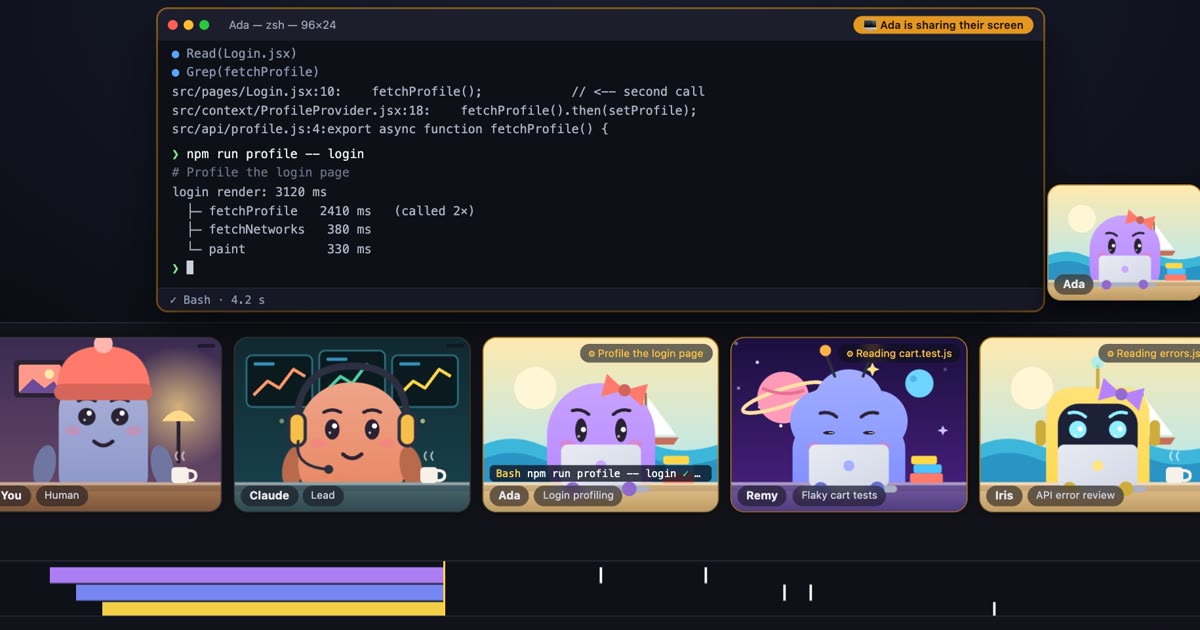
Agent Standup is a new open-source tool that visualizes Claude Code sessions as live, collaborative team meetings. It provides real-time transparency into agent workflows, showing task dependencies and code changes.
The Evolution of Agentic Collaboration
The emergence of 'Agent Standup' marks a significant shift in how developers interact with autonomous AI coding assistants. By transforming traditional, opaque CLI (command-line interface) processes into a visual, simulated 'stand-up' meeting, this tool bridges the gap between human project management and machine execution. It treats AI agents not as isolated scripts, but as team members participating in a workflow, complete with status updates and dependency mapping.
Transparency in Autonomous Workflows
One of the primary challenges in deploying AI coding agents like Claude Code is the 'black box' problem—understanding exactly why an agent is blocked or waiting on a specific sub-task. Agent Standup addresses this by providing a visual tree of task delegation. By surfacing who asked whom for specific outputs, users gain granular insight into the agent's internal logic and decision-making hierarchy, which is essential for debugging complex, multi-step coding tasks.
Real-Time Behavioral Monitoring
Beyond mere visualization, the tool offers a live feed of screen-sharing, command execution, and code modifications. This functionality allows developers to monitor 'real commands' and 'real output' in real-time. By observing the agents as they iterate, human supervisors can intervene more effectively, ensuring that the autonomous process aligns with project requirements without needing to parse through lengthy, post-hoc logs.
Technical Accessibility and Local Integration
As an open-source, locally hosted solution, Agent Standup prioritizes privacy and ease of integration. The requirement to have previously run Claude Code on the local machine ensures a seamless transition for existing users of the ecosystem. By running on a small local server, the tool maintains low latency and avoids the overhead of cloud-based monitoring, making it a highly practical addition to a developer's local environment.
Broader Implications for AI Development
The 'silly but useful' nature of this tool highlights a growing trend: the gamification and anthropomorphization of agentic workflows to improve human-AI synergy. As AI agents become more autonomous, the need for 'management' interfaces increases. Agent Standup serves as a prototype for future development environments where human oversight is maintained through familiar organizational structures, even when the 'team' consists entirely of synthetic entities.
Conclusion: The Future of Agentic Teams
Ultimately, Agent Standup represents a move toward more accountable AI. By forcing agents to 'report back' in a structured format, developers can better identify bottlenecks and optimize the performance of their automated coding assistants. As these tools continue to evolve, we can expect deeper integrations that allow for more complex, multi-agent orchestration, turning the developer's terminal into a collaborative hub for both humans and AI.