Serving GLM-5.3 at 607.8 tok/s across two Nvidia DGX stations with vLLM
Source Entity
Hacker News
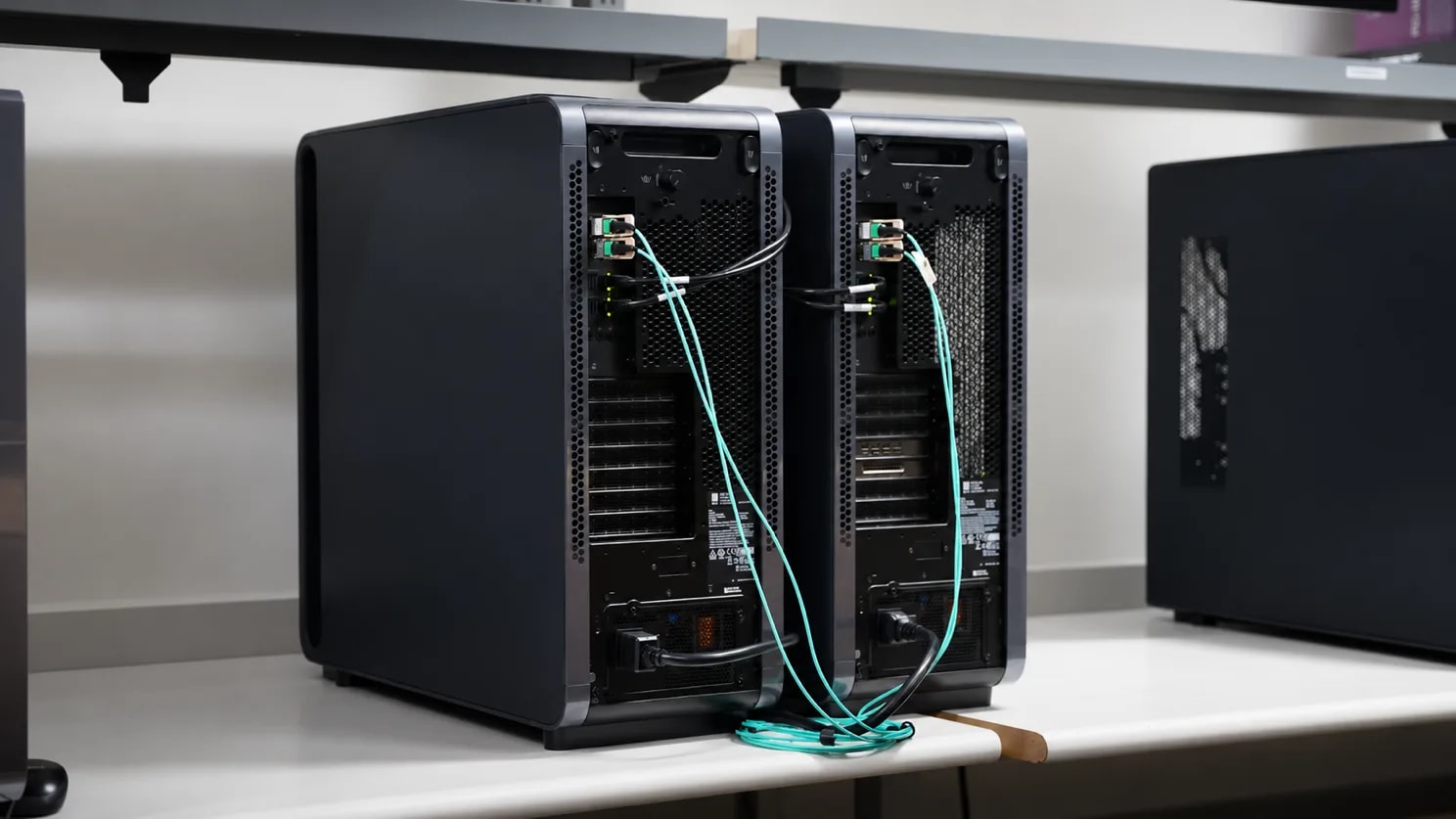
Technical advancements in local LLM deployment allow for running massive models like the 753B parameter GLM-5.3 across multi-node GPU clusters. Simultaneously, new quantization techniques for the Qwen3.8-27B model are significantly enhancing accuracy and efficiency for local inference.
Scaling Frontier Models Through Multi-Node Inference
The landscape of local large language model (LLM) deployment is undergoing a paradigm shift as model sizes outpace the physical memory constraints of single-GPU workstations. The successful serving of the GLM-5.3 model at 607.8 tokens per second demonstrates a critical breakthrough in distributed inference. By utilizing two NVIDIA DGX stations connected via ConnectX-8 RDMA, engineers are overcoming the limitations of HBM3e capacity, which currently caps out at 252 GB per GB300 GPU, well below the 464 GB required for the GLM-5.3 checkpoint.
The Mechanics of Tensor Parallelism
At the heart of this achievement is the implementation of tensor parallelism, which allows the 753-billion-parameter mixture-of-experts (MoE) model to be split across hardware boundaries. While MoE architectures like GLM-5.3 utilize sparse activation—only engaging 40 billion parameters per token—the entire weight set must remain resident in GPU memory to facilitate real-time routing to different experts. This setup proves that high-bandwidth interconnects are the new bottleneck for frontier-scale inference, necessitating RDMA-based solutions to maintain throughput.
Advancements in Model Quantization
Parallel to the scaling of massive models, the ecosystem for smaller, dense models is seeing rapid optimization. The release of Unsloth quantizations for the Qwen3.8-27B model represents a significant leap in efficiency. By enabling a 27B parameter model to run on 17GB of VRAM while maintaining a 256K context window, developers are democratizing access to high-level reasoning and vision capabilities previously reserved for cloud-based APIs.
The Impact of Dynamic Quants
The introduction of 'Dynamic' quants in the latest Unsloth update serves as a pivotal evolution in model compression. Initial data suggests a 5-10% improvement in average accuracy across benchmarks like Terminal Bench and DeepSWE. This indicates that the field is moving away from static, lossy compression toward intelligent, context-aware quantization methods that preserve model intelligence even as parameter precision is reduced.
Agentic Workflow Integration
Beyond raw inference speed and accuracy, the update highlights a growing focus on agentic tools. Enhanced support for developer roles and improved parsing of nested objects for tool calling are essential for integrating LLMs into automated coding environments. As these models become more capable of executing complex, multi-step tasks, the demand for robust, local, and low-latency inference will only continue to rise.
Future Trends in Local AI
Looking forward, the convergence of multi-node scaling and refined quantization techniques suggests a future where 'frontier-scale' performance is no longer tethered to massive data centers. As techniques like those applied to Qwen4 and beyond continue to mature, we can expect the gap between local performance and cloud-hosted model capabilities to narrow significantly, providing developers with unprecedented control over their AI infrastructure.