Middle-Class Career Ladder Is Changing: What Happens When AI Takes Over Entry-Level Work
Source Entity
NDTV News Search Records Found 1000
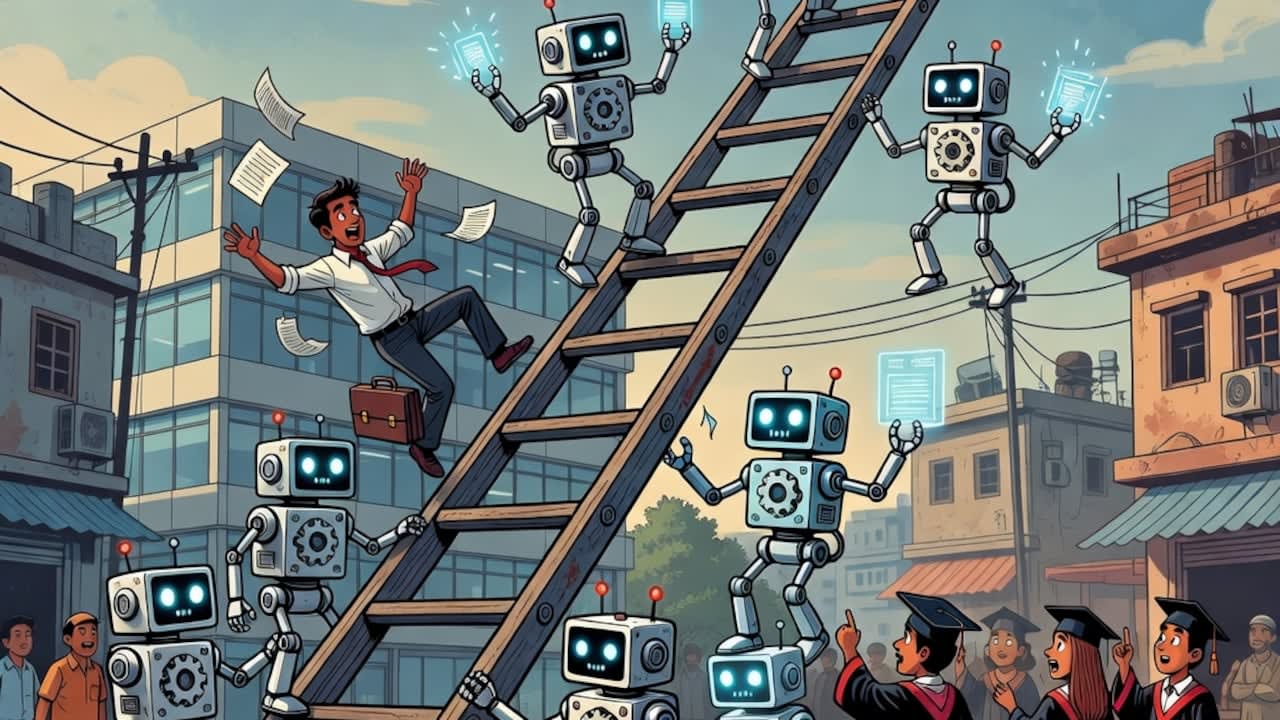
Artificial intelligence is increasingly automating entry-level roles, disrupting traditional career progression for recent graduates. This shift forces a reevaluation of how companies train new talent and how young professionals prepare for the workforce.
The Disruption of the Professional Entry Point
Artificial intelligence is rapidly taking over repetitive tasks that were once considered the bedrock of entry-level positions for fresh graduates. For decades, the professional career ladder relied on a 'learn-by-doing' model, where recent college graduates would spend their first few years performing data entry, basic research, or routine report generation. This period served as a critical apprenticeship, allowing juniors to understand the mechanics of their industry before moving into complex, strategic decision-making roles. The emergence of AI tools capable of executing these tasks with superior speed and accuracy is effectively dismantling this traditional training ground.
The Erosion of the Apprenticeship Model
When AI absorbs the monotonous tasks once assigned to interns and junior associates, the fundamental structure of organizational talent development is challenged. If these foundational roles disappear, companies face a significant 'experience gap.' Without the opportunity to perform basic tasks, junior employees may struggle to develop the foundational knowledge required for senior-level management. This creates a paradox where organizations must find new, accelerated ways to bridge the gap between academic theory and practical application, as the traditional rungs of the career ladder are being bypassed by automation.
Economic and Structural Implications
From a macroeconomic perspective, this shift suggests a fundamental change in how corporations value human labor. As AI becomes the primary engine for high-volume, low-complexity output, the demand for entry-level human workers may stagnate or shift toward roles that require high-level emotional intelligence, complex problem-solving, or nuanced human-to-human interaction. Organizations are currently navigating this transition by weighing the cost-efficiency of AI against the long-term necessity of cultivating human expertise. The risk here is a 'hollowing out' of the middle class, where the path to professional maturation becomes steeper and less accessible.
Adapting to the New Professional Reality
To survive this technological pivot, the labor market must evolve. Educational institutions and corporate training programs will likely need to focus on teaching 'AI-augmented' workflows rather than traditional manual processes. Graduates must now enter the workforce with a higher baseline of technical literacy, capable of managing and overseeing AI outputs rather than simply generating data from scratch. The focus of early career development will likely pivot toward critical thinking, ethical judgment, and creative synthesis—areas where human intervention remains superior to algorithmic processing.
Future Trends and Outlook
Looking ahead, we can expect a bifurcated job market. The entry-level roles of the future will likely require a higher level of specialization from day one, leaving less room for the exploratory learning that characterized the 20th-century workplace. While this could lead to higher productivity and innovation, it also poses a significant risk to social mobility. If the barriers to entry rise, the burden falls on both policy makers and employers to create new, structured pathways for talent development that account for an AI-integrated reality. The challenge lies in ensuring that the efficiency gains of AI do not inadvertently shut out the next generation of professional talent.
Verification Required?