Ancient Roman shipwreck discovered off Sicily coast
Source Entity
BBC News
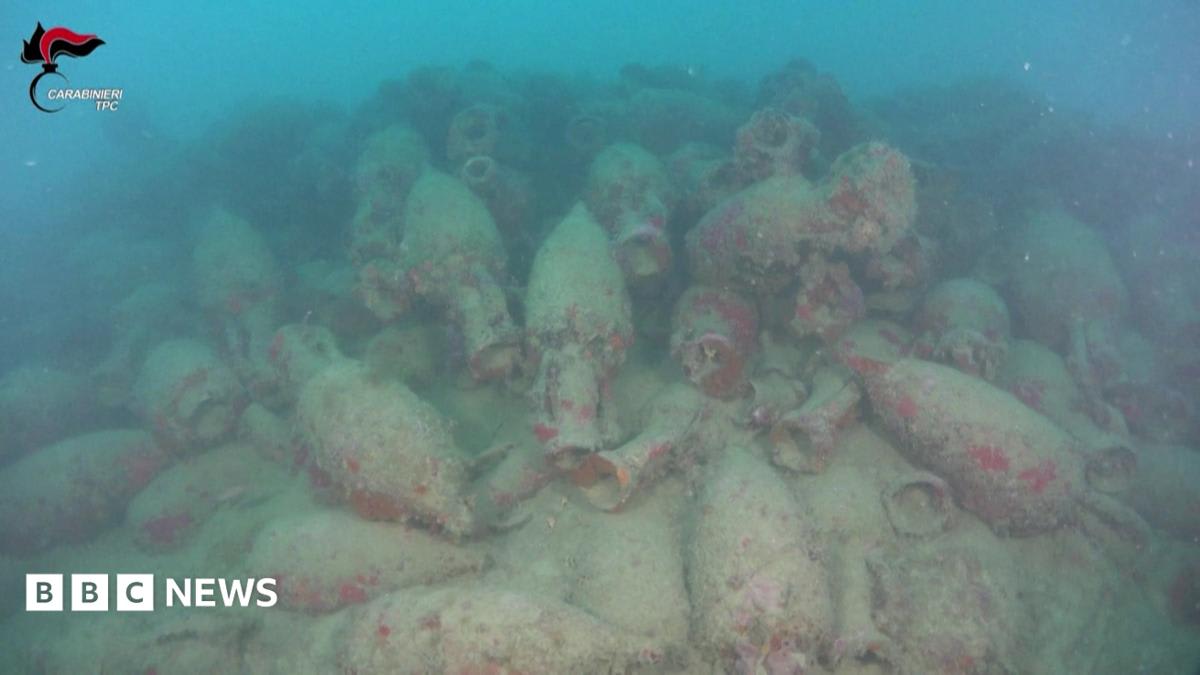
Italian divers have discovered a remarkably well-preserved 2,000-year-old Roman shipwreck off the coast of Sicily. Loaded with ancient trade goods, the vessel is being hailed as one of the most significant underwater archaeological finds in recent years.
An Unprecedented Glimpse into Roman Maritime Trade
The recent discovery of an ancient Roman shipwreck off the coast of Sicily marks a significant milestone in Mediterranean archaeology. Italian specialist police divers, acting on a tip-off from local fishermen, located the vessel resting at a depth of 46 meters (150 feet). Measuring 21 meters long and 6 meters wide, the ship provides a tangible connection to the maritime logistics that once fueled the Roman Republic’s economic engine during the second or 1st Century BC.
The Cargo: A Window into Ancient Commerce
What distinguishes this particular find is the remarkably well-preserved state of its cargo. The ship was discovered piled high with hundreds of containers, likely amphorae, which served as the standard shipping vessels of the ancient world. These containers were essential for the transport of vital commodities, primarily wine and olive oil, which were the lifeblood of Roman trade networks. The integrity of these goods suggests that the vessel may have settled into the seabed in a manner that protected it from the typical erosion and biological degradation seen in shallower waters.
The Role of Local Knowledge
The discovery underscores the critical role that local communities—specifically fishermen and free-divers like Giacomo De Mola—play in the preservation of cultural heritage. By surveying the seabed and reporting their findings, these individuals act as the first line of defense for historical sites. This collaborative effort between local maritime workers and the Italian culture ministry highlights a growing trend in archaeology where citizen science is becoming instrumental in mapping the submerged history of the Mediterranean.
Cultural and Historical Significance
Italy's Culture Minister, Alessandro Giuli, has officially classified the wreck as one of the most important underwater discoveries in recent years. This designation reflects the rarity of finding a vessel from this specific era (2nd to 1st Century BC) that remains largely intact. Such sites are invaluable to historians as they allow for the analysis of ancient shipbuilding techniques, trade routes, and the economic interactions between Sicily and the broader Roman world.
Implications for Future Underwater Research
This find serves as a catalyst for future underwater research in the region. As technology for deep-sea exploration improves, the ability to document and recover artifacts from depths of 46 meters becomes increasingly viable. This wreck provides a controlled environment for archaeologists to study the distribution of goods and the dangers faced by Roman mariners during the height of the Republic's expansion. The data recovered from this site will likely influence our understanding of ancient maritime supply chains for years to come.
Conclusion: Preserving a Sunken Legacy
As the Italian government moves to protect and potentially excavate the site, the discovery stands as a testament to the enduring mystery of the Mediterranean seabed. By bridging the gap between ancient history and modern discovery, this shipwreck offers a unique opportunity to expand our knowledge of the past. The preservation of this site is not merely an academic exercise; it is the safeguarding of human history hidden beneath the waves.