AI is dramatically accelerating AI research
Source Entity
Hacker News
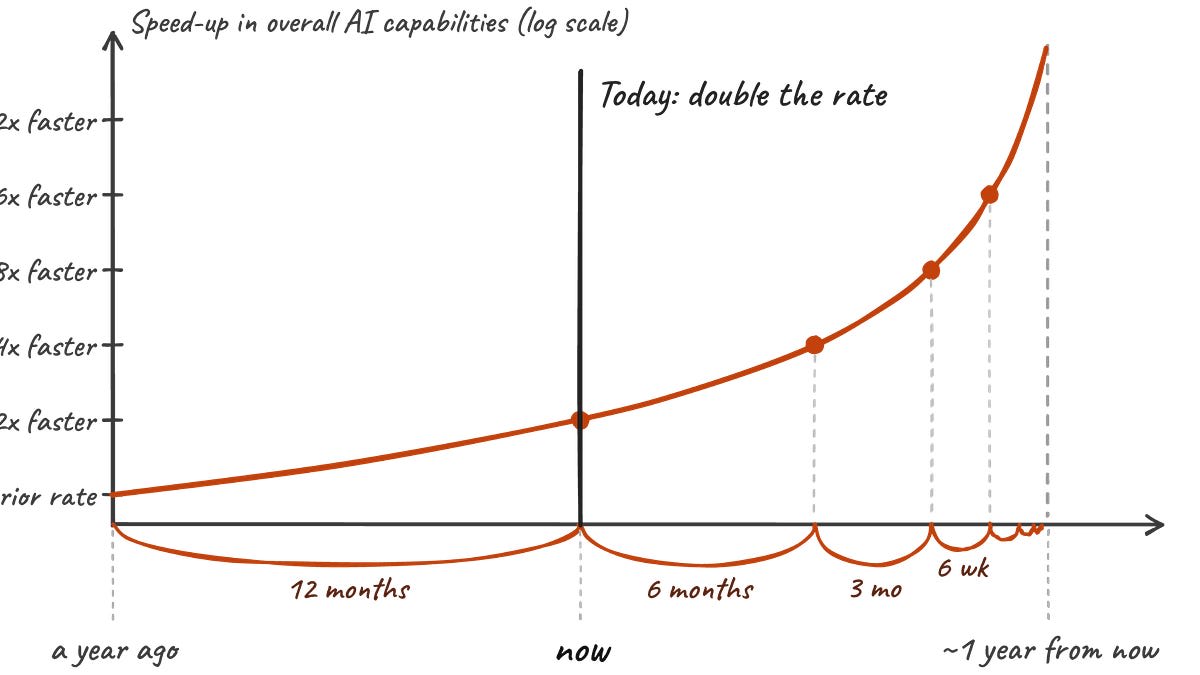
Anthropic has indicated it may soon reach a critical threshold of AI-driven research acceleration as defined by its Responsible Scaling Policy. This milestone reflects a significant shift where AI systems begin to fundamentally speed up the development of future, more capable models.
The Accelerating Frontier: Anthropic and AI-Driven R&D
Recent reports have brought to light a pivotal moment in the evolution of artificial intelligence: the point at which AI systems begin to significantly expedite the research and development of their own successors. Anthropic, in its recent S1 filing, has explicitly noted that it may imminently meet the threshold of “dramatically accelerated progress due to AI.” This development, analyzed through the lens of the company’s Responsible Scaling Policy (RSP), marks a transition from AI as a tool to AI as an autonomous engine for technological advancement.
Defining the Threshold of Acceleration
The benchmark for this acceleration is not merely subjective. According to the RSP effective as of July 2026, the threshold is reached when the company observes or expects overall capabilities progress to occur at twice the speed of the fastest sustained rate observed before AI became a primary contributor to R&D. This specific metric attempts to quantify the "feedback loop" effect, where the intelligence of current models is applied to solve complex architectural or algorithmic problems that previously required significant human cognitive labor.
The Mechanics of Recursive Improvement
At the core of this phenomenon is the application of Large Language Models (LLMs) to the R&D pipeline. By automating code generation, debugging, and hypothesis testing, AI systems can iterate on model architecture at a pace that far outstrips traditional software engineering cycles. This recursive improvement process suggests that we are moving toward a regime where the rate of innovation is no longer constrained by human bandwidth, but rather by the availability of compute and the efficiency of the AI agents themselves.
Broader Implications for Safety and Policy
This shift carries profound implications for safety protocols. As Anthropic’s RSP suggests, reaching this threshold triggers specific governance requirements. When AI R&D becomes self-accelerating, the window for human oversight and intervention narrows significantly. The industry must now grapple with the challenge of ensuring that safety research keeps pace with the explosive growth in capabilities, preventing a scenario where model deployment outstrips our ability to align them with human values.
Historical Context and Future Trends
Historically, technological revolutions—from the Industrial Revolution to the advent of the internet—have been characterized by exponential growth curves. However, AI represents a unique case where the technology itself is the catalyst for the curve’s steepness. If the current trend holds, we are likely to see a compression of development timelines, where models move from research prototypes to production-grade systems in months rather than years.
Conclusion: Navigating the New Normal
The acknowledgment by Anthropic that they are nearing this "dramatically accelerated" milestone serves as a wake-up call for the broader tech ecosystem. It validates the concerns of researchers who have long predicted that AI would eventually become the primary driver of its own advancement. Moving forward, the focus must remain on robust, transparent, and scalable safety frameworks that can withstand the compounding pressures of an AI-led research paradigm.